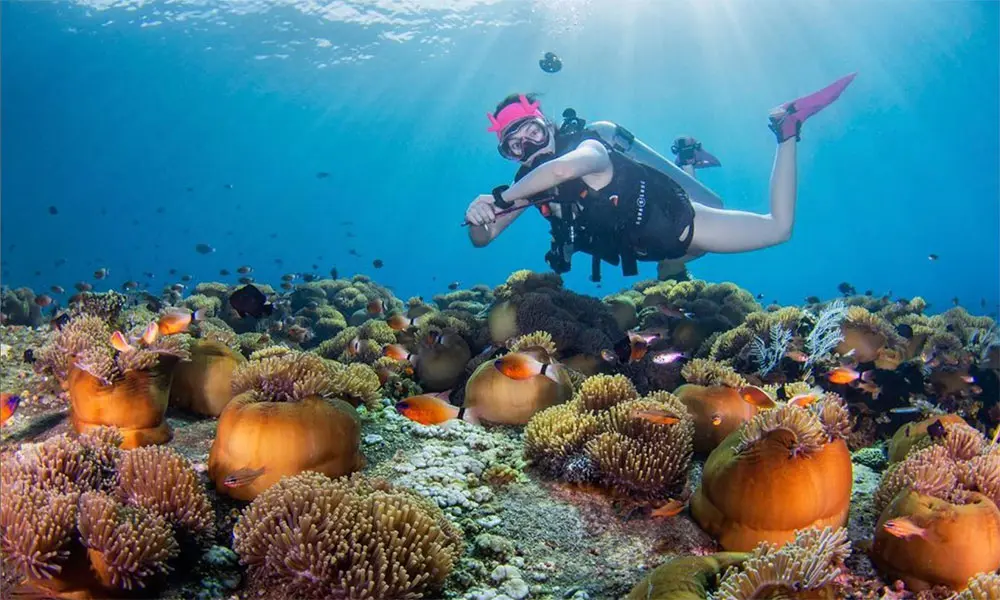
Every liveaboard-vs-resort article you have ever read follows the same script: the liveaboard costs more but delivers better diving, the resort costs less or delivers less, and the math settles it. Bonaire breaks that script entirely. This small Dutch Caribbean island — 24 miles long, 3 to 5 miles wide, sitting 50 miles off the coast of Venezuela — has spent three decades building the most accessible, most affordable, and most flexible shore diving infrastructure on the planet. There are 86 officially marked shore dive sites along Bonaire's leeward coast, each one identified by a painted yellow stone at the roadside, with entry points you can walk into from a rental truck carrying your own tanks. The Bonaire National Marine Park, established in 1979, protects the entire fringing reef system from the high-water mark to 60 meters depth across 2,700 hectares — and the reef health shows it (STINAPA Bonaire, 2025).
The liveaboard-vs-resort question in Bonaire is not the question it is in the Maldives, Komodo, or Raja Ampat. In those destinations, the liveaboard reaches dive sites a resort physically cannot — remote atolls, current-swept channels, multi-day routes through uninhabited water. In Bonaire, the resort is the dive infrastructure, and the liveaboard is the niche option that costs more for arguably less flexibility. This article explains why, with current 2026 pricing, honest dive-count comparisons, and a clear framework for which diver profile should book which experience.
Why Bonaire Is Different from Every Other Liveaboard-vs-Resort Decision
The reason every other destination's liveaboard-vs-resort comparison favors the liveaboard comes down to one word: distance. In the Maldives, reaching Hanifaru Bay from a North Male resort means a full-day seaplane transfer that burns a dive day each way. In Raja Ampat, reaching Misool from a Sorong-based resort means a multi-hour boat ride through open water. The liveaboard solves the distance problem by sleeping above the dive site.
Bonaire has no distance problem. The entire diveable coastline — from the southern tip at Willemstoren Lighthouse to the northwest point at Playa Funchi — is accessible by paved road. Yellow-painted stones mark every site: Andrea I, Andrea II, 1000 Steps, Karpata, Oil Slick Leap, Salt Pier, Te Amo, Windsock, Angel City, Hilma Hooker, and dozens more. You drive your rental truck to the stone, unload your gear, walk or giant-stride in, and dive. No boat ride. No schedule. No dive master unless you want one. The reef starts at 3 to 5 meters and drops to 30-plus on the wall, which begins at roughly 9 to 12 meters on most sites. This is not an exaggeration or a marketing line — Bonaire's shore diving model is structurally different from every other Caribbean and Indo-Pacific destination, and it changes the math completely (Bonaire Pros, 2025; STINAPA Bonaire, 2025).
What a Bonaire Resort Dive Package Actually Delivers
A typical Bonaire dive resort package — the kind sold by Buddy Dive Resort, Divi Flamingo, Hamlet Oasis, Captain Don's Habitat, or through group-booking operators — bundles three things: accommodation, unlimited shore diving with air or Nitrox fills, and a rental vehicle. Some packages add boat dives. Here is what that looks like in practice:
Buddy Dive Resort — Dive & Drive Package (2026 pricing, per person, double occupancy):
| Component | What you get | Typical cost |
|---|---|---|
| 7 nights studio apartment | Self-catering, kitchenette, A/C | Included in package |
| Unlimited shore diving | Air or Nitrox fills, 6 days | Included in package |
| 7-day vehicle rental | Pickup truck or SUV | Included in package |
| Boat dives (optional add-on) | 3-tank boat dive days available | ~$95–120 per day add-on |
| STINAPA Nature Fee | Marine park access, valid 1 year | $40 per person (non-diver) / $45 (diver) |
| Total package | 7 nights, unlimited shore diving, truck | $1,350–1,799 pp |
Sources: Buddy Dive Resort (2026), Scuba North group trip pricing (2026), OCD Divers Buddy Dive package (2026), Kids Sea Camp (2026).
The key number is not the package price — it is what you get for it. A diver at Buddy Dive on the Dive & Drive package can realistically log 3 to 5 dives per day: a morning shore dive, a mid-morning shore dive at a different site, an afternoon dive, and one or two house reef night dives. Over a 7-day trip, that is 21 to 35 dives without ever boarding a boat. The house reef at Buddy Dive — and at comparable resorts like Captain Don's Habitat and Divi Flamingo — is accessible 24 hours a day. Walk down the dock, giant stride in, descend on the reef. Night dives do not require a guide or a boat. The dive operation fills your tanks and leaves them on the rack; you swap empties for fulls whenever you want.
Other resorts follow the same model. Scuba North's 2026 group trip to Bonaire lists $1,350 per person for 7 nights, 7-day vehicle rental, 6 days of unlimited air/Nitrox fills, and daily breakfast (Scuba North, 2026). A PADI-promoted package in 2026 advertised $1,199 for 7 nights with unlimited shore diving, truck rental, fluoro diving intro, and free Nitrox upgrade (PADI Travel, 2026). The range across operators is $1,100 to $1,800 per person for a week of unlimited shore diving with accommodation.
What a Bonaire Liveaboard Delivers — and What It Does Not
Here is the uncomfortable truth: Bonaire does not have a permanent, dedicated liveaboard operation the way the Maldives, Indonesia, Egypt, or the Galapagos do. The Bonaire Aggressor — the most-cited vessel for Bonaire liveaboard itineraries — does not operate a fixed Bonaire-only route. Aggressor Adventures runs Caribbean liveaboards in Belize, Cayman, and the Turks and Caicos; Bonaire appears as a port stop on some Southern Caribbean itineraries rather than as a dedicated dive liveaboard destination (Aggressor Adventures, 2026).
What does exist for liveaboard-style diving near Bonaire:
- Caribbean Aggressor fleet vessels occasionally route through the ABC Islands (Aruba, Bonaire, Curaçao) on repositioning or specialty itineraries. Pricing for Caribbean Aggressor trips generally runs $2,500–$4,500 per person for 7 nights depending on vessel and cabin (Aggressor Adventures, 2026).
- Small charter boats and day boats operating out of Kralendijk offer boat diving to Klein Bonaire — the uninhabited island 800 meters offshore — and to sites along the northern coast that are less accessible by shore. These are not liveaboards; they are single-day boat operations.
- Cruise ship dive excursions stop in Bonaire's port at Kralendijk, offering 1- to 2-tank guided dives for cruise passengers. These are not liveaboards either, but they represent the only structured boat-dive-on-a-vessel model most visitors encounter.
The absence of a dedicated Bonaire liveaboard is not an accident or an underserved market gap. It is a structural consequence of the island's geography. Bonaire's fringing reef hugs the shoreline so closely, and the road network runs so parallel to the coast, that a boat-based dive operation cannot offer anything the shore-based system does not already deliver — except Klein Bonaire access and a few northern sites. For Klein Bonaire, a $45–65 day boat from Kralendijk solves the problem in 15 minutes. You do not need to sleep on a boat to reach it.
The Numbers: Bonaire Dive Trip Cost in 2026
7-Night Resort Package (per diver, USD)
| Tier | Package type | What's included | Total est. |
|---|---|---|---|
| Budget | Guesthouse + tank rental + truck | Self-catering apartment, unlimited fills, pickup truck | $1,100–1,400 |
| Mid-range | Dive resort Dive & Drive | Studio/1-bed apartment, unlimited shore diving, Nitrox, truck | $1,350–1,800 |
| Premium | Resort full-board + boat dives | Oceanfront room, unlimited shore diving, daily boat dives, Nitrox, truck | $2,000–3,200 |
Sources: Buddy Dive Resort (2026), Scuba North (2026), PADI Travel (2026), Kids Sea Camp (2026), Aquatic Adventures (2026).
7-Night Liveaboard or Boat-Based Option (per diver, USD)
| Option | What's included | Total est. |
|---|---|---|
| Day boat to Klein Bonaire (per day) | 2–3 boat dives, tanks, guide | $95–120/day ($570–840/week if daily) |
| Caribbean Aggressor (if routing through ABC) | 7 nights, all meals, 3–4 dives/day, transfers | $2,500–4,500 |
| Charter boat (private, per day) | 3 dives, captain, tanks, lunch | $400–600/day ($2,800–4,200/week) |
What the Per-Dive Math Looks Like
This is where the comparison gets decisive. A mid-range Bonaire resort diver logging 4 dives per day over 7 days on a $1,500 package pays roughly $54 per dive. A diver on the same package logging 3 dives per day pays $71 per dive. These are real numbers that include accommodation, unlimited fills, a truck, and marine park fees.
Compare that to the Caribbean Aggressor at $3,500 per person for 7 nights with 3–4 dives per day (21–28 dives total): that is $125–$167 per dive. The day-boat approach — $100/day for 3 Klein Bonaire dives plus $1,500 for the resort week — runs roughly $80–$95 per dive for the boat-dive component, but you still need the resort base.
The Bonaire resort model delivers the lowest per-dive cost of any structured dive vacation in the Caribbean. No liveaboard in any ocean comes close to $54 per dive with full accommodation included.
Diving Quality: What You Actually See Underwater
Shore Diving on Bonaire
Bonaire's reef system is among the healthiest in the Caribbean. The Bonaire National Marine Park's no-anchor, no-fishing, no-touching policies have been enforced since 1979, and the results are visible: hard coral coverage on the fringing reef averages 30–50% at well-maintained sites, with staghorn and elkhorn coral recoveries visible at several locations (STINAPA Bonaire, 2025; Reef Renewal Foundation Bonaire, 2025). The reef wall begins at 9–12 meters on most sites and drops to 30–60 meters, with sea fans, sponges, and soft coral colonizing the wall face.
Signature shore dive sites:
- 1000 Steps — The most famous site on the island. A cliff-side entry with (by actual count) 67 steps to the water. The wall starts at 10 meters with dense hard coral, turtles resting on ledges, and occasional reef sharks cruising the drop-off.
- Salt Pier — A working industrial pier with massive pillar coral formations, schooling tarpon, and frogfish hiding in the pilings. Depth: 5–18 meters. Best entered at slack tide.
- Andrea I and II — Easy entries, gentle slopes, dense coral gardens to 15 meters. Turtles, parrotfish, queen angelfish, and cleaning stations with juvenile drum fish.
- Hilma Hooker — Bonaire's wreck dive. A 70-meter cargo ship sunk in 1984 at 18–30 meters on the sand between the reef and the wall. Encrusted in coral, resident barracuda, and frequent nurse shark sightings.
- Karpata — Northern site with pristine hard coral coverage, sea turtles, and a wall that drops to 40-plus meters. Entry requires moderate fitness — rocky shore with moderate surge.
- Oil Slick Leap — Named for the literal leap off a 2-meter platform into the water. The reef below is covered in soft coral and sponges, with tarpon schools frequently circling at depth.
The macro diving is also world-class. Bonaire's population of longlure frogfish, banded coral shrimp, flamingo tongue snails, and seahorses (found at sites like Something Special and Invisibles) makes it a genuine macro photography destination — a rarity in the Caribbean.
Klein Bonaire: The Only Site You Need a Boat For
Klein Bonaire is the uninhabited island 800 meters off Bonaire's western coast, accessible only by boat. The dive sites — No Name Beach, Turtle City, and the moored area off the north point — offer deeper wall diving (15–40 meters), larger schools of fish, and more frequent turtle and ray encounters than most mainland shore sites. The reef around Klein Bonaire is pristine, with less diver traffic than the mainland shore sites.
Day boats run from Kralendijk daily, typically offering 2-tank or 3-tank trips at $95–$120 per day including tanks and guide. This is the one area where boat-based diving genuinely adds value over shore diving in Bonaire — but it is a $100/day add-on, not a $3,000+ liveaboard commitment.
When Each Option Wins: Decision Framework
Choose the Resort + Unlimited Shore Diving If:
- You want maximum dive count at minimum cost. Three to five dives per day, every day, at $50–$75 per dive all-in. No other model in the Caribbean matches this.
- You value independence. No boat schedule, no dive master, no group. Drive to the site, gear up, enter, dive.
- You are a photographer. Bonaire's shore diving lets you spend 90 minutes on a single dive at a single site — something no liveaboard schedule permits. The macro life rewards slow, patient divers.
- You are traveling with a non-diver. Bonaire has beaches, flamingos, kayaking, windsurfing, the Washington-Slagbaai National Park, and a walkable town in Kralendijk. A non-diver has a real vacation.
- You are a beginner or intermediate diver. Most shore sites have gentle entries, minimal current, and shallow starts. The wall is accessible at 10–12 meters. Buddy teams can go at their own pace.
- You want to dive at night on your own terms. House reefs at resorts are accessible 24 hours. Night dives without a boat or guide are standard practice in Bonaire.
Choose a Liveaboard (or Boat-Focused Trip) If:
- You want to combine ABC Islands. A Caribbean liveaboard route that includes Bonaire, Curaçao, and possibly Aruba gives you island variety that a single-resort stay does not. This is the strongest argument for a liveaboard near Bonaire.
- You specifically want Klein Bonaire every day. If Klein Bonaire's deeper walls and turtle encounters are your priority, daily boat trips ($95–120/day) deliver this. A liveaboard anchored at Klein Bonaire would offer unlimited access — but that liveaboard does not exist as a fixed product.
- You are a diver who does not want to manage logistics. A liveaboard handles everything: gear, tanks, food, navigation, mooring. The Bonaire resort model requires you to drive, load tanks, navigate to sites, and manage your own gear. For some divers, this is freedom; for others, it is work.
- You want a pure dive vacation with zero non-dive distraction. A liveaboard is a sealed dive bubble — every person on board is there to dive. Bonaire resorts mix divers with non-divers, families, and honeymooners.
What Bonaire Does Not Offer
Honesty requires naming the gaps. Bonaire's diving has limitations that a liveaboard destination does not:
- No current diving. Bonaire's leeward coast is sheltered. If you want channel dives, drift dives, or current-dependent megafauna encounters (hammerheads, oceanic mantas, whale sharks), Bonaire is not the place. The Maldives, Galapagos, and Indonesia deliver that.
- Limited big-animal encounters. Bonaire has turtles, eagle rays, tarpon, barracuda, and occasional nurse sharks. It does not have whale sharks, manta rays, hammerheads, or tiger sharks. You will not see a 30-shark aggregation at a baited dive.
- No multi-day route diving. A liveaboard in Raja Ampat or the Red Sea takes you through a sequence of progressively more remote sites over a week. Bonaire is one island — you see the same island every day, just from different points along the coast.
- No deep technical wall diving. Bonaire's wall starts at 9–12 meters and drops to 30–60. It is excellent recreational wall diving, but it does not compare to the thousand-meter walls of the Coral Sea or the deep blue of the Red Sea.
These are not criticisms — they are trade-offs. Bonaire delivers a different kind of diving: accessible, affordable, high-volume, and deeply rewarding for divers who value autonomy and marine health over megafauna spectacle.
The Full Trip Budget: What a Bonaire Week Actually Costs
| Cost component | Resort (mid-range) | Day boat + resort | Caribbean Aggressor (if available) |
|---|---|---|---|
| Package (7 nights) | $1,500 | $1,500 | $3,500 |
| STINAPA Nature Fee | $45 | $45 | $45 |
| Klein Bonaire boats (3 days) | — | $300 | — |
| International flights (from US) | $350–600 | $350–600 | $350–600 |
| Food and drink | $300–500 | $300–500 | Included |
| Nitrox (if not included) | Often included | Often included | Included |
| Gear rental (if needed) | $200–350 | $200–350 | Included |
| Total | $2,400–3,000 | $2,700–3,300 | $3,900–4,200 |
The resort option costs $900–$1,200 less than a liveaboard-style trip, delivers 2–3 times as many dives, and includes the freedom to dive on your own schedule. The only reason to spend the extra money on a liveaboard near Bonaire is if you specifically want the ABC Islands multi-stop itinerary or if you strongly prefer the managed, all-inclusive boat lifestyle.
Getting to Bonaire
Flamingo International Airport (BON) receives nonstop flights from Miami (American Airlines, ~3.5 hours), Houston (United, ~4.5 hours), Newark (United, ~5 hours), Amsterdam (KLM/TUI, ~9 hours), and seasonal service from Atlanta, Charlotte, and Toronto. Round-trip flights from the US East Coast typically run $350–600 in economy. From Europe, AMS-BON flights run €400–700 round-trip. There is no ferry from Curaçao or Aruba; inter-island flights are available but infrequent.
Bonaire is outside the hurricane belt — the ABC Islands sit at 12°N latitude, south of the typical hurricane track. This makes Bonaire a year-round dive destination with no seasonal closures. Water temperature ranges from 26°C (78°F) in February to 29°C (84°F) in October. Visibility is typically 20–40 meters, with occasional days exceeding 50 meters on calm, current-free mornings.
The Bottom Line: Bonaire Liveaboard vs Resort
In most dive destinations, the liveaboard-vs-resort question is a genuine trade-off between cost and quality. In Bonaire, it is not. The resort-with-shore-diving model is structurally superior for the vast majority of divers:
- Cost: $50–$75 per dive all-in versus $125–$167 on a liveaboard
- Dive count: 21–35 dives per week versus 21–28 on a liveaboard
- Flexibility: Dive any site, any time, at your own pace, with no schedule
- Independence: No dive master, no group, no boat — just you, your buddy, and the reef
- Non-diver compatibility: A real vacation for partners who do not dive
The liveaboard option near Bonaire only makes sense if you want a multi-island ABC itinerary, prefer the all-inclusive managed lifestyle, or specifically want to combine Bonaire with Curaçao diving in a single trip. For everyone else — beginners, intermediate divers, photographers, independent travelers, families, and budget-conscious dive enthusiasts — the Bonaire resort model delivers more diving, more freedom, and less money spent than any liveaboard in the Caribbean.
Bonaire is the one place in the world where the resort wins the liveaboard comparison outright. Book the truck, load the tanks, and go.
Sources
- STINAPA Bonaire — Bonaire National Marine Park, nature fees, and marine park regulations (stinapabonaire.org, 2025)
- Buddy Dive Resort — Dive & Drive package pricing and inclusions (buddydive.com, 2026)
- Scuba North — Bonaire 2026 group trip pricing (scubanorth.com, 2026)
- PADI Travel — Bonaire dive package promotions (PADI, 2026)
- Kids Sea Camp — Bonaire at Buddy Dive 2026 pricing (familydivers.com, 2026)
- OCD Divers — Bonaire 2026 Buddy Dive Resort trip details (ocddivers.com, 2026)
- Aquatic Adventures — Bonaire March 2026 trip pricing (aquaticadventuresva.com, 2026)
- Bonaire Pros — Shore dive package costs and guidance (bonairepros.com, 2025)
- Aggressor Adventures — Caribbean liveaboard fleet and pricing (aggressor.com, 2026)
- Reef Renewal Foundation Bonaire — Coral restoration and reef health data (reefrenewalbonaire.org, 2025)
- InfoBonaire — Marine park entry fees and regulations (infobonaire.com, 2025)
- ScubaBoard — Liveaboard vs Bonaire community discussion (scubaboard.com, 2025)