
Twenty-six atolls. Roughly 1,200 coral islands strung across 871 kilometers of the Indian Ocean. And exactly two ways to dive the place: from a moving boat, or from a fixed island. The maldives liveaboard vs resort decision sounds simple until you start running the numbers — and the numbers in 2026 do not flatter the assumption that "resort = easier, liveaboard = better diving" that most travel forums still repeat.
The Maldives hosts the largest recorded population of reef manta rays on the planet — roughly 4,000 individuals, with more than 6,000 identified across 80,000-plus sightings collected by the Manta Trust and the Maldives Manta Conservation Programme (Manta Trust, 2024). South Ari Atoll is one of only two year-round whale shark aggregation sites globally, with operators reporting 80%-plus sighting rates during peak months (Maldives Whale Shark Research Programme, via Maldives Nomad, 2025). Both megafauna events are accessible from the right liveaboard route and from a small subset of the right resorts. The wrong choice in either direction costs USD 1,000 to 4,000 in difference — and a lot of dive time.
This article answers the question every Maldives-bound diver eventually has to settle: maldives liveaboard vs resort, which one actually delivers the diving you came for, and at what real total cost in 2026?
Why This Comparison Matters in 2026
Two things changed materially in the last 18 months. First, Maldives tourism taxes shifted: the Tourism Goods and Services Tax (TGST) rose from 16% to 17% on July 1, 2025, and the Green Tax on liveaboards is now USD 12 per person per night, collected separately rather than bundled into headline rates (MIRA, 2025; Maldives Magazine, 2025). Second, the manta and whale shark sighting databases run by the Manta Trust have grown precise enough to predict route-by-route megafauna probability with real numbers. We analyzed current 2026 pricing across 46 active liveaboards and the four most-cited dive resorts, mapped them against verified seasonal data and atoll coverage, and built the comparison below. What you get: a clear picture of which option matches which diver profile, with the math behind it.
What Each Option Actually Delivers
Liveaboard Diving: Mobility and Volume
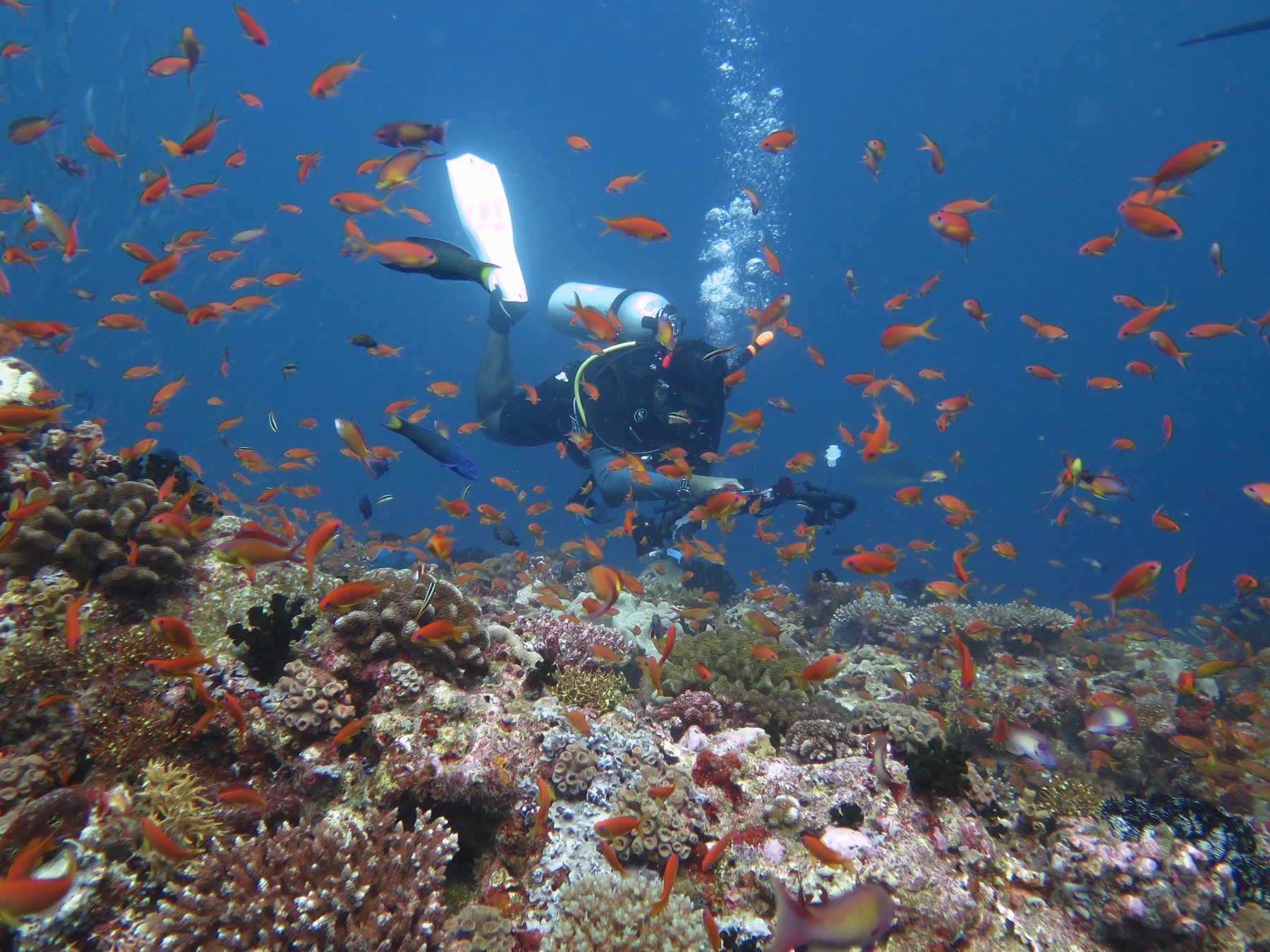
A standard 7-night maldives liveaboard runs three to four dives per day — typically two morning dives, an afternoon dive, and one or two night dives across the week — totaling 18 to 22 dives in a week (LiveAboard.com, 2026; Spirit Liveaboards, 2025). Vessels reposition overnight, so divers wake up at the next dive site rather than spending the morning on a transfer boat. Routes fall into four broad categories:
- Best of the Maldives (Central Atolls): Rasdhoo, North and South Ari, Vaavu, North and South Male. Operates year-round. Manta cleaning stations at Lankan, whale sharks at Maamigili, and channel diving at Vaavu (ZuBlu, 2025).
- Northern Atolls: Baa, Raa, Noonu, sometimes Lhaviyani. Operates May through November to coincide with manta and whale shark feeding aggregations at Hanifaru Bay (Manta Trust; ZuBlu, 2025).
- Southern Atolls: Huvadhoo, Laamu, sometimes Addu. October through April. Thresher sharks, scalloped hammerheads, oceanic mantas, and tiger sharks (DiveZone, 2025).
- Far South / Deep South: Fuvahmulah and Addu. Specialty trips, typically 10 to 14 nights, targeting tiger sharks at Fuvahmulah and pelagics in the southern channels (LiveAboard.com, 2026).
Critically, only liveaboards reach the second and fourth categories at any reasonable cost. Reaching Hanifaru Bay or Fuvahmulah from a North Male resort means a full-day domestic flight or seaplane plus boat transfer — burning a dive day each way.
Resort Diving: Comfort and a Shorter Radius
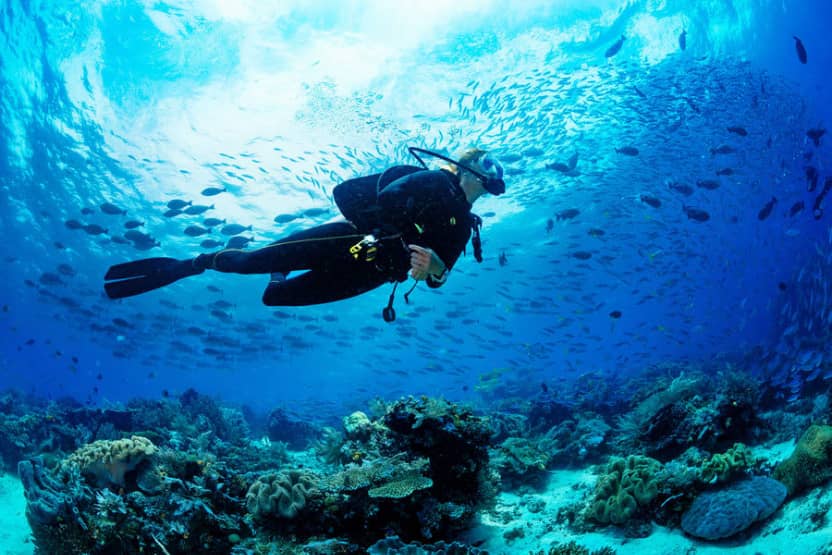
A maldives resort dive package centers on two-tank morning boat dives plus optional house reef and night dives. Most resort dive centers schedule one to two boat dives per day, with each boat dive reaching sites within a roughly 30-to-60-minute radius of the island (Bluewater Dive Travel, 2025). Per-dive pricing typically runs USD 80 to 100 for a single boat dive at mid-range resorts, with multi-dive packages dropping the per-dive cost (Maldives Magazine, 2025; Tripadvisor, 2026).
What resort diving does deliver, that liveaboards cannot:
- House reef access on demand. At resorts with strong house reefs — Anantara Kihavah's Golden Wall in Baa Atoll, Kandolhu in North Ari, Komandoo in Lhaviyani, and The Residence at Falhumaafushi in Gaafu Alifu — divers can shore-dive between scheduled boat dives, log dives at their own pace, and run unguided buddy dives if certified (Maldives Magazine, 2026; ZuBlu, 2025).
- Non-diver compatibility. A partner who does not dive has a real holiday. On a liveaboard, they have a small cabin and 21 dive briefings.
- Surface comfort. Fixed bed, fixed shower, full restaurants, spa, no swell at 03:00.
The trade-off: resort divers are bound to the dive sites within their atoll. A North Male resort cannot meaningfully reach Hanifaru Bay or South Ari's whale shark sites without paid excursions that consume an entire day.
The Numbers: Maldives Dive Trip Cost in 2026
Pricing is where the maldives liveaboard vs resort decision gets uncomfortable for the resort side. We compiled current 2026 rates from LiveAboard.com (46 active vessels), Maldives Magazine, DiveZone, and Bluewater Dive Travel, then layered in the post-2025 tax structure.
7-Night Liveaboard Cost (per diver, USD)
| Tier | Base fare | Taxes + green tax | Gear + Nitrox | Tipping | Total est. |
|---|---|---|---|---|---|
| Budget | 1,500–2,500 | 350–500 | 250–400 | 150–250 | 2,250–3,650 |
| Mid-range | 2,500–4,000 | 500–700 | 250–400 | 250–400 | 3,500–5,500 |
| Luxury | 4,000–7,500+ | 700–1,200 | 0 (often included) | 400–700 | 5,100–9,400+ |
Sources: LiveAboard.com (2026), Maldives Magazine (2025), MIRA (2025), Manthiri Liveaboard published rates (2026).
A budget vessel like MV Eagle Ray has been listed at USD 1,281 for 7 nights; mid-tier vessels including MY Duke of York & Spa publish 2026 rates between USD 2,555 and USD 3,290 depending on departure date; luxury operators such as Manthiri quote USD 495 per person per night plus 16% GST plus USD 6 per night in green tax integration (Deep Blue Adventures, 2026; Manthiri Liveaboard, 2026; Maldives Magazine, 2025). Headline rates almost never include international flights, domestic flights or seaplane transfers (USD 250 to 400 round-trip), or marine park fees (USD 20 to 50 per protected area).
7-Night Resort Dive Package Cost (per diver, USD)
| Tier | Room (7 nights, half-board) | Diving (10–14 dives) | Taxes + service charge | Total est. |
|---|---|---|---|---|
| Budget local-island | 700–1,400 | 600–900 | ~30% of pre-tax | 1,700–3,000 |
| Mid-range resort | 2,800–4,900 | 800–1,200 | ~30% of pre-tax | 4,700–8,000 |
| Luxury resort | 5,000–10,000+ | 1,000–1,500 | ~30% of pre-tax | 7,800–15,000+ |
Sources: Tripadvisor (2026), Maldives Magazine (2026), Bluewater Dive Travel (2025), TGST 17% + 10% service charge per MIRA (2025).
Local island guesthouses (Maafushi, Dhigurah, Fulidhoo) anchor the budget tier. Mid-range examples include Vilamendhoo and Komandoo. Luxury overwater resorts — Anantara Kihavah, Six Senses Laamu, LUX South Ari — sit at the top end. Even at the mid-range tier, a resort week runs USD 1,200 to 2,500 above an equivalent mid-range liveaboard week, while delivering roughly half the dives.
The math is consistent across tiers: per-dive cost on a liveaboard lands between USD 150 and 280 for a mid-range trip, while a resort runs USD 350 to 700 per dive once accommodation and taxes are included. That gap is the single most important fact in the maldives liveaboard vs resort calculation.
Megafauna Probability: Where Each Option Wins
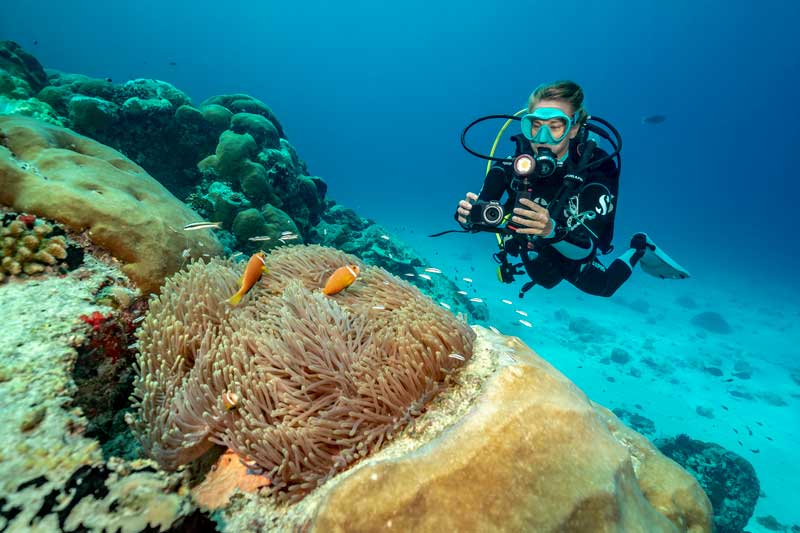
Maldives diving sells on three things: mantas, whale sharks, and channel diving with sharks. Probability of each is highly route-dependent, and route is destination-dependent.
Manta Rays
Reef manta cleaning and feeding stations operate on a calendar that swings between monsoons. Lankan Manta Point (North Male) sees mantas roughly mid-August through November, with daily sightings during peak weeks (LiveAboard.com, 2025). Hanifaru Bay (Baa Atoll) hosts the largest known manta feeding aggregation on Earth from May through November, peaking June through October around full and new moons — events where 100-plus mantas have been documented in a single feeding (Manta Trust; Four Seasons Landaa Giraavaru, 2025). Hanifaru visitor rules cap snorkel encounters at 45 minutes per group with a USD 20 ticket, and require a certified Biosphere Reserve guide.
A Northern Atolls liveaboard timed for July to October aligns with peak Hanifaru. A Baa Atoll resort (Anantara Kihavah, Four Seasons Landaa Giraavaru) gives the same access, plus the option of repeat visits across a week. A North Male or South Ari resort, by contrast, requires a paid day-trip excursion to reach Baa.
Whale Sharks
South Ari Atoll, specifically the Maamigili-Dhigurah corridor, is one of only two year-round whale shark aggregation sites globally (ZuBlu, 2025; Maldives Whale Shark Research Programme since 2006). Operators report 80%-plus sighting rates during peak months (March through May for the dry-season migration; August through November on the eastern side during southwest monsoon) (Maldives Nomad, 2025). The MWSRP has documented over 200 individual whale sharks in the area.
Best access: a Central Atolls liveaboard with a confirmed Maamigili stop, or a South Ari resort (LUX South Ari, Vilamendhoo, or any of the Dhigurah local-island guesthouses).
Channel Diving with Sharks
Vaavu Atoll's Fotteyo Kandu and Miyaru Kandu, Felidhoo's channels, and Fuvahmulah's tiger shark site are the headline shark dives. Currents are moderate to strong; advanced certification with drift-diving experience is the practical minimum (DiveZone, 2025; PADI). Liveaboards reach all of these efficiently. Most resorts cannot reach Vaavu in a day-dive radius; none reach Fuvahmulah without a dedicated trip.
The Comparison Matrix
| Criterion | Liveaboard | Resort |
|---|---|---|
| Dives per day | 3–4 (incl. night) | 1–2 boat + house reef |
| Total dives in 7 nights | 18–22 | 10–14 |
| Atolls accessible | 2–5 per route | 1 (home atoll only) |
| Per-dive total cost (mid-range) | USD 150–280 | USD 350–700 |
| 7-night total (mid-range) | USD 3,500–5,500 | USD 4,700–8,000 |
| Hanifaru Bay access | Direct (Northern route, May–Nov) | Only from Baa Atoll resorts |
| South Ari whale sharks | Direct (Central route) | Only from South Ari resorts |
| Fuvahmulah tiger sharks | Direct (Far South specialty trip) | Effectively no |
| Recommended certification | AOW + 50 dives (LiveAboard.com guidance) | Open Water acceptable |
| Non-diver-friendly | Poor | Excellent |
| Seasickness factor | Real, especially May–Aug | Zero |
| Manta probability (right route, season) | High to very high | Resort-dependent |
| Booking flexibility | Fixed schedule once underway | Choose dives daily |
Sources: LiveAboard.com (2026), Bluewater Dive Travel (2025), Maldives Magazine (2025–2026), DiveZone (2025), PADI, Manta Trust.
Decision Framework: Which Option Fits Which Diver
We use this framework when shortlisting Maldives trips for clients. The maldives liveaboard vs resort answer changes meaningfully by profile.
Choose a liveaboard if:
- You are AOW-certified with 50-plus logged dives and comfortable with drift diving.
- Your priority is dive volume — you want 18-plus dives in a week, not 10.
- You want to combine multiple atolls (Central + Vaavu, or Northern Hanifaru run, or Far South).
- Your travel partner also dives, or you are traveling solo or with a dive group.
- Specific megafauna targets — Hanifaru, Fuvahmulah tigers, southern hammerheads — define the trip.
- Mid-range total budget is USD 3,500 to 5,500 per diver; you want maximum diving per dollar.
Choose a resort if:
- You hold Open Water with limited recent diving and want a gentler reintroduction.
- You travel with a non-diving partner, children, or in-laws.
- House reef matters — at Kandolhu, Komandoo, Anantara Kihavah, or The Residence Falhumaafushi, the reef starts at the jetty.
- You want flexibility — to skip a day, do a spa morning, or shift to snorkeling.
- Your trip is built around a specific resort experience (overwater villa anniversary, family vacation), with diving as a major but not exclusive activity.
- Total budget is USD 5,000-plus and you value comfort margin over dive count.
Choose a hybrid (resort + day liveaboard, or split-stay) if:
- You have 10 to 14 nights and want both house-reef relaxation and route diversity.
- Specific megafauna events — full moon at Hanifaru, peak whale shark window in South Ari — anchor part of the trip.
- Budget is USD 8,000-plus per diver.
The Honest Caveats
Liveaboard downsides that matter. Cabins are compact. Schedules are rigid — typically a 6:30 a.m. first briefing. Seasickness during the southwest monsoon (May through August) is real, particularly on northern crossings. LiveAboard.com and DiveZone both flag that Maldives diving is "not really ideal for absolute beginner divers" given the prevalence of moderate-to-strong currents on most premier sites (DiveZone, 2025). Some operators require a logged-dive minimum and AOW certification at booking; others enforce it at check-in via a dive briefing assessment.
Resort downsides that matter. The dive radius is real. Most resorts publish a "dive site map" of 30 to 50 sites within reach — but not all are dived equally, and the headline atoll-defining sites are often outside the radius. Per-dive cost compounds: a 12-dive package at USD 95 per dive is USD 1,140 on top of room rate. House reef quality varies dramatically by resort; some publish "house reef" claims with reef fronts that are 100 meters of rubble and dying coral. Verify with recent diver reviews, not the resort brochure.
For both options, the Maldives charges mandatory taxes that are routinely missing from headline prices: TGST at 17%, service charge at 10% (resorts), green tax at USD 12 per night, and a USD 6 per night liveaboard integration fee since January 2025 (MIRA, 2025; Maldives Magazine, 2025). Add roughly 30% to any pre-tax quote.
The MantaraDive Recommendation
After running the comparison across 2026 pricing, route data, and seasonal probability, we recommend three concrete paths.
For most certified divers (AOW, 50+ logged dives), choose a liveaboard. Specifically, a 7-night Central Atolls "Best of Maldives" itinerary that includes Lankan Manta Point, Maaya Thila or Fish Head, Vaavu channel diving, and a Maamigili whale shark stop. Mid-range total: USD 3,500 to 5,500. This is the highest-density Maldives diving available and the strongest dollar-per-dive value.
For first-time tropical divers, mixed-interest couples, or families, choose a resort with a verified house reef. Our shortlist: Kandolhu (North Ari), Komandoo (Lhaviyani), Anantara Kihavah (Baa, with Hanifaru access May to November), or a South Ari property if whale sharks are the priority. Mid-to-luxury total: USD 5,000 to 12,000.
For 10-plus-night trips at a USD 8,000-plus budget, do both. Three to four nights at a resort, then a 7-night liveaboard, or vice versa. This lets one partner skip diving days without burning the trip's dive count.
The single biggest mistake we see: divers booking a North Male luxury resort and then expecting Hanifaru Bay or South Ari whale shark access from there. The geography does not cooperate. Either go to the atoll where the headline event happens, or take a liveaboard that does.
If your shortlist also includes Indonesia, our analysis on Raja Ampat vs Komodo diving walks the same cost-vs-experience math for the Coral Triangle—useful when divers are deciding between an Indian Ocean trip and a Pacific one.
Talk to a Specialist
Choosing the right maldives liveaboard vs resort path is route-and-date specific — Hanifaru in a low-moon week, a South Ari resort during the wrong monsoon, or a luxury vessel in a cabin class that does not match your partner's needs all turn a dream Maldives trip into an expensive miss. MantaraDive advisors cross-reference real-time vessel availability, resort pricing, and seasonal probability data with your trip dates, certification level, and travel-style preferences. Send us your dates, budget, and priorities and we will return a custom shortlist of two to three liveaboards or resorts (or both) within 24 hours, with the trade-offs spelled out.
Sources and Methodology
This article draws on data cross-referenced from the following independent sources: LiveAboard.com (2026 vessel counts at 46, pricing tiers, average guest rating 9.2/10 across 1,127 reviews, route descriptions), Maldives Magazine (2025–2026 cost breakdowns, hidden fees, house reef rankings), Manta Trust and Maldives Manta Conservation Programme (4,000-individual reef manta population estimate, 6,000+ identified, Hanifaru protocols), Maldives Whale Shark Research Programme via Maldives Nomad (South Ari year-round aggregation, 80% sighting rates, 200+ identified individuals since 2006), MIRA / Maldives Inland Revenue Authority (TGST 17% effective July 2025, USD 12 green tax, USD 6 liveaboard integration), ZuBlu (itinerary structures, manta and whale shark seasonality), DiveZone (vessel reviews, certification cautions), Bluewater Dive Travel (resort vs liveaboard pricing structure), PADI (certification requirements for South Ari and channel diving), Spirit Liveaboards (dive count per trip), Tripadvisor (2026 resort pricing data), and published 2026 rate sheets from Manthiri Liveaboard and Deep Blue Adventures (MY Duke of York & Spa). All prices are USD and reflect rates published in early 2026; actual costs vary by operator, season, cabin class, and booking lead time. Megafauna probabilities reflect historical patterns and operator-reported sighting rates, not guarantees.
Related MantaraDive planning links
- Solo Diving in the Philippines: Which Resorts and Liveaboards Welcome Solo Travelers?
- Komodo Liveaboard Prices: What It Actually Costs (and What's Worth It)
- Red Sea Liveaboard Itinerary: North vs South for European Divers
- Lembeh Strait for Macro Photographers: Complete 2026 Guide
- 5 Essential Beginner Tips for Your First Tropical Dive Trip
- Best Dive Sites in Bali: 3 That Matter for a 7-Day Trip
- Maldives Diving Under $3,000: A Realistic Budget Guide for 2026
- North Male vs South Male vs Ari Atoll: Where to Dive on Your First Maldives Trip