
A red sea liveaboard itinerary looks deceptively simple from Europe: book a cheap flight to Hurghada, step onto a boat, dive for a week, fly home with salt still in your hair. The difficult part is not reaching Egypt. The difficult part is choosing the only route you may ever do.
For most European divers, the split is blunt. The northern Red Sea gives you wrecks, reef variety, shorter crossings, and the SS Thistlegorm. The southern offshore routes - especially Brothers, Daedalus, and Elphinstone - give you walls, blue-water drifts, stronger current, and the best chance of shark-focused diving in Egyptian waters. Both are sold as classic Egypt. They are not the same trip.
This article answers one practical question: if you are doing Egypt once, should your Red Sea liveaboard go north for wrecks or south for the Brothers Daedalus Elphinstone liveaboard circuit?
Why This Article Matters
We analyzed current operator itineraries, 2026 price examples, transfer logistics, certification requirements, and recent safety guidance for Red Sea liveaboards. The goal is not to list every route name. It is to help a European diver with one week, one budget, and one shot choose the right itinerary before paying a deposit.
The Short Answer
MantaraDive recommends the northern wrecks Red Sea liveaboard for most European divers doing Egypt once, especially if the group includes newer Advanced Open Water divers, wreck-curious divers, couples with uneven experience, or photographers who want reliable subjects.
Choose the southern BDE route if you are already comfortable in current, can hold a blue-water safety stop without anxiety, have 50+ logged dives, and would rather spend a week looking into the open water for sharks than inside historic wreck holds. BDE can be the stronger dive trip for experienced divers. It is not the stronger default trip.
| Diver Profile | Best Route | Why |
|---|---|---|
| 20-50 logged dives, first liveaboard | North | More forgiving conditions and more varied sites |
| Wreck-focused diver | North | Thistlegorm, Abu Nuhas, Dunraven, Rosalie Moller on some routes |
| Shark-focused Advanced diver | South / BDE | Brothers, Daedalus, and Elphinstone are the main offshore shark circuit |
| Mixed-experience buddy pair | North | Easier to keep both divers engaged and within limits |
| Diver who hates long crossings | North | More sheltered routing and shorter site-to-site legs |
| 75+ dives, strong current skills | South / BDE | Better match for exposed walls, negative entries, and blue-water profiles |
The Northern Route: Wrecks, Reefs, and the Thistlegorm
A northern wrecks Red Sea liveaboard usually operates from Hurghada or Sharm el Sheikh and links the Gulf of Suez, Gulf of Aqaba edges, and the northern Red Sea reefs. Route names vary by operator - "Northern Wrecks and Reefs," "Best of the Red Sea," "North and Ras Mohammed," "North and Brothers" - but the core draw is consistent: wrecks with reef dives between them.
The SS Thistlegorm is the anchor. The British cargo steamship was built in 1940 and sunk by German aircraft in October 1941. Current dive guides place the wreck in roughly 15-30 metres of water, with cargo including trucks, motorcycles, munitions, railway equipment, and military supplies still visible in the holds. Many liveaboards schedule two dives on the wreck: one exterior orientation and one guided hold swim-through when conditions allow.
The second northern pillar is Shaab Abu Nuhas, the reef northwest of Shadwan Island known for multiple wrecks, commonly including Giannis D, Carnatic, Chrisoula K, and Kimon M. Operator descriptions commonly cite a 5-30 metre depth range across Abu Nuhas wreck dives, which makes the reef more flexible than the Thistlegorm for mixed groups.
Ras Mohammed adds the reef side of the route. Shark Reef and Yolanda Reef, Jackfish Alley, and related sites deliver walls, schooling fish, soft coral, and the famous scattered bathroom cargo from the Yolanda wreck. Gubal Island, Small Gubal, and the Dunraven often appear on the same week, depending on weather, port clearance, and operator style.
What Northern Diving Feels Like
Northern Egypt is busy, but it is rarely boring. A normal week gives you a rotating set of dive types: wreck exteriors, simple penetrations, reef walls, coral gardens, night dives, and a few current-sensitive entries. The sites are close enough that the crew can adapt the plan when wind or current changes.
For a one-time visitor, that variety matters. If the Thistlegorm is crowded, the next dive may still be strong. If a diver decides not to penetrate a wreck, the exterior often remains worthwhile. If a buddy pair has different comfort levels, the guide can usually offer a conservative version of the same site.
The caveat is crowding. The Thistlegorm is one of Egypt's busiest dive sites. Mooring lines, multiple boats, current, and silt inside the holds can turn a famous wreck into a stressful dive if the group is poorly managed. A thistlegorm liveaboard trip is best when the boat can dive early or late, split groups cleanly, and brief penetration limits clearly.
The Southern Route: Brothers, Daedalus, Elphinstone
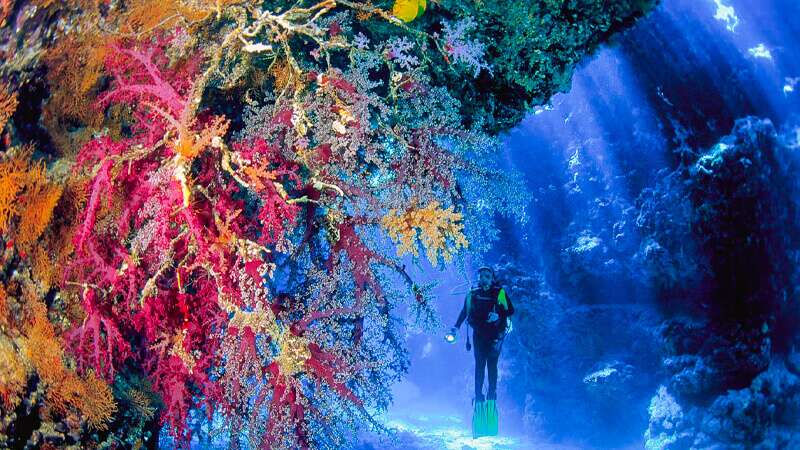
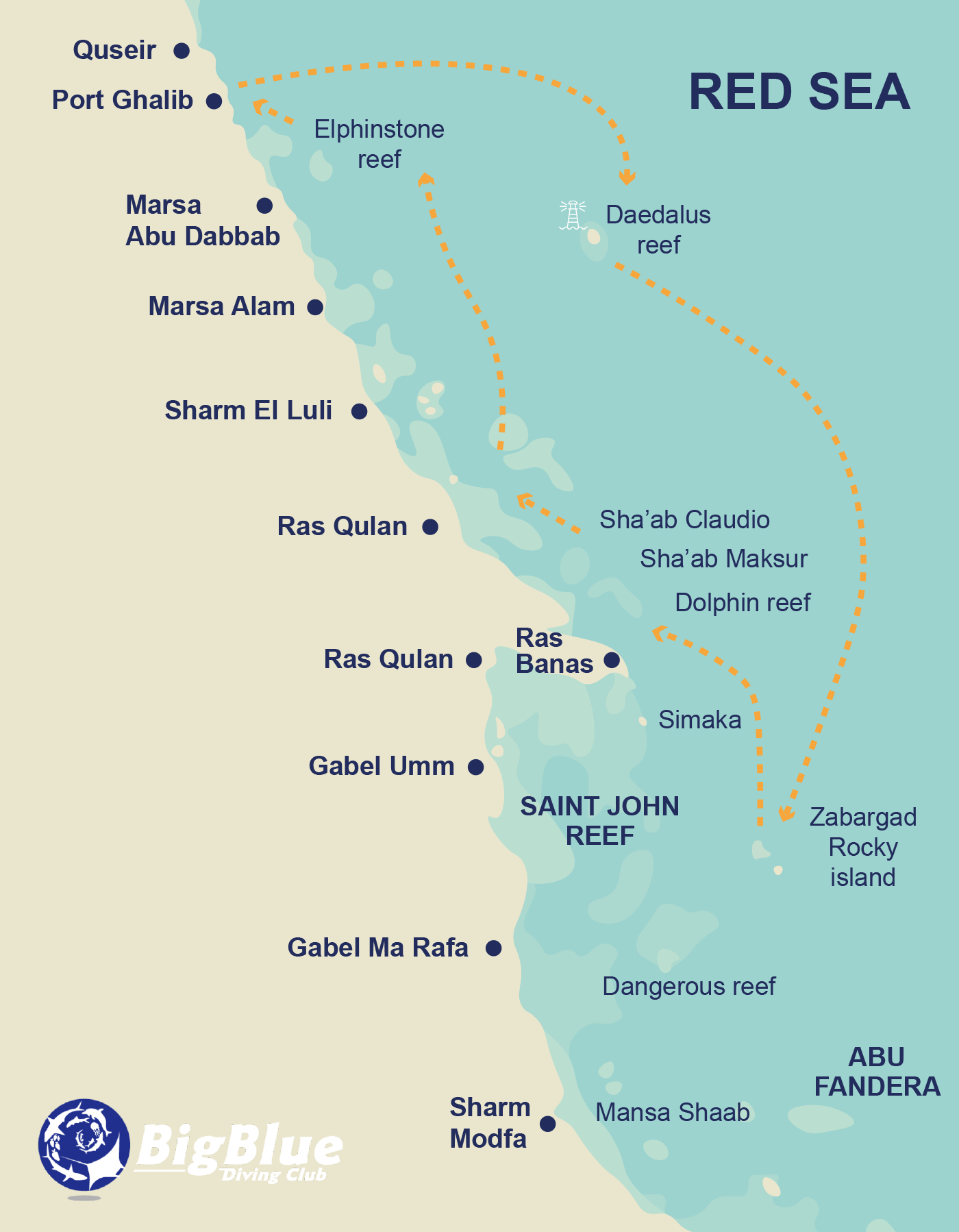
The southern offshore choice usually means Brothers, Daedalus, and Elphinstone, often shortened to BDE. Some operators call it "Simply the Best," "Marine Parks," or "Red Sea Sharks." Departures may be from Hurghada, Port Ghalib, or Marsa Alam area marinas, and the exact order changes with permits and weather.
This is not just "south" on a map. It is a different kind of diving. Big Brother and Small Brother are isolated offshore pinnacles with steep walls, current, and two famous wrecks on Big Brother: Numidia and Aida. Operator route notes commonly place Numidia from about 10 metres down to depths far beyond recreational limits, while Aida sits deeper, often cited around 30-60 metres. For recreational divers, these wrecks are mostly wall-and-wreck-edge experiences rather than relaxed interior tours.
Daedalus is a remote reef with a lighthouse, long walls, and blue-water shark potential. Elphinstone, about 12 kilometres offshore from the Marsa Alam coast according to several operator guides, is known for plateau dives, steep drop-offs, and oceanic whitetip encounters in the right season. PADI's Port Ghalib destination guide describes local visibility as often over 30 metres, with peak months around March-June and September-November and water temperatures commonly around 25-28°C in those windows.
What BDE Diving Feels Like
BDE is more repetitive on paper and more intense underwater. Many dives start from a zodiac. Entries may be negative. The useful part of the dive can be a wall corner, a plateau edge, or a blue-water zone where the group waits for passing sharks. Current can be part of the plan rather than a surprise.
The rewards are real. Brothers, Daedalus, and Elphinstone are Egypt's most reliable liveaboard circuit for pelagic-focused recreational diving. Bluewater Dive Travel and multiple Red Sea operators identify the region with oceanic whitetips, hammerheads, reef sharks, silky sharks, threshers, and occasional manta activity, with autumn often discussed as a strong window for oceanic whitetips and late spring into early summer a better hammerhead period.
The downside is also real. Shark encounters are not guaranteed. A week can produce memorable blue-water moments, or it can produce strong wall diving with only distant silhouettes. If a diver is not excited by current, deep profiles, and time spent scanning open water, a brothers daedalus elphinstone liveaboard can feel like a harder version of reef diving rather than a better one.
The One-Week Comparison
| Factor | North: Wrecks and Reefs | South: BDE / Marine Parks |
|---|---|---|
| Core appeal | WWII and merchant wrecks plus reefs | Offshore walls, current, shark potential |
| Signature sites | SS Thistlegorm, Abu Nuhas, Ras Mohammed, Dunraven | Big Brother, Small Brother, Daedalus, Elphinstone |
| Typical certification floor | Advanced often requested for Thistlegorm; some routes accept lower experience with limits | Advanced commonly expected; many operators require or recommend 50 logged dives |
| Depth profile | Many dives in 15-30 metres, with optional deeper wreck elements | Frequent 20-40 metre planning, walls dropping far below recreational range |
| Current exposure | Moderate and site-dependent | Higher and more central to the route |
| Wildlife focus | Reef fish, turtles, occasional dolphins, some pelagics | Oceanic whitetips, hammerheads, reef sharks, schooling fish |
| Photography | Reliable wreck and reef subjects | Strong wide-angle walls, less predictable big animals |
| Crowding risk | Higher at Thistlegorm and Abu Nuhas | Lower at remote sites, but boats cluster around marine park moorings |
| Best for | First Egypt liveaboard, mixed groups, wreck fans | Experienced divers who want shark-focused offshore diving |
Certification and Experience: Do Not Round Up
This is where many divers choose too optimistically. Egypt is close to Europe and comparatively affordable, so it attracts divers who are technically certified but not yet fluent underwater. A plastic Advanced card is not the same as being calm in current at 30 metres.
Emperor Divers' Egypt itinerary guidance gives a useful benchmark: they require a minimum of 20 logged dives for cruises visiting the Thistlegorm and 50 logged dives for cruises visiting marine parks such as Brothers, Zabargad, Daedalus, and Rocky. Other operators use similar language, sometimes framed as recommendations rather than hard requirements.
For the north, the skill question is buoyancy around wrecks. Can you hold position without kicking silt into a hold? Can you follow a guide through an overhead-like swim-through without touching metal, coral, or another diver? Can you end a dive if the wreck is crowded?
For BDE, the skill question is control in open water. Can you descend quickly but calmly? Can you deploy a DSMB away from the reef? Can you manage gas when the group is watching for sharks at depth? Can you complete a safety stop in blue water if the reef drops away below you?
If the honest answer is "not yet," choose the north. You will still get serious diving, and you will come home with better skills for a future BDE trip.
Season: When Each Route Makes Sense
Egypt is diveable year-round, but the routes are not equal every month. General Red Sea water temperatures are commonly reported around 22-24°C in winter and 27-30°C in summer, with shoulder seasons giving the best comfort for many European divers. PADI's Port Ghalib guide points to March-June and September-November as strong southern Red Sea windows, with shark encounters at Elphinstone most rewarding in late spring and autumn.
For northern wrecks, April through October is attractive for warmer water, longer light, and better comfort on repetitive dives. Summer can be hot on deck, but wreck interiors and reef sites are still productive. Winter is viable, though repetitive diving in 22-24°C water demands a warmer suit than many holiday divers expect.
For BDE, we would bias toward May-June or September-November for a one-time trip. Spring gives a better mix of conditions and schooling action; autumn is the classic oceanic whitetip window discussed by many Red Sea operators. July and August can work for heat-tolerant divers but are less comfortable topside. December through February is a bigger gamble for divers who chill easily.
European Logistics: Hurghada Is Easy, Port Ghalib Is Specific
The best Red Sea liveaboard for Europeans is partly an airport decision. Hurghada is the simplest hub. FlightsFrom listed Hurghada with 91 scheduled destinations and 38 airlines as of May 2026, including many European leisure carriers. That makes Saturday-to-Saturday liveaboards easy from the UK, Germany, Netherlands, Belgium, Italy, Austria, Switzerland, Poland, and Scandinavia.
Port Ghalib and Marsa Alam are better for many southern routes because they reduce the road-and-boat distance to the offshore reefs. The tradeoff is flight availability. Marsa Alam has direct Europe leisure flights, but fewer choices than Hurghada. Golden Dolphin's FAQ gives a useful transfer benchmark: Hurghada airport to Hurghada marina is around 10-15 minutes, Hurghada airport to Port Ghalib is around 3 hours, and Marsa Alam airport to Port Ghalib is around 15 minutes.
For a one-week trip, that matters. A north route from Hurghada can be logistically clean: land, short transfer, board, dive, disembark, fly. A BDE route from Port Ghalib is also clean if you can fly into Marsa Alam. If you must fly into Hurghada and transfer south, add road fatigue at both ends and be stricter about arrival times.
Budget: The Real 2026 Range
Egypt remains one of the best-value liveaboard destinations reachable from Europe. Current 2026 examples show budget-to-midrange seven-night sailings around EUR 1,000-1,600 per person before flights, tips, equipment rental, private guides, courses, and some marine park or fuel extras. Celesta Liveaboards lists seven-night expeditions from roughly EUR 1,290-1,600 including meals, guided dives, Nitrox, marine park fees, and transfers. Liveaboard Egypt listed seven-day North Safari examples around EUR 1,000 and BDE examples around EUR 1,100 in 2026. LiveAboard.com showed Blue Melody northern Red Sea dates around GBP 1,040 per person.
Those numbers are not interchangeable. A cheap route can become midrange after Nitrox, park fees, gear rental, transfer surcharges, and crew tips. A slightly more expensive boat may include more of those items and run a better dive deck. For Egypt in 2026, we would rather downgrade cabin luxury than downgrade safety, guide ratio, compressor discipline, or emergency briefing quality.
Safety: Ask Before You Pay
The honest caveat is that Red Sea liveaboard safety deserves active scrutiny. BSAC summarized the UK's Marine Accident Investigation Branch warning in March 2025 after a series of Egyptian Red Sea liveaboard incidents. BSAC cited 16 incidents involving Red Sea dive liveaboards over five years and three liveaboards lost within 21 months, with concerns including lifesaving equipment, fire protection, escape routes, safety briefings, and crew training.
This does not mean every boat is unsafe. It does mean the cheapest available cabin should not drive the decision. Before paying a deposit, ask the operator or agent for specifics:
| Safety Question | What You Want to Hear |
|---|---|
| When is the emergency briefing? | Before departure, with exits, muster points, life jackets, alarms, and abandon-ship procedure |
| Are emergency exits walked through? | Yes, including cabin-level routes and night access |
| What surface marker equipment is required? | DSMB for every diver, plus audible/visual signaling guidance |
| Is Nitrox analyzed by divers? | Yes, with logged oxygen percentage and MOD |
| What is the guide ratio? | Small enough to manage wreck penetration, current, and mixed experience |
| What happens in poor weather? | Clear authority to change route or hold in port |
For BDE, add questions about zodiac pickup procedures, lost-diver protocol, and DSMB expectations. For northern wrecks, add questions about Thistlegorm group management and whether penetration is optional.
North vs South: The Practical Decision Flow
Use this decision flow instead of a route label.
- If the Thistlegorm is the dive you would regret missing, choose the north.
- If shark encounters are the main reason for going to Egypt, choose BDE.
- If anyone in the group has fewer than 50 logged dives, choose the north unless the operator has a genuinely conservative mixed-level plan.
- If your Europe-to-Egypt flights point cleanly to Hurghada, the north has the easiest logistics.
- If you can fly into Marsa Alam and have current-ready skills, BDE becomes more attractive.
- If your week is in October or November and your group is experienced, BDE has a stronger wildlife argument.
- If your week is your first liveaboard or first Egypt trip, the north is the safer recommendation.
Common Mistakes We Would Avoid
The first mistake is trying to do everything. A seven-night Egypt trip cannot properly cover Thistlegorm, Abu Nuhas, Ras Mohammed, Brothers, Daedalus, Elphinstone, and the deep south without turning into a transit-heavy itinerary. Hybrid routes can work, but they usually dilute the best parts of each region.
The second mistake is booking BDE for the word "best." That route is best for certain divers, not all divers. If your actual interests are wrecks, reef color, night dives, and a relaxed week with a partner, BDE is likely the wrong status purchase.
The third mistake is treating "Advanced Open Water" as enough information. Logged dives, recent diving, DSMB skill, trim, gas discipline, and current comfort matter more than the card. Ask the operator what conditions they expect, not just what certification they accept.
The fourth mistake is ignoring route departure port. Hurghada and Port Ghalib are not the same logistical experience. A three-hour desert transfer after a delayed evening flight can make embarkation day harder than expected.
The MantaraDive Recommendation
For a European diver doing one Red Sea liveaboard itinerary, MantaraDive recommends the northern wrecks and reefs route as the default choice. It gives the clearest Egypt identity: SS Thistlegorm, Abu Nuhas wrecks, Ras Mohammed reefs, night dives, varied profiles, and easier logistics through Hurghada. It is also more forgiving for real-world groups where one diver is stronger than another.
Choose Brothers, Daedalus, and Elphinstone instead if the group is uniformly experienced and shark-focused. Our Sea Serpent Brothers & Daedalus Shark Week is a current example of this route with 2026 pricing for divers ready to book. In that case, book for May-June or September-November, prioritize Marsa Alam or Port Ghalib logistics where possible, and treat 50 logged dives as a floor rather than a marketing hurdle.
The red sea liveaboard north vs south decision is not about which route is more famous. It is about which route will still feel like the right call on dive five, when the first-day excitement is gone and the conditions are honest.
Talk to a Specialist
MantaraDive advisors can help match your dates, certification level, airport options, and risk tolerance to the right Egypt boat. For a Red Sea trip, we look at more than price: route history, departure port, guide ratio, current season, safety briefing standards, Nitrox inclusion, and whether the itinerary genuinely matches the divers on board.
If this is your one Egypt liveaboard, the right planning question is not "north or south?" It is "which week gives this specific group the best chance of coming home satisfied, safe, and not wishing they had booked the other route?"
Sources
Research and data for this article drew from the following sources: PADI Port Ghalib destination guide for visibility, season, and water-temperature ranges; PADI SS Thistlegorm dive site and Red Sea Diving Newsy's Thistlegorm wreck profile for wreck history and depth; Red Sea Explorers North & Wrecks itinerary and Sea Serpent Fleet Northern Reefs & Wrecks for northern route structure; Bluewater Dive Travel Red Sea liveaboards and destination guide for BDE wildlife and season framing; Emperor Divers Egypt itineraries for logged-dive requirements; Golden Dolphin FAQ for Hurghada and Port Ghalib transfer times; FlightsFrom Hurghada airport data for May 2026 route availability; Celesta Liveaboards and Liveaboard Egypt for 2026 price examples; BSAC / MAIB liveaboard safety advice for current safety considerations; Unsplash image metadata from Ekaterina Zlotnikova, Iryna Marienko, and Pascal van de Vendel for Red Sea underwater photography.
Related MantaraDive planning links
- Solo Diving in the Philippines: Which Resorts and Liveaboards Welcome Solo Travelers?
- Komodo Liveaboard Prices: What It Actually Costs (and What's Worth It)
- Lembeh Strait for Macro Photographers: Complete 2026 Guide
- 5 Essential Beginner Tips for Your First Tropical Dive Trip
- Best Dive Sites in Bali: 3 That Matter for a 7-Day Trip
- Cebu vs Bohol Diving vs Palawan: Which Philippine Island for Your First Dive Trip?
- Is Raja Ampat Worth It? An Honest Cost-Benefit Breakdown for 2026
- Malapascua Thresher Sharks: Is the 5 AM Dive Still Worth It in 2026?