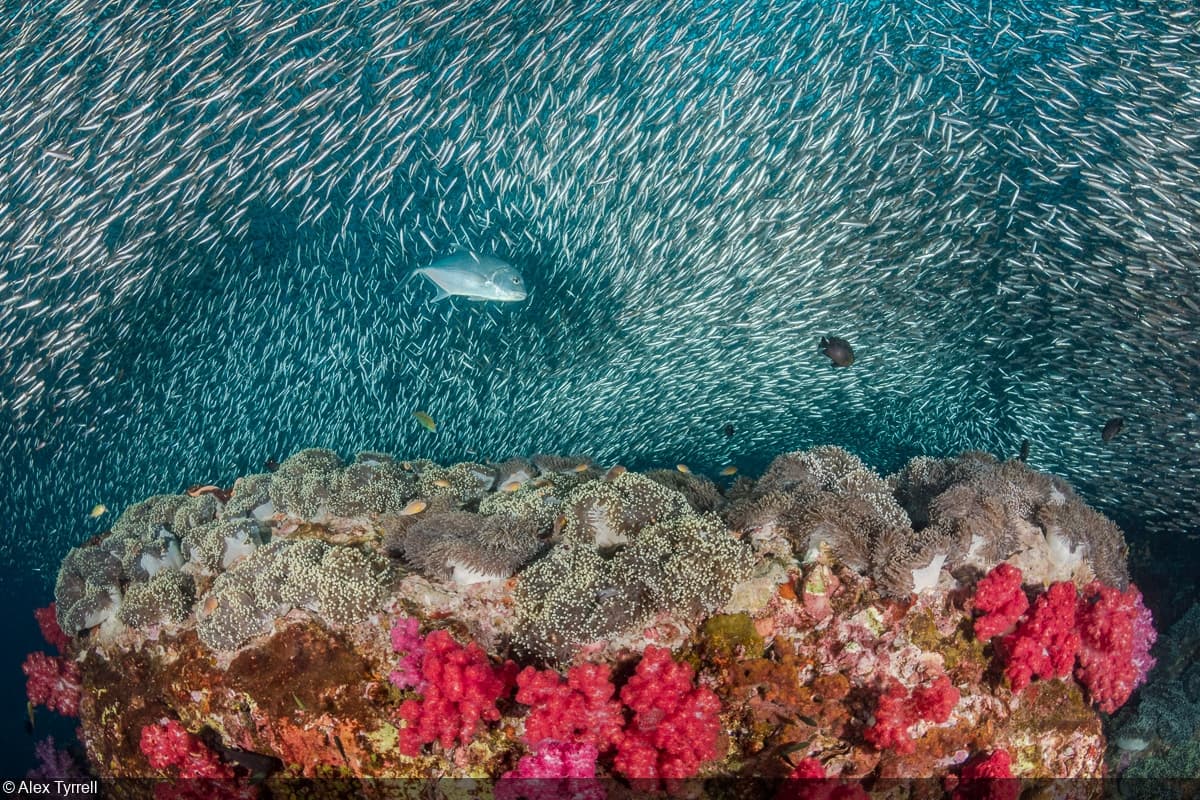
Cocos Island is the single most reliable place on Earth to dive with massive scalloped hammerhead schools. Not a handful of sharks circling a cleaning station — hundreds of hammerheads forming walls of silver bodies in blue water, stacked column upon column above a seamount in the eastern Pacific. The island sits 550 kilometers off Costa Rica's Pacific coast, reachable only by liveaboard, and its remote position in the Cromwell Current upwelling zone creates the nutrient conditions that sustain aggregations of this scale. Jacques Cousteau called it "the most beautiful island in the world" in 1994. Thirty years later, the hammerhead diving has only gotten better — in part because Costa Rica expanded the marine protected area to 9,600 square kilometers in 2022.
This article covers where exactly to dive for hammerhead schools at Cocos, when to go, what the diving actually demands of you, and how Cocos stacks up against the other Pacific hammerhead hotspots — Galapagos, Malpelo, and Socorro.
Why Cocos Island Dominates Hammerhead Diving
The reason Cocos produces hammerhead encounters at a scale no other destination matches is oceanography, not luck. The island sits in the path of the Cromwell Current — a subsurface equatorial current that upwells cold, nutrient-rich water along the island's seamounts. That upwelling drives a food chain: phytoplankton blooms attract baitfish, baitfish attract jacks and tuna, and the entire food web supports one of the highest shark biomasses recorded in any tropical marine ecosystem. Scalloped hammerheads are the most numerous large shark species at Cocos, and they aggregate at the seamounts in schools that researchers have counted in the hundreds.
The 2022 expansion of the Cocos Island National Park marine reserve — from 2,065 to 9,600 square kilometers — added critical buffer zones around the island's key seamounts. Illegal longlining, which had decimated shark populations in the surrounding waters, is now subject to enforcement across a much larger area. Early monitoring data suggests hammerhead numbers are recovering in the expanded zone.

The Short Answer
MantaraDive recommends Cocos Island for any diver whose primary bucket-list goal is hammerhead schools at scale. The aggregation density at Bajo Alcyone and Dirty Rock exceeds anything available at Galapagos, Malpelo, or Socorro. The trade-off is cost, trip duration, and the physical demands of deep drift diving in strong currents.
| Priority | Best choice | Why it wins |
|---|---|---|
| Largest hammerhead school encounters | Cocos Island | Bajo Alcyone regularly produces schools of 100+ scalloped hammerheads. |
| Best overall pelagic variety | Cocos Island | Hammerheads, whale sharks, mantas, whitetips, mobulas, dolphins, and schooling jacks. |
| Shortest travel time (from US) | Socorro | 24-hour crossing from Cabo San Lucas vs. 36-hour crossing from Puntarenas. |
| Closest hammerhead diving to Europe | Red Sea (Brothers) | Smaller schools, but accessible via short flights from European hubs. |
| Combining hammerheads with land wildlife | Galapagos | Marine iguanas, giant tortoises, and blue-footed boobies alongside hammerhead dives. |
| Budget hammerhead diving | Malpelo | Lower liveaboard fares, but the crossing is rougher and logistics are more complex. |
| Most consistent visibility | Cocos (June–November) | Dry-season visibility reaches 25–30 meters at the seamounts. |
The honest caveat: Cocos is not an easy trip. The 36-hour open-ocean crossing from Puntarenas is rough, the diving is deep (most hammerhead sites sit at 20–30 meters with strong currents), and a 10-day liveaboard itinerary commonly costs $5,500–$8,500 per diver before flights. If you want a gentler hammerhead experience, Galapagos offers smaller but still significant schools in more sheltered conditions. If you want the biggest hammerhead spectacle on the planet, Cocos is where you go.
Best Dive Sites for Hammerhead Schools
Cocos Island has roughly 20 named dive sites, but three produce the overwhelming majority of hammerhead school encounters. Understanding each site's characteristics helps you plan your liveaboard itinerary and set expectations for depth, current, and encounter style.
Bajo Alcyone — The Hammerhead Capital
Bajo Alcyone is the single most famous hammerhead dive site in the world. This submerged seamount rises to about 24 meters from the surface on its shallowest point, with the main hammerhead aggregation zone sitting between 22 and 30 meters. The school — often 100 to 300 scalloped hammerheads — circles the pinnacle in a slow, rotating column. Divers descend to the reef flat, settle into position, and watch the school pass overhead and around them.
What to expect: Current-dependent. On strong-current days the school is dense and compact. On slack-current days the hammerheads spread out and are harder to approach. Nitrox is strongly recommended — the 22–30 meter depth range consumes air quickly, and you want bottom time. Most liveaboards schedule Bajo Alcyone for early morning when the school is most cohesive.
Typical conditions: 22–30 m depth, moderate to strong current, visibility 15–25 m, water temperature 24–27°C.
Dirty Rock — Hammerheads Plus Pelagics
Dirty Rock (Roca Sucia) is a large rocky outcrop on the island's southwest side. The dive starts along a wall that drops to over 40 meters, with the hammerhead school occupying the blue water off the wall at 18–25 meters. Dirty Rock's advantage over Bajo Alcyone is variety: in addition to hammerheads, you regularly encounter whitetip reef sharks resting in crevices, schools of jacks and snappers, and — in season — whale sharks passing in the blue.
What to expect: This is a wall dive with a hammerhead component, not a seamount station. You fin along the wall and look out into the blue for the school. Current is usually moderate. The wall itself has excellent macro life — moray eels, octopuses, and cleaning stations.
Typical conditions: 18–25 m for hammerheads, wall to 40+ m, moderate current, visibility 20–30 m.
Manuelita — Shallow Hammerheads and Night Diving
Manuelita is a small island north of the main Cocos Island landmass. The channel between Manuelita and the main island produces hammerhead encounters at shallower depths — 12 to 18 meters — making it the most accessible hammerhead dive at Cocos for divers who are less comfortable at depth. The school is usually smaller than at Bajo Alcyone (20–80 individuals), but the shallower depth means longer bottom times and better photography conditions with natural light.
What to expect: A gentler introduction to Cocos hammerhead diving. The channel also hosts whitetip reef sharks, eagle rays, and large schools of fish. Night dives at Manuelita's shallow reef are outstanding — whitetip reef sharks hunting, octopuses, and basket stars.
Typical conditions: 12–18 m, light to moderate current, visibility 15–25 m.

Best Season for Cocos Hammerhead Diving
Cocos Island is diveable year-round, but hammerhead behavior and diving conditions vary significantly by season.
June to November — Peak Hammerhead Season
This is the season most liveaboard operators and returning divers recommend. The reasoning is counterintuitive: the June–November period is Costa Rica's rainy season, which means rougher surface conditions during the 36-hour crossing and occasional rain squalls at the island. But underwater, the rainy season brings the Cromwell Current upwelling to its peak — colder, nutrient-rich water that drives the food chain and produces the densest hammerhead aggregations. Visibility is slightly lower (15–25 m) than the dry season, but the sheer number of sharks more than compensates.
Water temperature: 24–26°C. Bring a 5mm wetsuit or a 3mm with a vest. The thermoclines at the seamounts can drop to 20°C.
Whale shark season: August to October overlaps with the hammerhead peak, making this the premium window for divers who want both species on the same trip.
December to May — Better Visibility, Fewer Sharks
The dry season brings calmer surface conditions for the crossing and visibility that can reach 25–30 meters. Hammerheads are still present — Cocos is never shark-free — but the schools are less dense and more dispersed. This season suits divers who prioritize comfort, photography conditions, and a broader pelagic mix (mantas are more common in the dry season) over maximum hammerhead numbers.
Water temperature: 26–29°C. More comfortable thermals, thinner wetsuit options.
Month-by-Month Summary
| Month | Hammerhead density | Visibility | Surface conditions | Whale sharks |
|---|---|---|---|---|
| January | Moderate | 20–30 m | Calm | Rare |
| February | Moderate | 20–30 m | Calm | Rare |
| March | Moderate | 20–30 m | Calm | Occasional |
| April | Moderate | 20–30 m | Calm | Occasional |
| May | Building | 18–25 m | Transitional | Occasional |
| June | High | 15–25 m | Rough crossings | Occasional |
| July | High | 15–25 m | Rough crossings | Occasional |
| August | Peak | 15–25 m | Rough crossings | Common |
| September | Peak | 15–25 m | Rough crossings | Common |
| October | Peak | 15–25 m | Rough crossings | Common |
| November | High | 15–25 m | Transitional | Occasional |
| December | Moderate | 20–30 m | Calm | Rare |
Liveaboard Logistics: Getting to Cocos
Cocos Island is liveaboard-only. There is no resort, no day-boat operation, and no accommodation on the island (it is a national park ranger station). Every diver reaches Cocos by liveaboard departing from Puntarenas, on Costa Rica's Pacific coast.
The Crossing
The open-ocean crossing from Puntarenas to Cocos takes 30 to 36 hours depending on sea state. This is not a coastal cruise — you are crossing 550 kilometers of open Pacific. The crossing is notoriously rough, particularly in the June–November rainy season. Seasickness medication is not optional. Bring scopolamine patches or strong oral medication, and start taking it before departure.
Trip Duration and Pricing (2026)
Most Cocos liveaboards run 10-day itineraries: 1.5 days crossing each way, 7 days of diving at the island with 3–4 dives per day.
| Operator | Vessel | Duration | Price range (per diver, USD) | Notes |
|---|---|---|---|---|
| Undersea Hunter | Argo | 10 days | $5,995–$7,495 | Flagship vessel, DeepSee submersible available |
| Undersea Hunter | Sea Hunter | 10 days | $5,495–$6,995 | Larger vessel, more deck space |
| Aggressor Fleet | Cocos Aggressor | 10 days | $5,995 | Standard Aggressor service level |
| All Star Liveaboards | Cocos Island | 10 days | $6,495 | Newer vessel, premium amenities |
Prices typically include all meals, diving, tanks, weights, and nitrox. They do not include the $525 round-trip domestic transfer fee, crew gratuity ($200–$300 typical), gear rental, or flights to San José.
Additional Costs
| Cost component | Estimated USD |
|---|---|
| International flights (US–San José round trip) | $400–$900 |
| Pre/post-trip hotel in San José or Puntarenas | $80–$200 |
| Cocos Island National Park fee | $525 |
| Crew gratuity | $200–$300 |
| Gear rental (if needed) | $150–$300 |
| Seasickness medication | $20–$40 |
| Total all-in estimate | $6,900–$9,500 |
How Cocos Compares to Other Hammerhead Destinations
The Pacific has four major hammerhead diving destinations. Understanding the differences helps you choose the right trip for your priorities and budget.
Cocos vs Galapagos
Galapagos (detailed cost analysis here) offers hammerheads at Darwin and Wolf Islands, but the school sizes are smaller — typically 20–80 individuals rather than the 100–300 seen at Bajo Alcyone. Galapagos wins on overall ecosystem diversity (marine iguanas, sea lions, penguins, whale sharks) and on accessibility from the US (shorter crossing, better flight connections). Cocos wins on pure hammerhead density and the visceral experience of diving inside a school of hundreds.
Choose Cocos if: Hammerheads are your single primary goal. Choose Galapagos if: You want hammerheads plus iconic land-and-sea wildlife, and you can tolerate the higher cost.
Cocos vs Malpelo
Malpelo Island, a Colombian territory 500 kilometers off the Colombian coast, is the only Pacific destination that rivals Cocos for hammerhead school density. Malpelo's schools are genuinely massive — counts of 500+ hammerheads in a single dive have been reported. The trade-off is logistics: Malpelo is harder to reach (flights to Bogotá, then to Buenaventura, then a 36-hour boat crossing), the liveaboard options are fewer, and the diving is more extreme — deeper sites, stronger currents, and more exposed rock formations.
Choose Cocos if: You want world-class hammerhead diving with established liveaboard infrastructure and better safety margins. Choose Malpelo if: You are an experienced cold-water diver who wants the absolute maximum hammerhead numbers and is comfortable with expedition-level logistics.
Cocos vs Socorro
Socorro (Revillagigedos) off Mexico's Baja California is the most accessible Pacific hammerhead destination from the US — a 24-hour crossing from Cabo San Lucas. Hammerhead encounters at Socorro are real but less consistent than at Cocos; the island's main draw is giant manta rays and dolphins rather than hammerhead schools. Socorro also runs shorter itineraries (8–9 days) at lower price points ($3,500–$5,500).
Choose Cocos if: Hammerhead schools are the priority. Choose Socorro if: You want a broader pelagic mix (mantas, dolphins, sharks) on a shorter, more affordable trip.
What You Need to Know Before Booking
Certification and Experience Requirements
Every Cocos liveaboard operator requires Advanced Open Water certification as a minimum. Most recommend or require 50+ logged dives. The diving at Cocos is not technically deep — most hammerhead sites sit at 18–30 meters — but the combination of strong currents, cold thermoclines, blue-water drift diving, and limited bottom time at depth means you need to be a confident, controlled diver. If your experience is limited to calm reef diving in the Caribbean or Southeast Asia, consider building more experience before booking Cocos.
Nitrox certification is strongly recommended. All liveaboards offer nitrox, and the 22–30 meter depth range at Bajo Alcyone is where nitrox's extended no-decompression limits genuinely matter.
Current Management
Cocos diving is current diving. The seamounts that attract hammerheads do so because of current-driven upwelling. You will frequently be hooking into the reef (using a reef hook to hold position in the current) and watching the hammerhead school pass in the blue ahead of you. This is not drift diving in the Cozumel sense — it is stationary diving in a current, which requires good buoyancy control and comfort with holding position.
Seasickness Management
The 36-hour crossing and the mooring conditions at the island (exposed to open-ocean swell) make seasickness a real factor. Divers who have never been seasick in sheltered Caribbean or Mediterranean conditions can be miserable on the open Pacific. Prepare seriously: scopolamine patches, oral medication (meclizine or dimenhydrinate), ginger supplements, and a strategy for the crossing days (stay on deck, watch the horizon, stay hydrated).
Photography Tips
Hammerhead photography at Cocos is challenging. The sharks are usually at 22–30 meters in blue water with moderate visibility. Wide-angle lenses (10–15mm rectilinear or fisheye) are the right tool. The school usually passes at a distance of 5–15 meters — too far for a medium lens, close enough for a wide-angle with strobes at reduced power. Shoot at f/8–f/11, 1/125–1/160 sec, ISO 400–800. The best images come from patience: settle into position, let the school come to you, and shoot when the column passes closest.
Planning Your Cocos Hammerhead Trip
Step 1: Choose Your Season
If hammerhead schools are the priority, book June through November — ideally August or September for the peak plus whale shark overlap. If you prefer calmer crossings and better visibility with still-good hammerhead encounters, book January through April.
Step 2: Select a Liveaboard
Book 6–12 months in advance. Cocos liveaboards sell out, particularly for peak-season departures. Compare vessel comfort, dive schedule (3 vs 4 dives per day), nitrox inclusion, and submersible availability (Undersea Hunter's DeepSee sub adds a unique dimension but costs extra).
Step 3: Prepare Physically
Get comfortable at 25–30 meters in current before the trip. Practice reef-hook techniques if you have not used them. Complete your nitrox certification. Build general fitness — the crossing, the early-morning dive briefings, and the 4-dive days take a toll.
Step 4: Pack for Cold Water
Despite the tropical latitude, Cocos water drops to 20°C at the thermoclines. Bring a 5mm fullsuit or a drysuit if you own one. A hood and gloves are recommended for the seamount dives. Most liveaboards provide hot drinks and warm towels between dives — you will appreciate them.
Step 5: Manage Expectations
Hammerhead schools are wild animals in open ocean. No operator can guarantee a 200-hammerhead encounter on any specific dive. What Cocos offers is the highest probability, at scale, of any destination on Earth. On a typical 7-day diving itinerary, you can expect hammerhead school encounters on 10–15 of your 20–25 dives. Some dives will produce massive schools; others will produce smaller groups or individuals. That is the nature of pelagic diving.
Frequently Asked Questions
How many hammerheads are in a typical Cocos school?
At Bajo Alcyone, researchers and experienced dive guides consistently report schools of 100 to 300 scalloped hammerheads. Schools of 500+ have been recorded but are not typical. At Manuelita, expect 20–80 individuals. Dirty Rock falls in between.
Is Cocos diving safe?
The diving itself is safe for experienced, properly certified divers. The risks are current-related (being swept away from the reef if you lose your reef hook), decompression-related (spending too long at depth on air instead of nitrox), and seasickness-related (dehydration from prolonged nausea during the crossing). Accidents at Cocos are rare but almost always involve divers who overestimated their experience level.
Can beginners dive at Cocos?
No. Every operator requires Advanced Open Water as a minimum, and most require 50+ logged dives. The currents, depth, and blue-water conditions are not appropriate for newly certified divers.
How does Cocos compare to the Galapagos for hammerheads?
Cocos produces larger, denser hammerhead schools than Galapagos. Galapagos offers a broader ecosystem (marine iguanas, sea lions, penguins) and more accessible logistics. See the comparison section above for details.
What other marine life will I see at Cocos?
Beyond hammerheads, Cocos regularly delivers whitetip reef sharks (particularly on night dives at Manuelita), whale sharks (August–October), manta rays, mobula rays, large schools of jacks and tuna, moray eels, octopuses, and occasionally tiger sharks and silvertips at the deeper sites.
Do I need a reef hook?
Yes. Bring your own or confirm the liveaboard provides them. A reef hook is essential equipment at Bajo Alcyone and Dirty Rock — it anchors you to the reef in current so you can hold position and watch the hammerhead school without exhausting yourself finning against the flow.