
Five thousand US dollars all-in for a mid-range week. Thirty hours of transit door-to-door for most North American and European divers. A reef-hook requirement at the headline sites and an unwritten 75-dive minimum from most operators. The question every diver eventually has to answer—and the verbatim title of one of the most-discussed threads in r/scuba's recent history—is whether Raja Ampat is worth it, or whether the spend buys hype as much as biodiversity. We pulled the 2026 pricing, the species data, and the operator and ScubaBoard reviews together to give a defensible answer.
The case for Raja Ampat rests on a single fact: it is, by independent scientific measure, the most biodiverse marine ecosystem on Earth. Dr. Gerald R. Allen logged 374 distinct fish species on a single 90-minute dive at Cape Kri in 2012—a record that still stands more than a decade later (Reef Life Survey; Papua Diving). The case against rests on a different set of facts: the trip costs roughly 30–50% more than equivalent diving in Komodo or the Philippines (Komodo Resort, 2026; Southeast Asia Diving), reaches you only after multiple flights, and demands real drift-diving competency at the headline sites. Both can be true at the same time. So is Raja Ampat worth it for you?
Why This Article Matters
We analyzed published 2026 liveaboard pricing across five operators, the official Raja Ampat marine park fee structure as updated for 2026, biodiversity figures from Reef Life Survey and Papua Diving, and roughly 200 ScubaBoard and Tripadvisor diver reviews discussing Raja Ampat versus alternatives. The output below is a cost-benefit framework, not a brochure: a real all-in price tag, what it buys, what it does not, and four diver profiles with explicit verdicts. If you have already decided Raja Ampat is the trip, our companion analysis on the Indonesia liveaboard split—Raja Ampat versus Komodo—handles the next decision down the funnel.
The Real 2026 Cost: What Raja Ampat Actually Sets You Back
Headline liveaboard rates almost never tell the truth about what a Raja Ampat trip costs door-to-door. Once you add international flights, two domestic legs, marine park and visitor entry fees, gear and Nitrox, and crew gratuities, the total commonly lands 35–50% above the published vessel fare.
7-Night Liveaboard Cost, All-In (per diver, USD, 2026)
| Tier | Vessel fare | Marine park + visitor fees | Domestic flights (Jakarta–Sorong rt) | Gear, Nitrox, gratuities | International flights (illustrative US/EU) | All-in total |
|---|---|---|---|---|---|---|
| Budget | 1,500–2,200 | 105–112 | 300–450 | 300–500 | 1,300–2,000 | 3,500–5,300 |
| Mid-range | 2,500–4,500 | 105–112 | 300–450 | 350–700 | 1,300–2,000 | 4,500–7,800 |
| Luxury | 5,000–9,000+ | 105–112 | 400–600 | 500–1,000 | 1,300–2,000 | 7,300–12,800+ |
Sources: La Galigo Liveaboard cost guide (2025/2026); Ocean Earth Travels (2026 entry-fee update); Travelocity / Traveloka (Jakarta–Sorong fares); Bluewater Dive Travel; LiveAboard.com.
A few specific data points behind the table. Situju7 published a 7-day Raja Ampat departure for early 2026 at USD 2,079 per person on a 10%-off promotion (Ocean Earth Travels, 2026). Mid-range vessels including Mari Liveaboard list from USD 4,490 (La Galigo, 2026), and Central and North Raja Ampat 8-day mid-range cruises were quoted at €3,101–€3,328 in late 2025 (Bluewater Dive Travel; ZuBlu). Marine park entry plus the visitor entry ticket—two separate fees—total IDR 1,700,000, approximately USD 105–112 per diver, with both required and now collected at registration before the trip (Ocean Earth Travels, 2026; Stay Raja Ampat).
Round-trip Jakarta–Sorong domestic fares ran USD 300–450 in early 2026 across Lion Air, Batik Air, Garuda, and Nam Air, with peak season pushing the ceiling and shoulder weeks bringing one-way prices to USD 200–250 (Travelocity, 2026; Traveloka, 2026). Total transit time from a North American or European hub to a Raja Ampat liveaboard pickup at Sorong commonly clears 30 hours including connections (Phinisi Trip; Stay Raja Ampat).
The honest number to budget against: USD 5,500–7,800 all-in for a competent mid-range week with a US/EU starting point. Anyone budgeting at the published vessel fare alone will be 30–50% short.
What the Money Buys: The Biodiversity Case
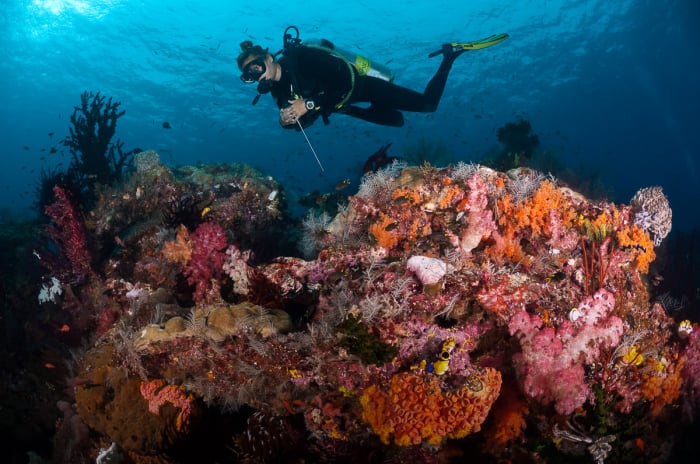
Raja Ampat's premium is not arbitrary. The archipelago sits at the geographic center of the Coral Triangle and supports more than 1,500 documented fish species, 75% of all known coral species worldwide, and over 700 species each of mollusks (Reef Life Survey; Papua Diving Resorts). Independent surveys conducted by Conservation International and Reef Life Survey have repeatedly ranked it the world's richest marine environment—the 2002 baseline survey first established the designation, and follow-up work has only widened the gap (Reef Life Survey).
The Headline Dive Sites
Cape Kri (Dampier Strait). The site of the world record. Dr. Gerald R. Allen logged 374 fish species in a single 90-minute dive in 2012, with later transects routinely recording 100-plus species per 50-meter segment (Papua Diving). Currents converge at the channel between Kri and Koh, funneling grey reef sharks, blacktip and whitetip reef sharks, wobbegongs, and large barracuda and trevally aggregations. Reef hooks are mandatory; this is intermediate-to-advanced diving (DiveIn.com; ScubaBoard).
Blue Magic. A submerged pinnacle between Mioskun and Cape Kri rising from roughly 30 meters to 7 meters. Functions as a manta ray cleaning station; mantas commonly pass within arm's reach. Gorgonian sea fans, reef sharks, and schooling barracuda complete the cast (DiveIn.com; Papua Diving).
Manta Ridge / Manta Sandy. Dampier Strait cleaning stations most active October through April. Hook on, watch mantas glide past at roughly 20 meters depth (Bluewater Dive Travel; Stay Raja Ampat).
Misool (south). The "kaleidoscope" diving Raja Ampat is famous for—rainbow soft corals at sites like Boo Windows, swim-throughs, and oceanic-plus-reef mantas at Shadow Reef's cleaning station. Macro depth pays off here: pygmy seahorses, ghost pipefish, and rare nudibranchs are routinely logged (LiveAboard.com; DiveIn.com).
Wayag (north). The lagoon and karst landscape that defines the Raja Ampat aesthetic—the photographs you see in marketing are almost always Wayag. The diving is secondary to the topside scenery, but a Wayag stop is what most divers describe as the trip's defining moment in post-trip reviews (ScubaBoard; Stay Raja Ampat).
What This Adds Up To
Underwater visibility runs 25–30 meters consistently, water temperature stays in the 26–30°C band year-round, and reef health—measured by live coral cover and fish biomass—is among the highest documented anywhere on the planet (Reef Life Survey; Bluewater Dive Travel). The dive count on a competent 7-night liveaboard runs 18–22 dives, including night dives (LiveAboard.com).
That is the case for the spend. It is real, it is verifiable, and it is not equaled by any other dive destination on a strict biodiversity-per-dive basis.
What the Money Doesn't Buy: The Honest Reality Check
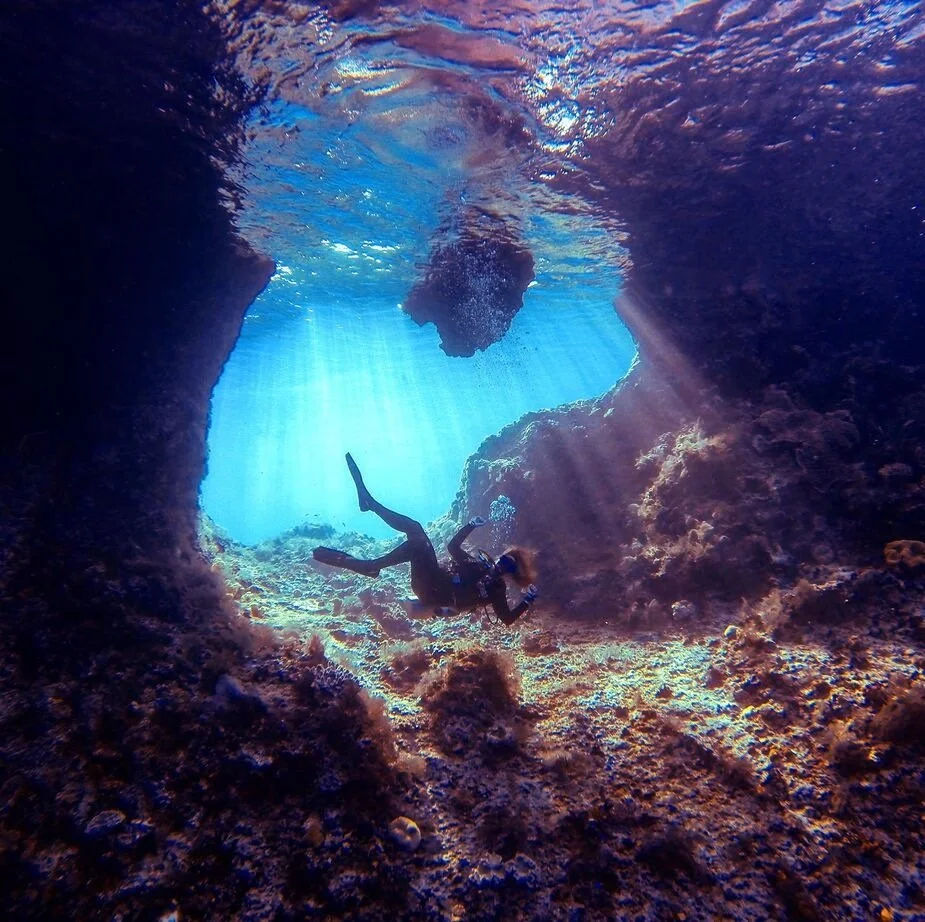
The case against the spend is just as real, and the operator marketing rarely surfaces it. Three things to weigh:
Currents are not optional. Raja Ampat sits at the Pacific–Indian Ocean tidal exchange, and the headline sites—Cape Kri, Blue Magic, Manta Ridge, Mike's Point—run currents that demand competent drift technique, reef-hook use, and negative entries. Most operators recommend Advanced Open Water plus 50–75 logged dives as a practical minimum, even though they will accept Open Water on paper (ScubaBoard; Calico Jack Charters; PADI Travel). Down-current incidents at sites like Mike's Point are not theoretical—they are documented in trip reports (ScubaBoard).
Accessibility is the single biggest tax on the trip. Komodo is reachable in a one-hour flight from Bali. Raja Ampat requires Jakarta–Sorong as a domestic leg, then a transfer to the boat or a 2-hour ferry to Waisai (Phinisi Trip; Stay Raja Ampat). For most international divers, that is two long-haul flights plus a domestic leg plus a transfer—no destination in the Maldives, Philippines, or Egyptian Red Sea matches that transit penalty. Komodo costs about a third less for comparable diving largely because of this logistics differential (Komodo Resort, 2026).
The marketing premium is real. ScubaBoard threads consistently surface that Raja Ampat costs 30–50% more than other top Indonesian destinations and 50–100% more than comparable Philippines diving, even when the underwater experience is genuinely better but not 50% better (ScubaBoard; Southeast Asia Diving). Some repeat Indonesia divers have explicitly switched to land-based Raja Ampat resorts—USD 150 per day for an ocean-view bungalow with two boat dives, all meals, and unlimited shore diving on a private house reef (ScubaBoard)—as a way to cut the spend by 40–60% versus a liveaboard.
The weather risk is not symmetric. December and January are technically inside the dry-season October–April window, but they bring the heaviest rainfall and the strongest occasional storms (Stay Raja Ampat). Liveaboards rarely cancel, but visibility drops to 15–20 meters during heavy rain and surface conditions get rough on northern crossings.
This is the part of the trip the marketing leaves out, and it materially changes the worth-it calculation for at least three of the diver profiles below.
The Cost-Benefit Decision Matrix
| Diver profile | Typical priorities | Worth the spend? | Suggested alternative if no |
|---|---|---|---|
| Newly certified (OW, < 30 dives) | Easy logistics, gentle conditions, reef variety | No | Philippines (Anilao, Dauin) — gentler, USD 2,500–4,000 all-in |
| Intermediate (AOW, 30–75 dives), first Indonesia trip | Variety, value, manageable currents | Probably no | Komodo — 30% cheaper, easier access, comparable diving |
| Advanced (75+ dives, drift-comfortable), first Coral Triangle trip | Best diving on Earth, willing to invest | Yes | n/a — Raja Ampat is the destination |
| Repeat Indonesia diver who has done Komodo | Wants the ultimate biodiversity experience | Yes | n/a — Raja Ampat is the natural next step |
| Underwater photographer | Wide-angle reef + macro density, manta encounters | Yes | n/a — biodiversity per frame is unmatched |
| Mixed-interest couple with non-diver partner | Diving + topside experience | Conditional yes | A land-based Raja Ampat resort, not a liveaboard — partner has a real holiday |
| Budget-constrained (< USD 4,000 all-in) | Diving, period | No | Philippines (Bohol, Malapascua), Bali, Komodo budget liveaboard |
| Time-poor (< 10 days door-to-door) | Maximum dive time per vacation day | No | Maldives, Komodo, Egyptian Red Sea — less transit overhead |
Sources: synthesis of LiveAboard.com (2026), Komodo Resort (2026), ScubaBoard threads (2024–2026), MantaraDive operator data.
The "Worth It" Verdict by Diver Profile
First-time tropical diver
Verdict: not worth it. Raja Ampat's headline sites are demanding even for AOW divers. Mike's Point, Cape Kri, and Manta Ridge involve negative entries, strong currents, and reef-hook technique that most newly certified divers have not practiced. The trip's total cost (USD 5,500–7,800 all-in) is also disproportionate to what a less experienced diver can extract from it—much of the famous biodiversity demands the buoyancy and current skills that take 50+ logged dives to develop. The Philippines (Anilao for macro, Dauin for reef variety) delivers a better learning environment at less than half the price.
Intermediate diver, first Indonesia trip
Verdict: probably not worth it on the first Indonesia trip. Komodo costs roughly 30% less, requires a one-hour flight from Bali instead of two domestic legs, and delivers manta aggregations and pelagic encounters that are competitive with Raja Ampat (Komodo Resort, 2026; LiveAboard.com). Most divers in this profile get more value from doing Komodo first and then Raja Ampat as the deliberate second Indonesia trip after building Indonesian-current experience.
Advanced diver, first Coral Triangle trip
Verdict: yes, this is the trip. A diver with 75-plus logged dives, drift-diving comfort, and a budget that absorbs USD 6,000–8,000 all-in is the target audience for Raja Ampat. Cape Kri, Blue Magic, and Misool deliver experiences that no other reef system replicates on a like-for-like basis, and the skill floor protects the quality of the experience.
Repeat Indonesia diver
Verdict: yes, and the timing is right in 2026. Komodo's new 1,000-person daily visitor cap (effective April 2026) is squeezing supply at the most popular Indonesia route, while Raja Ampat continues to operate without a hard cap (LiveAboard.com, 2026). For a diver who has already done Komodo and is weighing the next Indonesia trip, this is the year to book Raja Ampat.
Underwater photographer
Verdict: yes, with one caveat. Per-frame biodiversity is unmatched—374 species in a 90-minute dive is the operational ceiling for what reef photography can capture (Papua Diving). The caveat: you need to bring competent dive skills first; managing a camera in a 3-knot current at Cape Kri is not a place to develop them.
Budget-constrained diver
Verdict: not worth it now. A USD 3,500–4,500 budget delivers a much better trip in the Philippines or on a Komodo budget liveaboard. Raja Ampat at the budget tier still requires the USD 1,300–2,000 international flight + USD 105–112 fees + USD 300–450 domestic flight floor, which leaves USD 1,500–2,200 for the vessel itself—the bottom of the operator market. Better to wait, save, and book a competent mid-range trip in 2027 or 2028.
Honest Caveats
A few facts that operator marketing tends to omit:
- The marine park and visitor entry fees are now collected before the trip and require pre-registration via the official Raja Ampat conservation portal, not at the airport. Skipping this step risks denial of entry to the protected zone (Stay Raja Ampat; Ocean Earth Travels, 2026).
- Most Raja Ampat liveaboards do not operate during the May–September southeast-monsoon window for the central and northern routes. Misool-only southern itineraries continue, but the "best of Raja Ampat" itineraries cluster in October–April (Bluewater Dive Travel).
- The headline aesthetic—Wayag karst lagoons, Misool soft-coral kaleidoscopes—comes with real distance. Wayag is a 12-hour overnight sail from the central Dampier Strait. Misool is similar. A 7-night itinerary that hits both ends of the archipelago compresses the dive day count.
- Newer divers underestimate the down-current risk at sites like Mike's Point. ScubaBoard contains documented reports of partial-group down-current events (ScubaBoard). Operators screen, but the responsibility lands with the diver.
The MantaraDive Recommendation
After running the 2026 numbers and the diver-profile matrix, our position is direct: Raja Ampat is worth the spend for advanced divers and underwater photographers, conditional yes for repeat Indonesia divers, and not worth the spend for newly certified divers, intermediate divers on a first Indonesia trip, or anyone working with a budget below USD 4,500 all-in.
If you fit the worth-it profiles, the right move in 2026 is to book a 7-night Central + North Raja Ampat itinerary (Dampier Strait + Wayag) on a mid-range vessel—USD 4,500–7,800 all-in—departing November through March to catch peak Manta Ridge and Manta Sandy activity. Add Misool only if you can extend to 10 nights; otherwise, save Misool for a second trip rather than rushing the south on a 7-night clock.
If you do not fit the worth-it profiles, we recommend Komodo as the single best value substitute. Our Raja Ampat vs Komodo diving comparison for 2026 walks the dollar-by-dollar trade-off across the two flagship Indonesia destinations and is the right next read if you are weighing a switch. The single biggest mistake we see is a diver booking Raja Ampat as a first Indonesia trip and discovering at Cape Kri that the current is real—the same diver booking Komodo first builds the skills and saves USD 1,500–2,500 in the process.
Talk to a Specialist
The is-Raja-Ampat-worth-it question turns on three numbers: your real all-in budget, your logged dive count, and your travel calendar. MantaraDive advisors cross-reference live 2026 vessel availability across the Indonesia operator fleet with seasonal probability data and your specific dive history to give you a yes/no answer with the trade-offs in writing. Send us your dates, certification level, and budget and we will return either a Raja Ampat itinerary that fits—or, if the math says it does not, a direct recommendation for the alternative that does. We do not push the highest-margin trip; we push the right one.
Practical Planning FAQ
Is whether Raja Ampat is worth the cost suitable for newer divers?
It can be, but only if the operator matches the itinerary to certification level rather than selling the most dramatic version of the destination. For Raja Ampat, ask for the first two dives to stay conservative: easy entries, clear ascent procedures, a guide who keeps the group small, and a hard plan for what happens if current, visibility, or surface chop changes during the day. Newer divers should treat the first day as a checkout day, not a bucket-list race.
Which specific dive sites or route stops should I ask about?
Use named sites to test whether an operator is giving you real advice. For this trip, ask about Cape Kri, Blue Magic, Manta Sandy, Melissa’s Garden, Magic Mountain, and the Dampier Strait jetties. If the salesperson cannot explain which of those are seasonal, current-sensitive, beginner-friendly, or camera-friendly, keep shopping. Strong operators will tell you which sites they would skip for your dates as clearly as which sites they hope to include.
What gear or training makes the biggest difference?
The practical kit is simple: SMB, reef hook for current sites, nitrox, warm-water exposure protection, and spare camera batteries because charging windows can be limited. The training priority is buoyancy first, current awareness second, and camera handling last. If you cannot hold position without sculling or touching the reef, leave the big camera rig behind until the second half of the trip. A good guide would rather manage a calm diver with modest gear than a distracted diver with expensive equipment.
What budget range should I plan around?
A realistic planning range is USD 4,500-8,000 for a serious liveaboard week and USD 2,500-5,000 for simpler homestay or resort-based routes before flights. The hidden costs are usually transfers, marine-park fees, Nitrox, equipment rental, crew tips, private guide surcharges, and lost-dive buffers for weather. If the trip is built around a rare animal encounter, add at least one spare day so a cancelled morning does not become the whole story.
What should I read next before booking?
Cross-check this guide against planning link 1, planning link 2, planning link 3, planning link 4, planning link 5. Those pages cover adjacent seasons, route trade-offs, beginner fit, and cost assumptions, which helps prevent a single article from carrying the whole booking decision.
Sources and Methodology
This article draws on data cross-referenced from the following independent sources: La Galigo Liveaboard 2025/2026 cost guide (vessel pricing tiers); Ocean Earth Travels 2026 update on Raja Ampat entry fees and pre-registration requirements; Stay Raja Ampat (marine park permit, visitor entry ticket, weather and access guides); Bluewater Dive Travel (mid-range vessel pricing, season strategy, dive site descriptions); LiveAboard.com (2026 vessel listings, fleet count, hidden-cost breakdown); ZuBlu (operator route data); Reef Life Survey and Papua Diving Resorts (Cape Kri 374-species record, biodiversity statistics, fish biomass data); Calico Jack Charters and PADI Travel (certification and skill prerequisites); ScubaBoard (multi-thread synthesis of 2024–2026 trip reports, "Is RA worth it?" thread, 10-week Raja Ampat trip report across 9 operators, "Anywhere beat Raja Ampat?" thread, current-incident reports at Mike's Point); Tripadvisor Raja Ampat forum (cost-benefit threads); Travelocity and Traveloka (Jakarta–Sorong domestic fare data); Komodo Resort 2026 cost comparison (Raja Ampat vs Komodo pricing differential); Southeast Asia Diving (Indonesia vs Philippines comparison); Phinisi Trip and Misool Trip (transit logistics). All US dollar figures reflect rates published in early 2026; actual costs vary by operator, season, cabin class, departure airport, and booking lead time. Diver profile recommendations reflect operator-reported skill prerequisites and ScubaBoard community consensus, not absolute rules. Pre-registration for marine park and visitor entry fees should be cross-checked against the official Raja Ampat conservation portal before booking.
Related MantaraDive planning links
- Solo Diving in the Philippines: Which Resorts and Liveaboards Welcome Solo Travelers?
- Komodo Liveaboard Prices: What It Actually Costs (and What's Worth It)
- Red Sea Liveaboard Itinerary: North vs South for European Divers
- Lembeh Strait for Macro Photographers: Complete 2026 Guide
- 5 Essential Beginner Tips for Your First Tropical Dive Trip
- Best Dive Sites in Bali: 3 That Matter for a 7-Day Trip
- Raja Ampat vs Komodo Diving: Which Indonesian Liveaboard Earns Your Money in 2026?
- Anilao vs Lembeh for Macro Diving: Which Critter Capital Actually Wins?