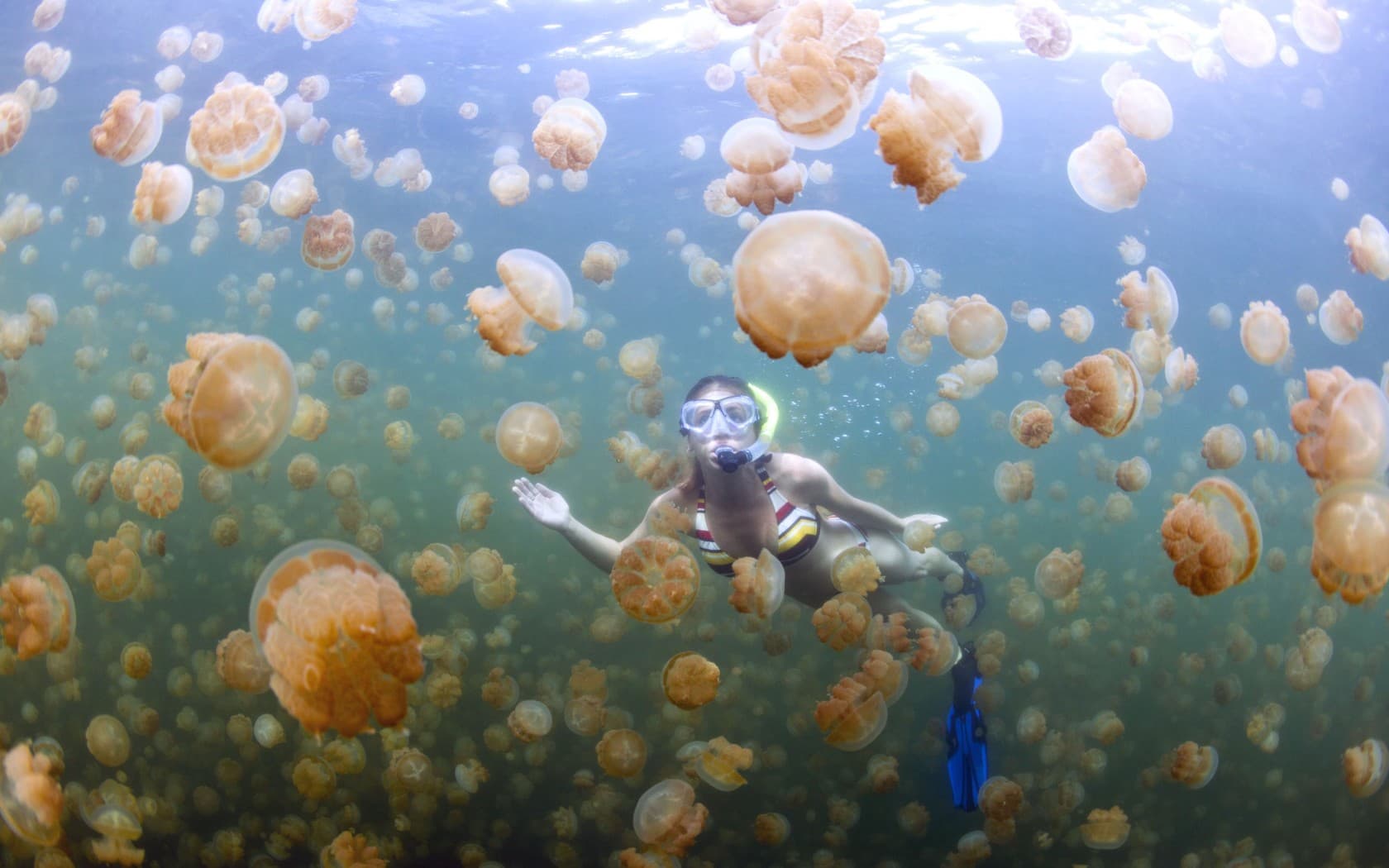
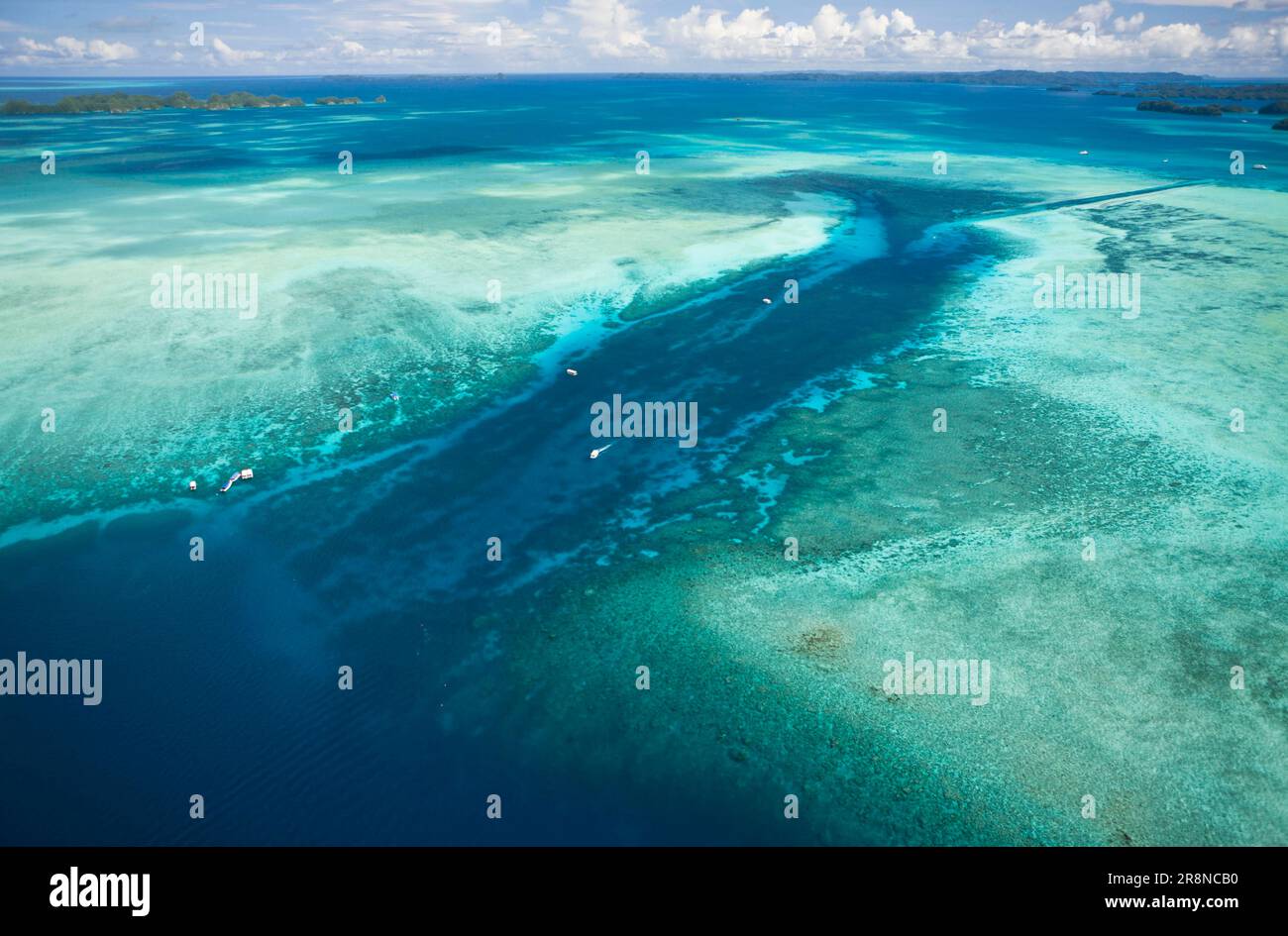
Five hundred limestone islands draped in jungle, ringed by reef, floating in water so clear you can see your shadow on the sand at 30 meters. Palau's Rock Islands are one of the last places on earth where the reef system is intact enough to support grey reef sharks in numbers that genuinely startle first-time visitors. The question every Palau-bound diver has to answer is not whether to go — it is how to go: from a liveaboard that repositions overnight and drops you on the reef at dawn, or from a resort in Koror where you ride a speedboat out to the same sites each morning.
The palau liveaboard vs resort calculation is tighter here than in the Maldives or the Red Sea, because Palau is small. The Rock Islands sit within a 30-to-50-minute speedboat ride of Koror. A liveaboard does not unlock a hidden quadrant of the archipelago the way it does in Egypt or the Maldives. What it does unlock is dive volume, tidal timing, and access to the southern sites — Peleliu especially — that day boats treat as a weather-dependent special trip rather than a daily target.
This article runs the numbers on 2026 pricing, compares what each option actually delivers across Palau's signature sites, and gives a decision framework based on your certification, budget, and priorities.
Why This Comparison Is Different in Palau
In most liveaboard destinations, the resort-versus-liveaboard debate is a geography question. Can you reach the sites from shore? In Palau, the answer is mostly yes. Blue Corner, German Channel, Blue Holes, and Ulong Channel are all within day-boat range of Koror. The Rock Islands are not remote the way Hanifaru Bay or Fuvahmulah are remote.
The difference is operational. A liveaboard sleeps 100 meters from the reef. It dives Blue Corner at slack tide at 06:30 while your resort boat is still loading tanks at the dock in Koror. It repeats German Channel three times in a week when the mantas are running, instead of scheduling it once on Tuesday. It spends two full days at Peleliu when the snapper aggregation fires, instead of running a single day trip that burns two hours each way in choppy seas.
Those operational differences compound into a real gap — not in which sites you see, but in how many dives you log, how well those dives are timed, and whether Peleliu and the outer walls get the attention they deserve.
What Each Option Actually Delivers
Liveaboard Diving: Volume and Tidal Precision
A standard 7-night Palau liveaboard runs three to four dives per day — typically two morning dives, an afternoon dive, and one or two night dives across the week — totaling 18 to 24 dives in a seven-day trip (Aggressor Fleet, 2026; Solitude Liveaboards, 2025). Vessels anchor in the Rock Islands overnight, so divers wake up at the next dive site rather than spending 40 to 70 minutes on a speedboat from Koror each morning.
Palau liveaboard routes cover the core Rock Islands circuit plus Peleliu:
- Rock Islands Classic: Blue Corner, Blue Holes, German Channel, Ulong Channel, Ngemelis Wall (Big Drop-off), Chandelier Cave. This is the standard itinerary and covers the sites that define Palau diving.
- Peleliu Extended: Multiple days at Peleliu Wall, Peleliu Express, and Peleliu Cut. Liveaboards can anchor near Peleliu and time dives to tidal windows and spawning aggregations — something day boats from Koror cannot do reliably.
- Night Dives: Liveaboards run night dives on the house reef or sheltered sites without requiring a separate evening boat trip from Koror.
The Peleliu advantage is the single biggest liveaboard differentiator in Palau. Peleliu sits at the southern tip of the archipelago, roughly 90 minutes by speedboat from Koror in calm seas, longer in rough conditions. Day boats treat it as an occasional full-day trip subject to weather cancellation. Liveaboards can spend two or three days there, diving the walls and channels at optimal current windows and returning to the site repeatedly when conditions align.
Resort Diving: Flexibility and Land-Based Comfort
A Palau resort dive package centers on two- or three-tank morning boat dives from Koror, with operators running speedboats to the Rock Islands dive sites within a roughly 40-to-70-minute radius. Most operators schedule two boat dives per day, with a third tank available on request or as part of a "three-tank big day" package (Sam's Tours, 2026; Fish 'n Fins, 2025; Palau Dive Adventures, 2025).
What resort diving delivers that liveaboards cannot:
- Schedule flexibility. You choose which days to dive. A non-diving day, a land tour of Peleliu's WWII battlefields, or a Jellyfish Lake excursion slots into your week without burning a liveaboard day.
- Non-diver compatibility. A partner who does not dive has a real holiday — beach, spa, kayaking, island tours. On a liveaboard, they have a small cabin and 21 dive briefings.
- Surface comfort. A proper bed, a real shower, restaurants, and no swell at 03:00. Liveaboard cabins in Palau are functional but compact.
- Repeat dive site choice. You can request Blue Corner three days in a row if you want. Liveaboard itineraries follow a route; you go where the boat goes.
The trade-off: resort divers log fewer dives per day — typically two, sometimes three — and are constrained by the commute from Koror. A 50-to-70-minute speedboat ride each way means you arrive at Blue Corner after the liveaboards have already done their first dive and are eating breakfast. Tide windows are harder to hit precisely when your boat departs Koror at a fixed time.
The Numbers: Palau Dive Trip Cost in 2026
Palau is not cheap. It sits in the western Pacific, flights are limited, and the infrastructure is small-scale. But the cost gap between liveaboard and resort is smaller here than in the Maldives, because Palau's liveaboard market is less price-competitive and the resort-adjacent dive operators offer multi-day packages that reduce per-day costs.
7-Night Liveaboard Cost (per diver, USD)
| Tier | Base fare | Permits + fuel | Gear + Nitrox | Tipping | Total est. |
|---|---|---|---|---|---|
| Mid-range | 3,500–4,200 | 350–450 | 250–400 | 200–350 | 4,300–5,400 |
| Premium | 3,800–4,500 | 350–450 | 0–250 | 300–450 | 4,450–5,650 |
| Luxury | 4,000–4,800 | 350–450 | 0 (often included) | 400–500 | 4,750–5,750+ |
Sources: Aggressor Fleet published 2026 rates (Palau Aggressor II at US$3,835–4,035 pp for 7 nights), Solitude One agent listings (US$3,500–4,200 pp), Palau Siren and Ocean Hunter agent estimates (US$3,500–4,500 pp), Black Pearl upper-range estimates (US$4,000–4,800 pp). Permits include port/permit fees (~US$240) and fuel surcharge (~US$150).
Key exclusions across all liveaboards: international flights, the PPEF (US$100, included in your air ticket), Nitrox, rental gear, alcohol beyond basic offerings, crew gratuities, and airport-boat transfers (~US$30–50 each way). The Palau Aggressor II's published 2026 rate table is the most transparent in the market — US$3,835 for a double cabin, US$4,035 for deluxe, with port/permit and fuel surcharges itemized separately (Aggressor Fleet, 2026).
7-Night Resort Dive Package Cost (per diver, USD)
| Tier | Room (7 nights) | Diving (10–14 dives) | Permits + gear | Total est. |
|---|---|---|---|---|
| Budget (Rose Garden) | 280–420 (pp share) | 910–1,190 | 200–350 | 1,390–1,960 |
| Mid-range (Palau Plantation) | 455–630 (pp share) | 910–1,190 | 200–350 | 1,565–2,170 |
| Luxury (Palau Pacific Resort) | 1,330–2,100 (pp share) | 910–1,400 | 200–350 | 2,440–3,850 |
Sources: Rose Garden Resort (US$80–120/night room, ~US$40–60 pp share), Palau Plantation Resort (US$130–180/night, ~US$65–90 pp share), Palau Pacific Resort (US$380–600/night, ~US$190–300 pp share), Palau Royal Resort (US$340–380/night, ~US$170–190 pp share). Day-boat diving at US$130–170/day for 2-tank, US$170–230 for 3-tank (Sam's Tours, Fish 'n Fins, Palau Dive Adventures). PPEF of US$100 is included in international air tickets. Rock Islands permits (~US$50 for 5 days) may be covered by the PPEF — confirm with your operator.
A 2026 group package from Sam's Tours bundled 8 nights of sea-view accommodation plus 5 days of 3-tank diving (15 dives), daily breakfast, dive-day lunches, Nitrox, and permits for US$3,195 per person (Scuba San Diego, 2026). This is the kind of all-in resort-package pricing that makes the cost comparison tighter than headline per-night rates suggest.
The math: a mid-range liveaboard week runs US$4,300 to 5,400 per diver for 18 to 24 dives. A mid-range resort week with 5 days of 2-tank diving (10 dives) runs US$1,565 to 2,170. The liveaboard delivers roughly double the dives — but at roughly double the total cost. Per-dive cost lands around US$200 to 280 on a mid-range liveaboard and US$155 to 220 on a mid-range resort package. In Palau, unlike the Maldives, the resort per-dive cost can actually be competitive — because the dive sites are close enough that day-boat logistics do not carry the same penalty.
Marine Life Probability: Where Each Option Wins
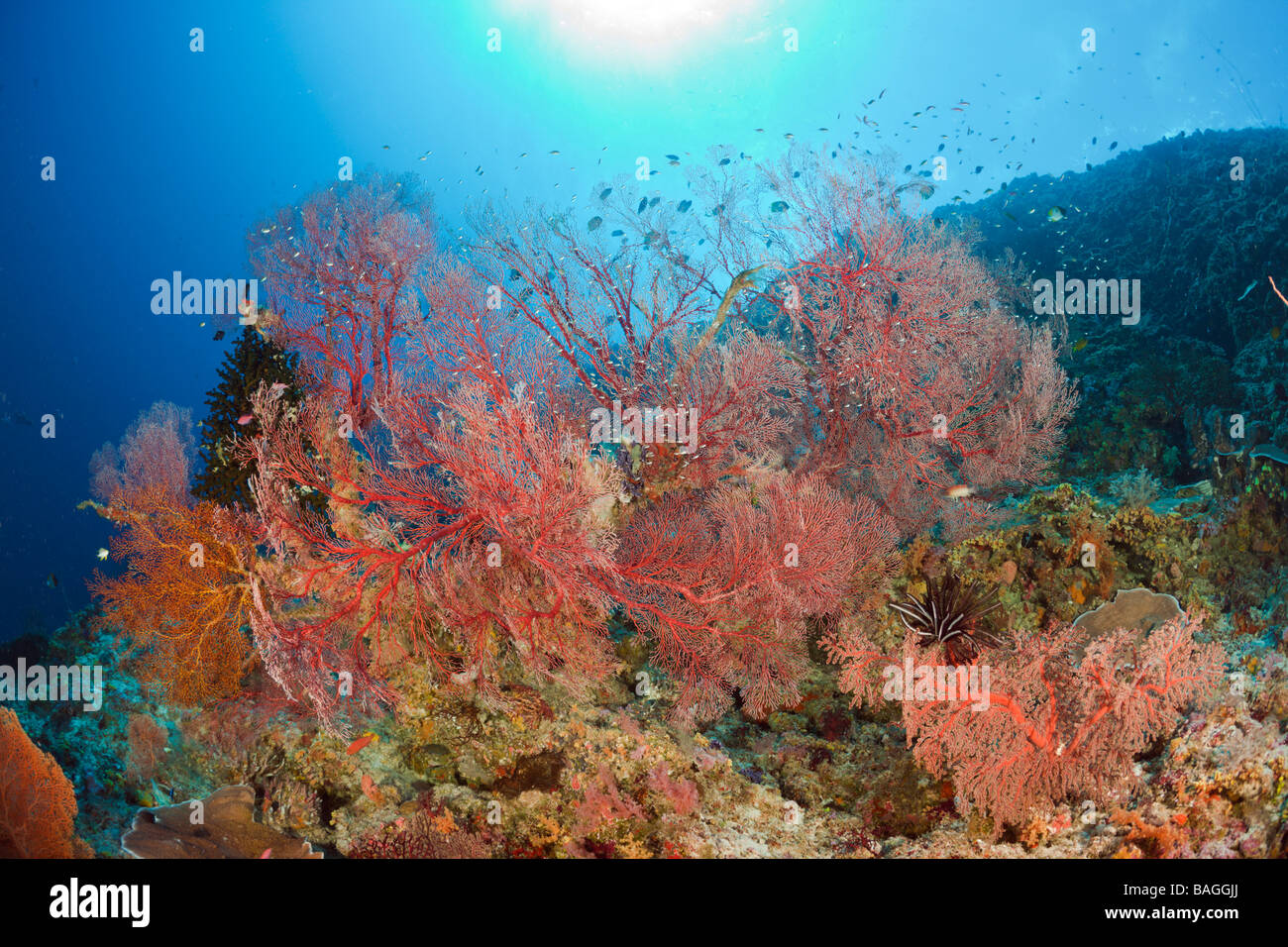
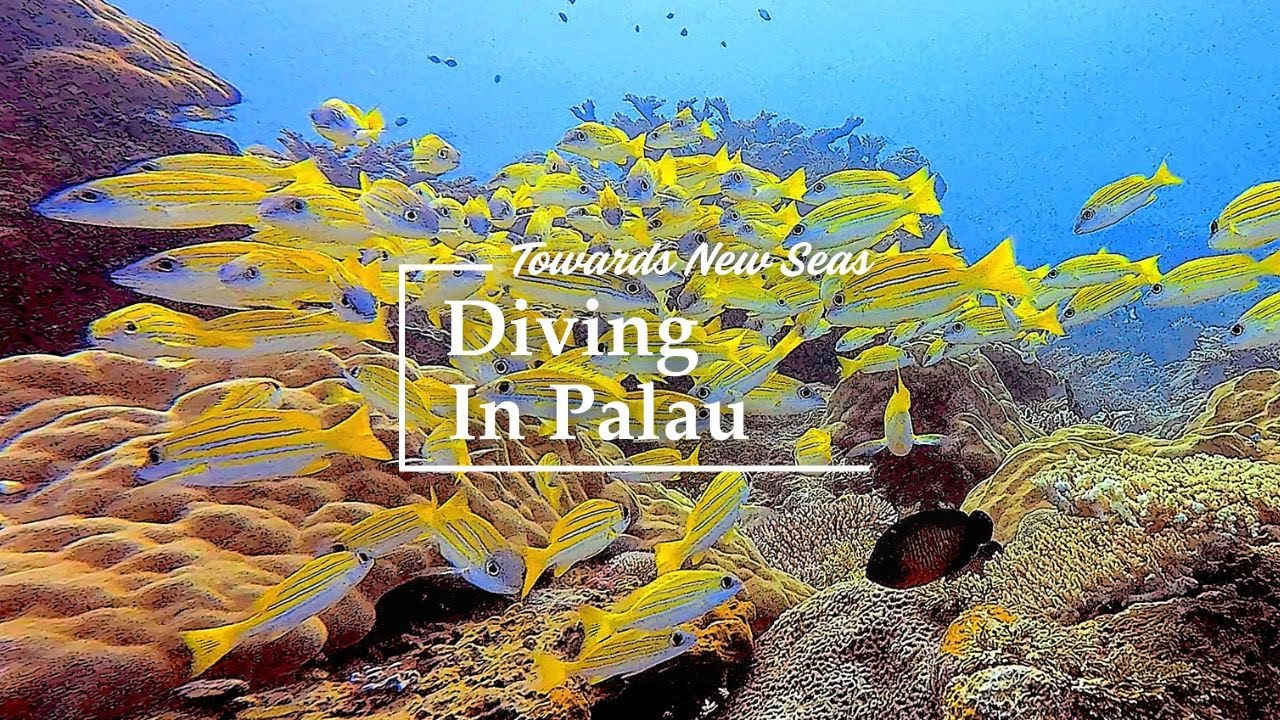
Palau diving sells on sharks, mantas, and the sheer density of reef life along the Rock Islands walls and channels. Both liveaboards and resorts access the same species — the difference is frequency, timing, and which sites get repeated.
Blue Corner
Grey reef sharks, whitetip reef sharks, schooling barracuda, jacks, Napoleon wrasse, and bumphead parrotfish. Blue Corner is Palau's signature dive and the site every visitor hits at least once. Both liveaboards and day boats reach it regularly. Liveaboards have the edge in timing — they can dive Blue Corner at slack tide at dawn, then return for a second dive when the current shifts. Day boats are constrained by the Koror departure schedule and may arrive after the optimal window.
German Channel
Palau's top manta site. Mantas are most common November through February, but singles appear year-round at the cleaning stations. Liveaboards can hit German Channel multiple times in a week and schedule dawn or dusk sessions when mantas are most active. Day boats visit it regularly but cannot repeat it as freely within a single trip.
Peleliu
This is where the liveaboard advantage is decisive. Peleliu Wall, Peleliu Express, and Peleliu Cut deliver the strongest currents and the biggest pelagic action in Palau — hammerheads, bull sharks, massive schools of snapper and jacks. Snapper and sailfin fish aggregate around Peleliu in March through June near full and new moons. Liveaboards can anchor near Peleliu for two or three days, timing dives to tidal windows and returning to the site repeatedly. Day boats from Koror treat Peleliu as an occasional full-day trip subject to weather cancellation; you are unlikely to get more than one Peleliu day in a standard resort week.
Ulong Channel
One of the world's great drift dives. Hard coral gardens, giant clams, grey reef sharks at the channel mouth, and grouper spawning aggregations April through July around full moons. Both liveaboards and day boats reach Ulong, but liveaboards can time the dive to the exact incoming tide window — the difference between a gentle drift and a fast ride. Day boats are limited by fixed departure times from Koror.
Night Dives
Liveaboards run night dives on sheltered reef sites without requiring a separate evening boat ride. Resort operators offer night dives but they involve an additional evening departure from Koror, which some divers find tiring after a two-dive morning.
The Comparison Matrix
| Criterion | Liveaboard | Resort |
|---|---|---|
| Dives per day | 3–4 (incl. night) | 2–3 boat dives |
| Total dives in 7 nights | 18–24 | 10–14 |
| Peleliu access | Multi-day, timed to tides | Occasional day trip, weather-dependent |
| Blue Corner timing | Dawn slack-tide dives, repeat visits | Fixed morning departure from Koror |
| German Channel repeats | Multiple visits when mantas run | Usually once per trip |
| Per-dive total cost (mid-range) | US$200–280 | US$155–220 |
| 7-night total (mid-range) | US$4,300–5,400 | US$1,565–2,170 (5 dive days) |
| Non-diver-friendly | Poor | Excellent |
| Seasickness factor | Minimal (sheltered Rock Islands) | Zero (land-based) |
| Manta probability (Nov–Feb) | Higher (repeat visits, dawn timing) | Good (single visits) |
| Booking flexibility | Fixed schedule once underway | Choose dives daily |
| Shark density at Peleliu | High (multi-day access) | Moderate (single day trip) |
| Night dives | Routine | Extra evening trip |
| Recommended certification | AOW + 30 dives | Open Water acceptable |
Sources: Aggressor Fleet (2026), Solitude Liveaboards (2025), Sam's Tours (2026), Fish 'n Fins (2025), Palau Dive Adventures (2025), PADI.
Decision Framework: Which Option Fits Which Diver
The palau liveaboard vs resort answer depends on three variables: how many dives you want, whether Peleliu matters, and who you are traveling with.
Choose a liveaboard if:
- You are AOW-certified with 30-plus logged dives and comfortable with current diving.
- Your priority is dive volume — you want 18-plus dives in a week, not 10.
- Peleliu's big-pelagic action and spawning aggregations are on your list.
- You want to hit Blue Corner at slack tide and German Channel at dawn.
- Your travel partner also dives, or you are traveling solo or with a dive group.
- Mid-range total budget is US$4,300 to 5,400 per diver.
Choose a resort if:
- You hold Open Water with limited recent diving and want a gentler reintroduction.
- You travel with a non-diving partner, children, or family.
- Flexibility matters — you want to skip a diving day for a Jellyfish Lake excursion or a Peleliu WWII land tour.
- You want to log 10 to 14 solid dives across 4 to 5 dive days at the core Rock Islands sites.
- Total budget is US$1,500 to 3,000 per diver (mid-range to luxury).
- This is your first Palau trip and you want to scout the sites before committing to a liveaboard on a return visit.
Choose a hybrid (resort + liveaboard, or split-stay) if:
- You have 10 to 14 nights and want both land-based exploration and maximum diving.
- Your budget is US$6,000-plus per diver.
- You want to dive Peleliu extensively but also spend time on land.
The Honest Caveats
Liveaboard downsides that matter. Cabins are compact — standard doubles on most Palau boats are functional, not spacious. Schedules are rigid, with first briefings typically at 06:30. The Rock Islands are sheltered, so seasickness is less of a concern than in the Maldives or Red Sea, but crossings to Peleliu can be rough in the wet season (May through October). Several operators require AOW certification and a logged-dive minimum at booking. The Aggressor Fleet publishes 2026 rates that are transparent, but many other operators quote through agents with variable markups — always request a line-item quote separating cruise fare, permits, fuel, Nitrox, and transfers.
Resort downsides that matter. The dive count is real: 10 to 14 dives in a week versus 18 to 24. The Koror commute means you arrive at sites after liveaboards have already dived. Peleliu access is weather-dependent and limited to occasional day trips. Per-dive cost at luxury resorts — Palau Pacific Resort at US$380 to 600 per night plus US$130 to 170 per dive day — can exceed liveaboard per-dive costs once you add accommodation.
For both options, the PPEF (US$100) is now included in international air tickets, replacing the old separate Rock Islands permit system. Confirm with your operator whether any additional site fees apply for specific excursions. Palau's water stays warm year-round at 27 to 30°C (81 to 86°F) — a 3 mm suit is sufficient for most divers.
Season Considerations
Palau is diveable year-round, but conditions vary meaningfully by season.
Dry season (October through May): Calm seas, best visibility (30 to 40+ meters), drier weather. December through March is the consensus peak window — mantas at German Channel peak November through February, and the dry season delivers the most reliable conditions at Blue Corner and Ulong Channel. This is high season for both resorts and liveaboards, with prices at their highest.
Wet season (June through September): More rainfall, choppier seas, slightly lower visibility. But plankton levels increase, which can attract mantas and large pelagics. Grouper spawning at Ulong Channel peaks April through July. Snapper aggregations at Peleliu fire around full and new moons in March through June. Fewer visitors and often better pricing on both resorts and liveaboards.
For most divers, December through March delivers the best combination of conditions and marine life. For budget-conscious divers or those targeting specific spawning events, the shoulder months of October, November, April, and May offer excellent value with only marginally less reliable conditions.
The MantaraDive Recommendation
After running the comparison across 2026 pricing, operator data, and site access, we recommend three concrete paths.
For most certified divers (AOW, 30+ logged dives), choose a liveaboard. Specifically, a 7-night Rock Islands itinerary that includes multiple Blue Corner and German Channel dives, at least two days at Peleliu, and timed Ulong Channel drift dives. Mid-range total: US$4,300 to 5,400. This is the highest-density Palau diving available and the only way to give Peleliu the time it deserves.
For first-time tropical divers, mixed-interest couples, or families, choose a resort with a reputable dive operator. Our shortlist: Palau Pacific Resort (luxury, strong house reef), Palau Plantation Resort (mid-range boutique), or Rose Garden Resort (budget-friendly). Pair with Sam's Tours, Fish 'n Fins, or Palau Dive Adventures for 4 to 5 days of 2-to-3-tank diving. Mid-range total: US$1,500 to 2,500. You will hit Blue Corner, German Channel, Blue Holes, and Ulong Channel — the core Rock Islands experience — with the flexibility to add land tours and rest days.
For 10-plus-night trips at a US$6,000-plus budget, do both. Three to four nights at a Koror resort exploring Jellyfish Lake and Peleliu's WWII sites, then a 7-night liveaboard for maximum diving. This gives your non-diving partner a real holiday while you get the full Palau liveaboard experience on the second half.
The single biggest mistake we see: divers booking a Koror resort and then expecting multiple Peleliu days and dawn-timed Blue Corner dives. The logistics do not support it. If Peleliu and dive volume are priorities, the liveaboard is the only honest answer.
If your shortlist also includes Indonesia, our analysis on Raja Ampat vs Komodo diving covers a similar cost-versus-experience comparison in the Coral Triangle — useful when divers are weighing a Pacific trip against an Indonesian one.
Talk to a Specialist
Choosing the right palau liveaboard vs resort path is operator-and-season specific — a Peleliu trip in rough conditions, a luxury liveaboard with the wrong cabin class, or a resort week when the mantas are running at German Channel all turn a dream Palau trip into an expensive compromise. MantaraDive advisors cross-reference real-time vessel availability, resort pricing, and seasonal probability data with your trip dates, certification level, and travel-style preferences. Send us your dates, budget, and priorities and we will return a custom shortlist of two to three liveaboards or resorts (or both) within 24 hours, with the trade-offs spelled out.
Sources and Methodology
This article draws on data cross-referenced from the following independent sources: Aggressor Fleet (2026 published rate table — Palau Aggressor II at US$3,835–4,035 pp for 7 nights, inclusions and exclusions), Solitude Liveaboards (Solitude One agent listings at US$3,500–4,200 pp for 7-night Palau departures), Sam's Tours (2026 group package pricing at US$3,195 pp for 8 nights + 5 days of 3-tank diving via Scuba San Diego), Fish 'n Fins (operator site descriptions and pricing), Palau Dive Adventures (private charter and boutique package pricing), PADI (Palau diving page, certification guidance), Bluewater Dive Travel (Palau resort and liveaboard package pricing), Palau Pacific Resort and Palau Royal Resort (published rack rates via Travelweekly and OTA data), Rose Garden Resort (budget pricing via Bluewater Dive Travel), Travelweekly (Palau hotel rate data), Kayak (meta-search Palau hotel pricing), Explorer Ventures (Palau liveaboard site descriptions and marine life), Divernet (Palau marine sanctuary and spawning aggregation data), Scuba Diving magazine (Blue Corner feature, German Channel manta data), and Solitude World (Ulong Channel grouper spawning and liveaboard-vs-resort comparison). All prices are USD and reflect rates published in early 2026; actual costs vary by operator, season, cabin class, and booking lead time. The PPEF of US$100 is included in international air tickets per current Palau government policy. Marine life probabilities reflect historical patterns and operator-reported sighting rates, not guarantees.
Related MantaraDive planning links
- Blue Holes Palau: Complete Guide for Divers (2026)
- Maldives Liveaboard vs Resort: Which Actually Gives You Better Diving in 2026?
- Raja Ampat vs Komodo Diving: Which Indonesian Liveaboard Earns Your Money in 2026?
- Red Sea Liveaboard Itinerary: North vs South for European Divers
- Komodo Liveaboard Prices: What It Actually Costs (and What's Worth It)
- Solo Diving in the Philippines: Which Resorts and Liveaboards Welcome Solo Travelers?
- Great Barrier Reef Liveaboard: What You Actually Get in 2026
- 5 Essential Beginner Tips for Your First Tropical Dive Trip