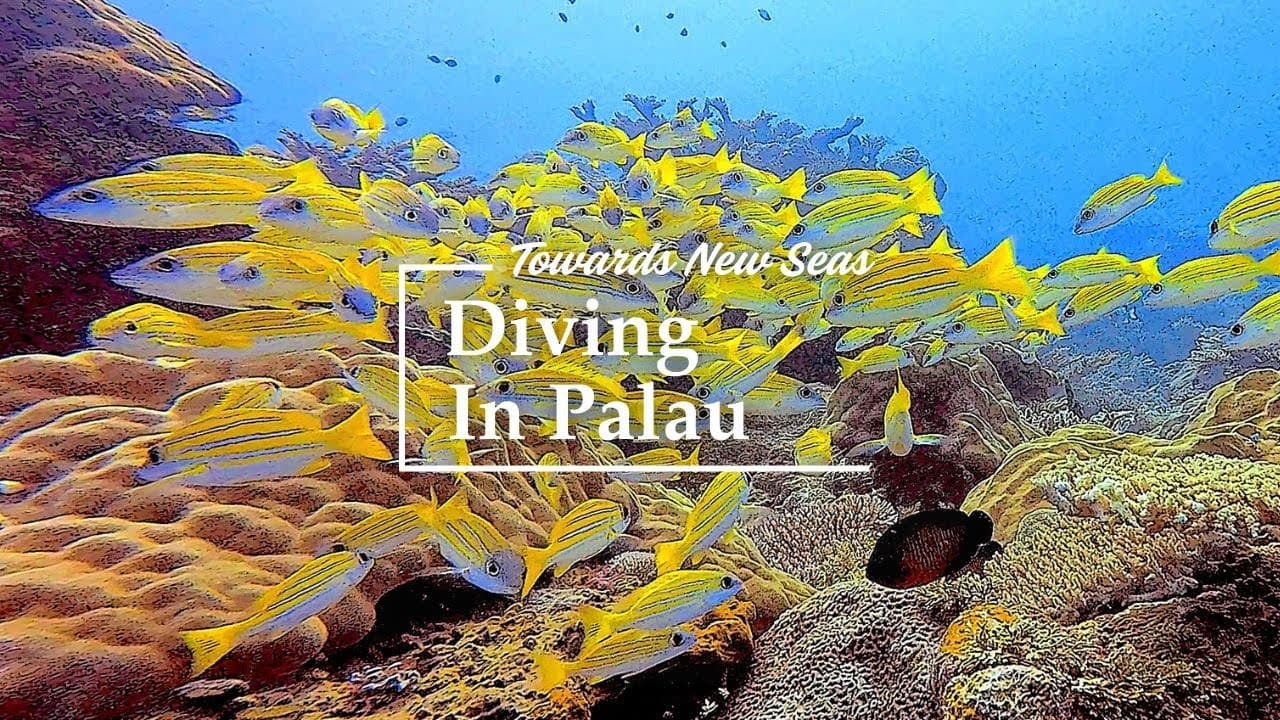
Blue Holes is one of those dive sites that looks impossible until you drop through it. Four openings in the shallow reef top plunge into a massive light-filled cavern, and the far wall opens onto an oceanic drop-off that feeds directly into Blue Corner — arguably the most famous reef dive in the Pacific. The combination makes Blue Holes not just a standalone spectacle but the entry point to one of the densest concentrations of marine life any recreational diver can access.
This guide covers what Blue Holes actually is, how to dive it safely, what you will see, how it connects to Blue Corner and the rest of the Ngemelis reef system, and what a Palau dive trip around these sites realistically costs in 2026.
What Blue Holes Actually Is
Blue Holes sits on the Ngemelis reef complex, roughly 30 miles southwest of Koror — about 50 to 70 minutes by speedboat depending on sea conditions. The reef top is shallow, around one to two meters, with four natural openings that drop into a cavern inside the reef structure.
The cavern itself is the main event. It is large, well-lit from above, and has two exits on the outer wall: a smaller window at around 15 to 17 meters and a much larger opening at 26 to 42 meters that faces open ocean. The floor of the main chamber typically sits at 30 to 40 meters, though most operators keep the dive around 25 to 30 meters to manage no-decompression limits and gas consumption.
On the north side of the cavern there is a restricted overhead extension called Temple of Doom. It is a genuine cave system with fatalities on record. Do not enter it without full cave certification, proper equipment, and a qualified cave guide. The main Blue Holes cavern, by contrast, is a large overhead environment with abundant ambient light and obvious exits — not a cave dive in the technical sense.
A typical Blue Holes profile starts on the shallow reef, descends through one of the openings, spends time exploring the cavern at 20 to 30 meters, exits through the large west-facing opening, then multi-levels along the wall. Many operators extend the dive as a drift toward Blue Corner, which is roughly a seven to ten minute swim from the Blue Holes exit. The two sites are often combined into a single long dive, making for one of the most memorable profiles in Pacific diving.
What You Will See
Blue Holes is famous for atmosphere and light rather than raw animal density, but the cavern and surrounding wall still deliver substantial marine life.
Inside the cavern, the walls carry soft corals, Tubastraea (orange cup corals), whip corals, and sea fans. The sandy bottom hosts nudibranchs and small invertebrates. Guides will often point out electric clams and other cryptic creatures tucked into cracks. Schooling fish — fusiliers, anthias, pyramid butterflyfish — silhouetted against the blue light from the openings make for some of the best wide-angle photography opportunities in Palau.
On the outer wall and along the drift to Blue Corner, the marine spectacle ramps up considerably. Reef fish appear in large numbers: surgeons, snappers, jacks, triggerfish. Turtles are common along the wall. Occasional leopard or zebra sharks rest on ledges. Reef sharks cruise the drop-off.
If the dive continues to Blue Corner, you enter one of the most pelagic-rich shallow dives on earth. Grey reef sharks school in dense formations. Barracuda, jacks, big snappers, and occasionally wahoo or tuna move through the blue. Napoleon wrasse may approach divers closely. The biomass at Blue Corner is staggering — a direct result of Palau's marine protection policies and the strong currents that funnel nutrients through the reef system.
Water Conditions
Palau's water stays warm year-round. Expect 27 to 29°C (81 to 84°F). Most divers are comfortable in a 3 mm full suit; some prefer 5 mm on repetitive deep dives or if prone to getting cold.
Visibility at Blue Holes and the surrounding Ngemelis sites typically runs 20 to 40 meters (60 to 130+ feet). The cavern itself has excellent visibility when divers maintain good buoyancy — kicking up the sandy bottom will cloud the chamber quickly.
Currents vary significantly with the tide. Inside the cavern, conditions are usually mild with occasional surge near the large opening. Along the wall toward Blue Corner, currents range from medium to strong and can shift direction. The general pattern flows south to north on incoming tide and north to south on outgoing, but local operators time dives around tidal windows for good reason. Very low tide combined with swell can make the reef-top entries impractical, in which case operators may start the dive along the wall instead.
Difficulty and Certification
Blue Holes is not a tight cave. It is a large, well-lit cavern with clear exits and ambient light throughout. That said, it involves an overhead environment and depth that require reasonable competence.
Most operators classify Blue Holes as suitable for intermediate divers — those with good buoyancy control, comfort in overhead environments, and the ability to manage descents and ascents without a fixed reference line. Advanced Open Water certification or equivalent is the typical recommendation. Twenty or more logged dives and comfort at 25 to 30 meters make the dive significantly more enjoyable.
When Blue Holes is combined with Blue Corner in a single drift, the overall profile becomes more demanding. Blue Corner involves strong currents, reef-hook use, and possible rapid current shifts including down-currents. Many operators recommend at least 50 logged dives and some current experience before diving Blue Corner. Nitrox certification is useful in Palau for extending no-decompression limits on repetitive deep-ish dives across a multi-day trip.
Best Time to Dive
Palau is diveable year-round, but conditions are generally best during the dry season from October through May. December through March is often highlighted as the peak period for calm seas and excellent visibility. June through September is windier with rougher crossings to the Ngemelis reef, though diving continues throughout.
Blue Holes itself is less dependent on specific lunar or seasonal events than sites like Ulong Channel, where snapper spawns are tied to moon phases. The cavern's appeal is topography and light, which are consistent year-round. Current strength along the wall and at Blue Corner does vary with tidal cycles, and operators schedule accordingly.
For a first visit to Palau, five to six diving days gives you the best odds of hitting Blue Holes at least twice in different conditions, repeating Blue Corner, and reaching other Rock Islands highlights like German Channel and Ulong Channel.
Getting to Palau and to Blue Holes
Flights arrive at Roman Tmetuchl International Airport (ROR) near Koror. Regional carriers serve Palau from Guam, Manila, Taipei, Seoul, and other Pacific and Asian hubs, though schedules shift year to year. Check current routes when planning 2026 travel.
Most divers stay in Koror and either join day boats from local dive operators or board a liveaboard departing from Koror. Travel time to Blue Holes by fast boat is 50 to 70 minutes each way. A typical dive day includes two or three dives at Ngemelis-area sites — Blue Holes, Blue Corner, German Channel, or other walls and channels in the complex.
Palau Permits and Fees
Two separate fee systems apply to diving Blue Holes and the Rock Islands.
The Pristine Paradise Environmental Fee (PPEF) is US$100 and is included automatically in most international air tickets into Palau. It funds the Palau National Marine Sanctuary, which protects roughly 80 percent of Palau's exclusive economic zone from commercial fishing.
Separately, Koror State requires a Rock Islands Permit for diving and snorkelling in state waters, including Blue Holes and Blue Corner. The permit costs approximately US$50 for five days. A combined Rock Islands plus Jellyfish Lake permit runs around US$100. These permits are typically arranged through your dive operator. Other states like Peleliu may charge their own dive permits (around US$30). Fees can be adjusted by local governments, so confirm current amounts when booking.
Operators and Pricing
Liveaboards
Liveaboards are the most efficient way to dive Blue Holes multiple times in a week. Most run seven-night Rock Islands itineraries with 18 to 22 dives, typically including multiple visits to Blue Holes and Blue Corner when conditions allow.
Solitude One is well-reviewed for comfort and service, with itineraries covering German Channel, Blue Corner, Blue Holes, Ulong, and Ngemelis. Seven-night pricing runs roughly US$2,600 to 3,600 per person depending on cabin and season.
Rock Islands Aggressor is dive-focused, often running four to five dives per day when conditions allow. Seven nights costs approximately US$2,700 to 4,000 per person.
Ocean Hunter operates smaller boats with more intimate groups. Pricing ranges from US$2,800 to 4,200 for seven to ten nights depending on the vessel.
Premium boats like Black Pearl and Palau Siren offer more spacious cabins and higher service levels at US$3,200 to 4,500 or more for seven nights.
Liveaboard prices typically exclude flights, the PPEF, Koror State permits, rental gear, nitrox, and crew gratuities.
Land-Based Day Boats
Day-boat diving from Koror gives more flexibility and works well for divers who want to mix diving with land exploration or travel with non-diving partners.
Sam's Tours is one of Palau's best-known operators, running regular Rock Islands trips including Blue Holes and Blue Corner. Two-tank day-boat dives cost around US$150 to 180 per day excluding permits and rental gear. They also offer a Blue Corner distinctive specialty course.
Fish 'n Fins has operated in Palau for decades and runs full-day two- and three-tank trips to the Rock Islands. Pricing is roughly US$150 to 170 for a two-tank day. They are known for solid guiding and tech-friendly operations.
Palau Dive Adventures takes a boutique approach with limited diver numbers and multi-day packages averaging US$150 to 200 per dive day.
Other operators including Splash and Neco Marine run regular Rock Islands trips at similar pricing, roughly US$140 to 180 per day for two-tank dives.
For land-based trips, budget US$60 to 150 per night for mid-range Koror accommodation, or US$280 to 450+ for luxury resorts like Palau Pacific Resort. A five-day diving trip with mid-range accommodation and diving runs roughly US$1,500 to 2,500 total per diver before international flights.
What to Budget
| Trip style | Realistic per-person budget | What you get |
|---|---|---|
| Land-based, 4-5 dive days, mid-range hotel | US$1,800-2,800 | 10-12 dives, flexibility, hotel comfort |
| Land-based, 6-7 dive days, mid-range hotel | US$2,500-3,800 | 14-18 dives, repeat Blue Holes and Corner |
| Liveaboard, 7 nights | US$2,600-4,500 | 18-22+ dives, maximum efficiency, boat life |
| Luxury liveaboard or resort, 7+ nights | US$4,500-7,000+ | Premium cabins, top service, extensive route |
All budgets exclude long-haul international flights, the US$100 PPEF, Koror State permits, rental gear, nitrox, tips, and personal spending.
Blue Holes vs Blue Corner: Understanding the Pair
Blue Holes and Blue Corner are not competing sites. They are complementary halves of a single reef system and are best experienced together.
Blue Holes is about the cavern — light beams, geological formations, the surreal experience of dropping through a reef into a cathedral-like space. It is a wide-angle photography site and a topography dive. Marine life is present but secondary to the environment itself.
Blue Corner is about the reef edge and what gathers there. Strong currents push nutrient-rich water past a triangular plateau, attracting grey reef sharks, barracuda, jacks, Napoleon wrasse, and dense schools of reef fish. Divers hook into bare rock on the plateau and watch the parade. It is a current dive, a pelagic dive, and one of the most visually intense shallow reef dives anywhere.
When combined into a single drift — Blue Holes cavern, exit onto the wall, multi-level along the reef, arrive at Blue Corner for the hook-in and the show — the dive becomes one of the defining experiences of Pacific diving. Most experienced Palau divers consider this combination the single best dive day available in the Rock Islands.
Other Rock Islands Sites Worth Your Time
Blue Holes and Blue Corner anchor the Ngemelis area, but the Rock Islands offer several other dives that deserve space in your itinerary.
German Channel is a short boat ride from Blue Corner — a man-made channel through the reef with a famous manta ray cleaning station. It is often combined in the same dive day as Blue Holes and Blue Corner.
Ngemelis Wall (also called Big Drop-off) is a sheer vertical wall starting at one meter and plunging to around 900 meters. The coral coverage and reef life along the wall make it one of the best wall dives in Micronesia.
Ulong Channel is current-dependent and known for snapper spawns timed to lunar cycles. It requires comfort in strong current and is typically scheduled for experienced groups.
Jellyfish Lake is a snorkelling experience rather than a dive — a marine lake filled with golden jellyfish that have lost their sting due to isolation. Access requires the combined Rock Islands and Jellyfish Lake permit.
Practical Tips
Bring a reef hook. Blue Corner requires one, and you may want one even on the Blue Holes wall drift. Most operators provide them, but confirm when booking.
Deploy a DSMB on ascent. Blue Holes is a busy site with multiple boats. A delayed surface marker buoy signals your position to tenders and protects you from boat traffic during safety stops.
Stay off the cavern floor. Kicking up sand in the main chamber destroys visibility for your group and everyone behind you. Maintain neutral buoyancy and stay slightly above the bottom.
Agree on a maximum depth. The large opening at Blue Holes exits at 26 to 42 meters. It is easy to drift deeper than intended. Set a depth limit with your guide — commonly 30 to 32 meters — and monitor your no-deco time.
Use Nitrox if certified. Palau's repetitive multi-dive days benefit from extended no-deco limits. Confirm your mix and maximum operating depth before each dive, especially for the deeper cavern profiles.
Do not enter Temple of Doom. The restricted overhead extension on the north side of the cavern is a true cave with fatalities. It requires full cave certification, specialized equipment, and a qualified cave guide. The main Blue Holes cavern is the dive.
Carry a signaling device. An audible whistle or surface marker helps with boat pickup, especially in choppy conditions or current along the wall.
Plan no-fly time. Respect 18 to 24 hours of no-fly time after your last dive. If your international flight departs early, schedule your last dive day accordingly and budget an extra hotel night in Koror if needed.
MantaraDive Recommendation
For most divers, the best Palau trip is five to seven diving days with at least two visits to Blue Holes, two to Blue Corner, and one each at German Channel, Ngemelis Wall, and Ulong Channel if conditions and experience allow. Land-based diving from Koror gives flexibility and costs less; liveaboards give more dives and shorter boat rides to the Rock Islands.
Budget US$2,500 to 4,000 per diver for a strong land-based trip including mid-range accommodation and five to six days of diving, or US$2,800 to 4,500 for a seven-night liveaboard. Add international flights, the US$100 PPEF, Koror State permits, rental gear, nitrox, tips, and personal spending for your total.
Blue Holes is worth the trip on its own. Combined with Blue Corner as a single drift, it is one of the best dives available anywhere in the world. If you are planning a Pacific diving trip in 2026, Palau's Rock Islands — and Blue Holes specifically — should be near the top of the list.
Sources
Research for this article drew on current operator information and site descriptions from Fish 'n Fins' Blue Holes site page, Palau Dive Adventures' Blue Holes guide, Master Liveaboards' best dive sites in Palau, PADI's Palau diving page, Splash Palau's Blue Holes dive point page, Scuba Diving magazine's Blue Corner feature, SeaCrush's Palau diving guide, and Pristine Paradise Palau's traveller information. Permit and fee details were cross-referenced with operator pre-trip documentation and the Koror State permit structure. Pricing reflects 2025–2026 operator listings and may vary by season, cabin, and exchange rate.
Related MantaraDive planning links
- Komodo Liveaboard Prices: What It Actually Costs (and What's Worth It)
- Raja Ampat vs Komodo Diving: Which Indonesian Liveaboard Earns Your Money in 2026?
- Is Raja Ampat Worth It? An Honest Cost-Benefit Breakdown for 2026
- Maldives Diving Under $3,000: A Realistic Budget Guide for 2026
- Solo Diving in the Philippines: Which Resorts and Liveaboards Welcome Solo Travelers?
- 5 Essential Beginner Tips for Your First Tropical Dive Trip
- Best Dive Sites in Bali: 3 That Matter for a 7-Day Trip
- Cebu vs Bohol Diving vs Palawan: Which Philippine Island for Your First Dive Trip?