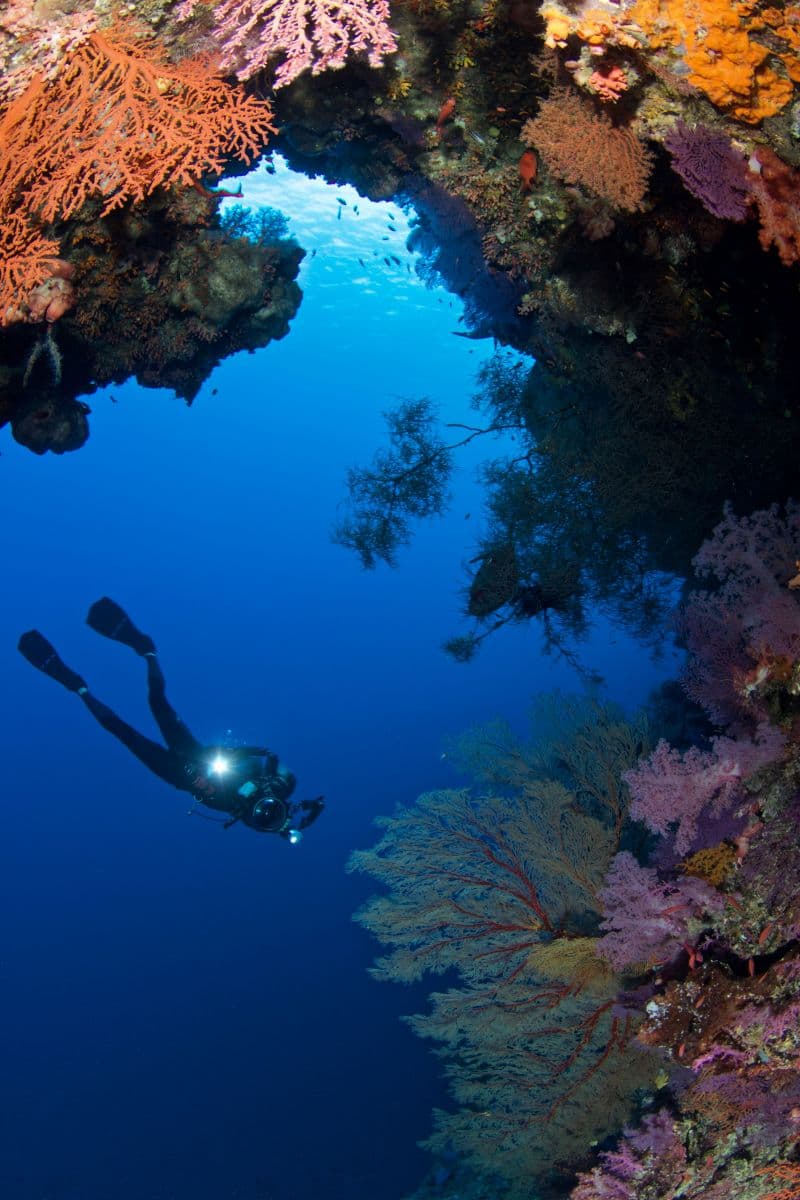
The envelope sits on the cabin counter on the last night of the trip. You have had seven incredible days of diving in Raja Ampat — mantas at Manta Sandy, schooling barracuda at Blue Magic, a night dive that delivered three bobtail squid — and now the question you have been quietly dreading finally needs an answer. How much do you tip?
Tipping on liveaboards in Southeast Asia is not like tipping at a resort restaurant where 10 to 15 percent is a safe default. Liveaboard crews work around the clock for days at a stretch, the crew-to-guest ratio is often two-to-one or higher, and the economic reality in Indonesia and the Philippines means your tip is not a polite gesture — it is a meaningful part of how these people earn a living. Getting it right matters.
This guide breaks down exactly how much to tip on liveaboards in Indonesia and the Philippines, who receives the money, how different operators handle collection, and the practical details of currency and etiquette that no one tells you before you board.
Why Tipping Matters More on a Liveaboard
On a resort dive trip you interact with a handful of staff — your instructor, maybe a boat captain, a receptionist. On a liveaboard you are living with a crew of 15 to 30 people for a week or more. The captain navigates overnight passages so you wake up at the next dive site. The chef prepares three full meals and snacks every day, often in a galley smaller than your bathroom at home. Deck hands inflate and stow your BCD after every dive. The compressor team fills tanks around the clock so you never wait. Engineers keep the engines, generators, water makers, and air conditioning running without you ever noticing.
In Indonesia, base wages for marine crew are often between $150 and $300 per month. In the Philippines the range is similar, sometimes lower for deck hands and kitchen staff. A single tip from one guest can represent a significant fraction of a crew member's monthly income. When divers skip the tip or leave a token amount, it is not just rude — it has a real financial impact on people who just spent a week ensuring your safety and comfort.
We are not arguing for guilt-driven generosity. We are arguing for informed, proportionate tipping that reflects the service you actually received.
The Standard: How Much to Tip
The most widely cited guideline across liveaboard operators, dive forums, and industry surveys is 10 to 15 percent of the base trip price, or $15 to $25 per guest per day. These two benchmarks usually arrive at the same number for trips in the $2,000 to $4,000 range.
A 2024 survey by Undercurrent, the long-running dive industry publication, found that experienced liveaboard divers recommend approximately $19 per person per day, with an average of around $82 per crew member across a typical trip. Girls that Scuba's community poll showed 44 percent of respondents tip between 6 and 10 percent of the trip cost, with another 30 percent tipping 11 to 15 percent.
Here is how the math works in practice:
| Trip Price (per person) | 10% Tip | 15% Tip | Per Day (7-night trip) |
|---|---|---|---|
| $2,000 | $200 | $300 | $29 – $43 |
| $3,000 | $300 | $450 | $43 – $64 |
| $4,000 | $400 | $600 | $57 – $86 |
| $5,000 | $500 | $750 | $71 – $107 |
For budget liveaboards — and there are excellent ones in Indonesia starting under $2,000 for a five-night Komodo trip — the percentage guideline can produce a number that feels too low. In that case, switch to the per-day floor: $15 per guest per day is the minimum we would recommend for any liveaboard in Indonesia or the Philippines, regardless of trip price.
Indonesia vs. the Philippines
The core tipping math is the same for both countries. The difference lies in how operators collect and distribute tips, and in local customs around amounts.
Indonesia — particularly Raja Ampat and Komodo — has a strong tradition of the communal tip box. Operators like Neptune Liveaboards and many others pool all tips and distribute them among the full crew at the end of the trip. The standard recommendation from Indonesian operators is $15 to $25 per guest per day, with the amount pooled and split evenly or weighted by role and seniority. Some operators suggest a minimum of $5 per guest per day for shorter or budget trips, but this is genuinely the floor, not the target.
The Philippines — Tubbataha, Coron, Anilao, and the Visayas — tends toward a slightly more direct model. Some operators collect a communal pot; others provide envelopes for individual tips to dive guides and boat crew separately. The common guideline from Filipino dive professionals is 10 percent of the trip cost to the dive guides and 10 percent to the boat crew, though many operators combine these into a single pool. The Philippines also has a stronger tradition of tipping in Philippine pesos, which we cover below.
Who Gets the Tip
A liveaboard crew is a team, and the tip should reflect that. Here is who is working for you behind the scenes:
Captain and bridge crew — Responsible for navigation, anchoring, and overnight passages. You may barely see them, but they are the reason you wake up at the right dive site every morning.
Dive guides and divemasters — The crew members you interact with the most. They plan dive briefings, lead underwater excursions, manage groups of varying skill levels, and handle emergencies if they arise. In most tipping pools they receive a slightly larger share.
Chef and kitchen staff — Three full meals a day plus snacks, often catering to a dozen different dietary preferences, in a compact galley with limited fresh provisions after day three.
Engineers and compressor operators — Keeping the vessel operational and your tanks full. Compressor duty often runs through the night.
Deck hands — Launching and recovering tenders, helping guests with gear, maintaining the dive deck, cleaning equipment. The most physically demanding job on board.
Housekeeping — Cabin cleaning, laundry on longer trips, common area maintenance.
The key principle is that tips go to the full crew, not just the divemaster who led your dive. Operators that use a communal tip box enforce this automatically. If you are tipping directly, make sure you include the less visible crew members — a private thank-you to the chef or engineer goes a long way, but so does slipping something into the communal pot.
Tip Box vs. Handshake: How Operators Collect
Three models dominate in Indonesia and the Philippines:
The Communal Tip Box
The most common approach. A sealed box or envelope sits in a common area, usually introduced on the first or second day. Guests deposit their tip at the end of the trip (or throughout). The cruise director or operator distributes the pooled amount among the crew.
This is the model we recommend for most divers because it removes the guesswork and ensures equitable distribution. It also means you do not need to track which crew member did what — the system handles it.
The Envelope System
Some operators, particularly in the Philippines, provide individual envelopes for different crew groups: one for dive guides, one for boat crew, one for the kitchen. This gives you more control but also more responsibility. If you use this system, distribute proportionally — the dive guide who was visibly excellent should not get five times what the compressor operator gets just because you never saw the compressor operator.
Direct Tipping
Less common on organized liveaboards but occasionally encountered on smaller, more informal boats. If you are tipping directly, prepare small denominations in advance and give tips on the last evening or morning of disembarkation. Do not hand a $100 bill to one person and nothing to others — it creates visible inequality that is uncomfortable for everyone.
Currency: What to Bring
This is one of the most practical questions and one of the least discussed before the trip.
US dollars are universally accepted on liveaboards in both Indonesia and the Philippines. Crisp, newer bills are preferred — some operators in remote areas cannot deposit bills with stamps, tears, or heavy creasing. Bring a mix of $20s and $10s so you can round to the amount you intend without needing change.
Indonesian rupiah is perfectly acceptable in Indonesia and appreciated by crew members who live locally. Larger denominations (IDR 100,000 notes, roughly $6 each) are easier to handle than stacks of small bills.
Philippine pesos are the expected currency in the Philippines if you are tipping individually. PHP 500 and PHP 1,000 notes are the practical denominations.
Euros and other currencies are sometimes accepted but often awkward for crew to exchange, especially in remote areas. Stick to USD or local currency.
Credit cards and digital transfers are not a tipping mechanism on any liveaboard we are aware of in Indonesia or the Philippines. Tips are cash. Period.
Coins are universally impractical. No crew member on a liveaboard wants to deal with coins. Bring paper bills.
What Is Usually Included — and What Is Not
Understanding what your trip price covers helps calibrate your tip.
Included in the trip price:
- All meals and non-alcoholic beverages
- Tanks, weights, and belt
- Guided dives (typically 3 to 4 per day)
- Towels and cabin linens
- Port and park fees (usually, but check)
Not included:
- Alcoholic beverages (commonly available at a reasonable markup)
- Nitrox (often $10 to $15 per fill or $100 to $200 for unlimited)
- Gear rental (BCD, regulator, wetsuit — $15 to $30 per day per item)
- Marine park and port fees (sometimes separate, $50 to $200)
- Crew gratuity — this is explicitly not included in the trip price on virtually every liveaboard in the region
The gratuity line item being separate is important. It means the operator has made a deliberate choice to let you decide the amount rather than building it into the price. Respect that intention by tipping appropriately.
Common Mistakes
We see these regularly in dive forums and post-trip reviews:
Tipping based on dive conditions, not service. If the visibility was poor or the current was strong, that is not the crew's fault. Tip based on how well the crew managed the logistics, safety, food, and comfort — not on whether the mantas showed up.
Forgetting the hidden crew. The divemaster who took you on a spectacular night dive deserves recognition. So does the person who filled your tank at 3 AM so it was ready for your 6 AM dawn dive. Tip the whole crew.
Leaving it until the airport. Tip on the boat, at the end of the last dive day. Do not wait until you are at the airport lounge wondering if you should have left more. By then it is too late.
Converting to "per dive" math. Some divers try to calculate a per-dive tip ($2 to $3 per dive). This usually produces a number far below the 10-to-15-percent guideline and undervalues the round-the-clock service that is not limited to the time you spend underwater.
Assuming the crew is paid fairly without tips. In many cases, especially on budget and mid-range liveaboards, tips constitute 30 to 50 percent of a crew member's total compensation. The trip price you paid covers the boat, fuel, food, and insurance — not generous wages for the crew.
Indonesia and the Philippines Compared
| Factor | Indonesia (Raja Ampat, Komodo) | Philippines (Tubbataha, Visayas) |
|---|---|---|
| Typical tip range | $15 – $25/guest/day | $15 – $25/guest/day |
| Common collection | Communal tip box | Mixed: box or envelopes |
| Preferred currency | USD or IDR | USD or PHP |
| Crew size (mid-range boat) | 12 – 20 | 10 – 18 |
| Trip length | 5 – 12 nights | 3 – 7 nights |
| Tip as % of crew income | 30 – 50% | 25 – 45% |
| Season | Oct – Apr (Raja Ampat) / Mar – Oct (Komodo) | Nov – Jun (Tubbataha) / year-round (Visayas) |
The numbers are similar because the economic realities are similar. Indonesia tends toward slightly larger crews and longer trips; the Philippines has more variation in trip length and operator style.
Our Recommendation
For a standard 7-night liveaboard in Indonesia or the Philippines:
- $20 per guest per day is our recommended baseline. This translates to $140 per person for a week, which falls squarely in the 10-to-15-percent range for a $1,000 to $1,400 trip.
- Tip up, not down. If the crew was exceptional — and on a good liveaboard they often are — $25 per day is entirely appropriate.
- Use the communal tip box if one is provided. It is the fairest system.
- Bring crisp US dollar bills in $20 and $10 denominations as your default, supplemented by local currency if you have it.
- Tip on the last evening of the trip, before you disembark the next morning.
If you are on a luxury liveaboard where the trip price exceeds $5,000 per person, the percentage calculation becomes more important than the per-day floor. Fifteen percent of $5,000 is $750, or roughly $107 per day — a generous but appropriate amount for a crew that has been providing top-tier service for a week.
If you are on a budget liveaboard under $1,500, the per-day floor ($15 minimum, $20 preferred) protects the crew from receiving below-market tips simply because the trip price was low.
A Note on Regional Context
Both Indonesia and the Philippines are developing economies where tourism jobs are valued but wages are modest by international standards. The liveaboard diving industry provides some of the better-paying employment available in coastal communities — a good divemaster in Raja Ampat or Tubbataha can earn two to three times the local average — but the economics only work when tips supplement the base wage.
This is not charity. It is a recognition that the crew-to-service ratio on a liveaboard is extraordinarily high, and the trip price alone does not fully compensate the people who make the experience possible. A well-tipped crew is a crew that stays, and a crew that stays is one that gets better at their jobs, remembers your preferences, and keeps the boat in the condition you expect.
Plan your tipping budget before you board. Factor it into the total trip cost alongside flights, park fees, and gear rental. That way the envelope on the last night is not an awkward surprise — it is a planned thank-you to the people who made your trip worth taking.
Sources
- Neptune Liveaboards, "Tips & Gratuities," neptuneliveaboards.com — standard Indonesia liveaboard tipping guidance: $15–25/guest/day, pooled among full crew.
- Komodo Dive Center, "Liveaboard Tipping Guide," komododivecenter.com — Indonesia tip box norms, $5/guest/day minimum.
- Diverout, "Tipping Etiquette for Divers in Southeast Asia," diverout.com — SE Asia general: 10% of cruise price, $5–10/tank day.
- Girls that Scuba, "How to Tip on a Liveaboard," girlsthatscuba.com — community survey data: 44% tip 6–10% of trip cost.
- Undercurrent, "Liveaboard Tipping Survey," uwireport.com — $19/day per person recommended, ~$82 per crew member average.
- r/scuba community discussions on liveaboard tipping in Indonesia and the Philippines — Raja Ampat: 10% of base trip; Philippines: 10% to guides + 10% to crew.
- Facebook r/scuba threads on Philippines dive tipping norms.
Related MantaraDive Planning Links
- Philippines Diving: Solo Resorts & Liveaboards — plan your Philippines liveaboard trip.
- Komodo Liveaboard Prices (2026) — budget for your Indonesia liveaboard.
- Raja Ampat vs. Komodo: Which Liveaboard Region Is Right for You? — choose your Indonesian diving destination.