
The Maldives sells two megafauna headlines harder than any other dive destination: feeding aggregations of 100-plus reef manta rays inside a single bay, and a year-round whale shark population catalogued at over 500 individuals. Most dive travelers assume those two events sit on the same calendar. They do not. The peak manta window and the most reliable whale shark window run on different monsoons, on opposite sides of different atolls, and overlap only briefly. Booking a Maldives trip without that disambiguation is how divers end up at the wrong atoll in the wrong month, looking at fine reef but no megafauna.
The single fact behind the best time to dive Maldives manta whale shark question is the two-monsoon system. Iruvai, the northeast monsoon, runs December to April: calm seas, high visibility, dry-season whale sharks on the western side of South Ari. Hulhangu, the southwest monsoon, runs May to November and pushes plankton-rich water into the eastern channels — fueling Hanifaru Bay's manta aggregations and the wet-season whale shark window on the east. Pick the wrong half of that calendar and the trip's headline animal will not be where you are.
This article answers the question every Maldives-bound diver eventually has to settle: when to go for mantas, when to go for whale sharks, and which weeks actually deliver both.
Why This Article Matters
We compiled month-by-month sighting data, monsoon current direction, and route patterns from the Manta Trust / Maldivian Manta Ray Project, the Maldives Whale Shark Research Programme (MWSRP), Save Our Seas Foundation, ZuBlu, LiveAboard.com, Master Liveaboards, Maldives Magazine, and Manta Trust-affiliated resort programs at Four Seasons Landaa Giraavaru and Anantara Kihavah. The output is a decision framework, not a brochure: explicit "if you want X, go in month Y to atoll Z" guidance, with the trade-offs spelled out for divers whose dates do not match the ideal window.
The Maldives Monsoon System: The One Thing You Must Understand
The Maldivian dive calendar runs on two monsoons, named in Dhivehi and tracked by every operator on the archipelago.
Iruvai (northeast monsoon) runs December through April. Calm seas, light winds, low rainfall, eastern-side visibility 20 to 30 meters and sometimes higher (Maldives Nomad, 2025; ZuBlu, 2025). Currents flow into the atolls through eastern channels and out through western channels, so the water on the eastern side is open-ocean blue. Whale sharks on the western side of South Ari are most reliable here.
Hulhangu (southwest monsoon) runs May through November. More rain, more wind, plankton-rich water pushed by the prevailing southwesterly current. Currents reverse: water now flows in through western channels and out through eastern channels, dumping zooplankton on the eastern flanks. That nutrient pulse triggers the feeding events at Hanifaru Bay (Baa), Lankan (North Male), and the eastern side of South Ari (Maldives Insider, 2024; Master Liveaboards, 2025). Eastern-side visibility drops to 15 to 20 meters during plankton blooms; the western side holds cleaner at 20 to 25 meters (Maldivers, 2024).
The hard rule: megafauna goes where the plankton goes. Plankton follows the down-current channels. Monsoon flips the channel direction twice a year. The right side of the right atoll therefore changes by season.
Reef Manta Seasonal Map
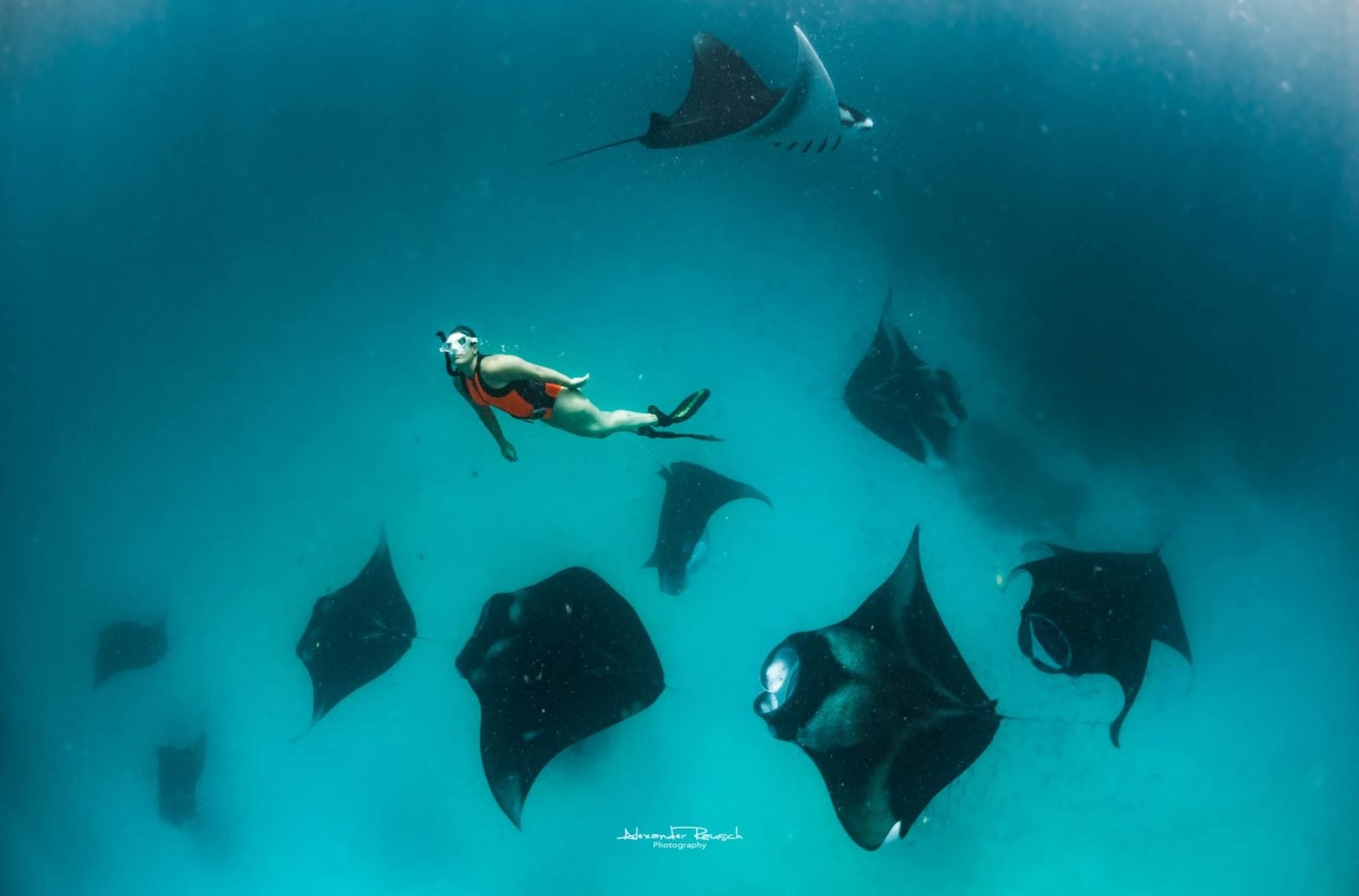
The Maldives hosts more than 6,000 individually identified reef mantas — the largest documented population on Earth — recorded across more than 80,000 sightings by the Maldivian Manta Ray Project, run by the Manta Trust (Manta Trust, 2024). Four sites concentrate the bulk of the encounters.
Hanifaru Bay (Baa Atoll) is the headline. Season runs May through November, peaking June through October around full and new moon weeks. The Manta Trust has documented 100-plus-manta aggregations on 65 separate occasions; five exceeded 200 individuals in a single survey day, with a recorded maximum of 245 (Save Our Seas Foundation; Important Shark and Ray Areas factsheet, 2024). Over 15 years the project has photo-identified more than 1,800 unique mantas at this single bay. The unique "cyclone feeding" behavior — a column of up to 150 mantas spiraling a dense plankton patch for up to 30 minutes — has only been documented here. Hanifaru is snorkel-only (scuba is banned inside the bay), permits are capped, encounters are limited to 45 minutes per group, and a certified Biosphere Reserve guide is mandatory (Manta Trust; Liquid Salt Divers, 2025).
Lankan Manta Point (North Male Atoll) comes alive in the final months of the southwest monsoon. Mantas appear daily from mid-August through November at three cleaning stations on a gently sloping reef, average depth around 15 meters (LiveAboard.com, 2025; Divescover, 2025). It is divable — unlike Hanifaru — and is the most reliable manta dive accessible from a Central Atolls liveaboard or a North Male resort.
Baa Atoll thilas beyond Hanifaru — Nelivaru Thila, Dhonfanu Thila, and Dharavandhoo Corner — host cleaning-station manta activity from May through November. Dharavandhoo Corner is the strongest in-water manta dive in the atoll, since Hanifaru itself prohibits scuba (ZuBlu, 2025).
South Ari Atoll carries year-round manta activity at sites like Rangali Madivaru and Kudarah Thila, with peaks broadly tracking the southwest monsoon. Mantas here are a regular bonus to the headline whale shark draw (Maldives Magazine, 2025).
The maldives manta season pattern is consistent: mantas follow plankton, plankton follows Hulhangu, and the eastern flanks of the central and northern atolls concentrate the action from May through November. Within that window, June through October are the peak months, with full-moon and new-moon weeks the highest-density dates at Hanifaru.
Whale Shark Seasonal Map
The South Ari Atoll Marine Protected Area (SAMPA) is one of only two known sites globally where whale sharks aggregate year-round. The Maldives Whale Shark Research Programme has photo-identified more than 500 individual whale sharks since 2006; the population is roughly 91% juvenile males and is believed to use SAMPA as a secondary nursery (MWSRP, 2024; Visit Maldives, 2025; Nature, 2020). The MPA was gazetted in June 2009 specifically to protect this aggregation.
Sighting data by month tells two stories — one for each monsoon — and is the entire reason the whale sharks maldives when question splits in two.
Iruvai / dry-season pattern (December through April). Whale sharks concentrate on the western side of South Ari, off Maamigili and Dhigurah. Surface visibility and sea state are at their best, boosting spotting reliability. Operators report 70 to 90 percent encounter rates on dedicated tours during this window, with March through May the published "best" months across multiple operator calendars (Master Liveaboards, 2025; Resortlife Maldives, 2026; Spirit Liveaboards, 2024).
Hulhangu / wet-season pattern (May through November). The aggregation shifts to the eastern side. Plankton density is higher, and August through October sees the highest single-day individual counts — operators have reported five to ten different whale sharks on the same outing during peak weeks (Resortlife Maldives, 2026; Maldives Secrets, 2024). Surface visibility drops because of the plankton — which is also why the animals are there.
Hanifaru Bay overflow. Whale sharks occasionally join the manta feeding events at Hanifaru during peak Hulhangu blooms (Manta Trust; Master Liveaboards, 2025). Treat that as a bonus, not a base case.
The line travel agents repeat — "year-round whale sharks in the Maldives" — is technically true and practically misleading. Whether you see them depends on which side of South Ari you are on, which monsoon is running, and whether your operator switches sides as the season turns. April, May, October, and November are the published "best for whale sharks" months because they straddle the monsoon transitions (Master Liveaboards, 2025).
Visibility, Sea State, and Sighting Probability by Month
The table below consolidates what each month delivers across visibility, sea state, manta probability (Hanifaru / Lankan / Baa thilas combined), and whale shark probability (South Ari combined). Probabilities are operator-reported sighting rates on dedicated tours, not a guarantee for any single dive day.
| Month | Monsoon | Visibility (E side) | Sea state | Manta probability | Whale shark probability |
|---|---|---|---|---|---|
| Jan | Iruvai | 25–30 m | Calm | Low | High (W South Ari) |
| Feb | Iruvai | 25–30 m | Calm | Low | High (W South Ari) |
| Mar | Iruvai | 25–30 m | Calm | Low | Very high (W South Ari) |
| Apr | Iruvai → Hulhangu | 20–30 m | Calm to moderate | Low to moderate | Very high (transition) |
| May | Hulhangu | 15–25 m | Moderate, occasional rough | Moderate (Hanifaru opens) | High |
| Jun | Hulhangu | 15–20 m | Moderate to rough | High (Hanifaru, Baa thilas) | Moderate (E shift begins) |
| Jul | Hulhangu | 15–20 m | Moderate to rough | Very high (Hanifaru peak) | Moderate |
| Aug | Hulhangu | 15–20 m | Moderate | Very high (Hanifaru + Lankan opens) | High (E South Ari) |
| Sep | Hulhangu | 15–20 m | Moderate | Very high (peak overlap) | Very high (peak overlap) |
| Oct | Hulhangu | 15–20 m | Moderate | Very high (peak overlap) | Very high (peak overlap) |
| Nov | Hulhangu → Iruvai | 18–25 m | Calming | High (Lankan, late Hanifaru) | Very high (transition) |
| Dec | Iruvai | 25–30 m | Calm | Low | High (W South Ari) |
Sources: Maldives Nomad weather guide (2025); Maldivers (2024); ZuBlu (2025); LiveAboard.com season calendar (2026); Master Liveaboards (2025); the Nautilus Maldives manta guide (2024); Resortlife Maldives whale shark tours (2026).
The honest caveat: May/June and October/November can produce occasional rough-weather days that cancel diving outright on northern routes, and Hulhangu visibility on the eastern side dips precisely because of the plankton that is attracting the megafauna. You are trading clarity for animals.
Combined-Trip Windows: When to Catch Both
The overlap is narrow. Late August through early November is when both species are simultaneously near peak on the eastern flanks of the relevant atolls. Within that, September and October are the strongest two months for a single-trip "manta plus whale shark" goal: Hanifaru is still in peak feeding, Lankan is in full daily-sightings mode, and the South Ari aggregation has rotated to the eastern side and is hitting its highest single-day counts.
Master Liveaboards publishes April–May and October–November as the strongest combined windows because the monsoon transitions concentrate both species (Master Liveaboards, 2025). ZuBlu's Best of Maldives itinerary pitches near-guaranteed whale shark encounters at Maamigili plus manta cleaning stations at Lankan as the central draw of the central-atolls route (ZuBlu, 2025).
April is the secondary overlap window for divers who cannot travel in September or October. It delivers the late-Iruvai whale shark window on the western side of South Ari plus the very beginning of the manta season as Hanifaru opens. Manta probability in April is materially lower than in September or October — Hanifaru aggregations build through May and June — but dry-season visibility and sea state are dramatically better.
A combined-trip itinerary requires either a liveaboard reaching both Baa and South Ari (a Northern Highlights or Best of Maldives route timed for September or October) or a hybrid trip stitching a Baa resort week to a South Ari stay. A North Male resort cannot deliver both meaningfully.
Geographic Disambiguation: Which Atoll for Which Animal
| Goal | Primary atoll | Secondary atoll | Best months |
|---|---|---|---|
| Manta cleaning dives (in-water) | North Male (Lankan) | Baa (Dharavandhoo Corner, Nelivaru) | Aug–Nov |
| Manta feeding aggregation (snorkel) | Baa (Hanifaru Bay) | — | Jun–Oct, full/new moon weeks |
| Whale shark, dry-season | South Ari (W: Maamigili, Dhigurah) | — | Dec–May |
| Whale shark, wet-season | South Ari (E side) | Baa (Hanifaru overflow) | Aug–Nov |
| Both species, one trip | Multi-atoll liveaboard or Baa+S Ari hybrid | — | Sep–Oct primary; Apr secondary |
Sources: ZuBlu (2025); Manta Trust (2024); MWSRP (2024); Maldives Magazine (2025); LiveAboard.com (2026).
The Decision Framework
We split the best time to dive Maldives manta whale shark answer four ways by goal.
Hanifaru Bay manta feeding event: July through September, dates timed to a full-moon or new-moon week. Stay at a Baa Atoll resort with direct Hanifaru access — Anantara Kihavah, Four Seasons Landaa Giraavaru, Reethi Beach, Soneva Fushi — or a Dharavandhoo local-island guesthouse with a permitted operator (Liquid Salt Divers, Fehivelaa Dive). Expect snorkel-only access, 45-minute permit windows, and a strong chance of 20-plus mantas on a peak day with a non-trivial chance of 100-plus during a feeding cyclone.
In-water manta diving at cleaning stations: mid-August through November, with a North Male resort within reach of Lankan Manta Point or a Best of Maldives liveaboard including Lankan plus Baa thilas. Daily manta sightings are realistic at Lankan in this window. The hanifaru bay season overlaps Lankan in September and October — that overlap is why these are the single best Maldives manta dates of the year.
Whale shark priority: the dry season (December through April, peaking March through May) is more reliable for both sightings and conditions, with West-side South Ari (Maamigili, Dhigurah) the home base. October and November on the East side run a close second, with higher per-encounter counts and worse sea state. Stay at LUX South Ari, Vilamendhoo, or a Dhigurah guesthouse, or book a Central Atolls liveaboard with confirmed Maamigili stops.
If you want both species on one trip, late September through early November is the answer, with a multi-atoll liveaboard route or a Baa-to-South-Ari hybrid as the delivery mechanism. This is also where the maldives liveaboard vs resort decision becomes load-bearing — the right liveaboard route hits both targets in one week, while the wrong resort choice locks you into a single atoll. Our maldives liveaboard vs resort breakdown walks through how to match the route or the resort to the season window you have just identified.
The single biggest mistake we see: divers who book a North Male resort in March because they read "year-round whale sharks in the Maldives," then discover that South Ari is a paid full-day excursion away and that Hanifaru does not even open for another two months. The maldives diving monsoon math does not forgive that booking.
The MantaraDive Recommendation
Three concrete plans cover most divers asking this question.
Both-species goal — book a 7-night Best of Maldives or Northern Highlights liveaboard departing late September or early October. Highest-probability week of the year for stacking Hanifaru manta encounters, Lankan cleaning-station dives, and east-side South Ari whale sharks into one route. Mid-range 2026 total: USD 3,500 to 5,500 per diver.
Manta priority — 7-night Baa Atoll resort or Dharavandhoo local-island stay timed to a July, August, or September full-moon or new-moon week. Hanifaru access is repeatable, and Dharavandhoo Corner delivers the in-water manta dive that Hanifaru itself does not allow.
Whale shark priority — March, April, or early May at a South Ari resort (LUX South Ari, Vilamendhoo) or Dhigurah local island, diving the Maamigili-Dhigurah corridor on the western side. The maldives manta season is effectively closed in this window, so treat mantas as a lottery, not a plan.
If your travel dates do not align with any Maldives window — common for divers locked into mid-January or late-December school holidays — the Coral Triangle is the cross-ocean alternative we point clients to. Our Raja Ampat vs Komodo diving comparison covers how the Indonesian dry-season window lines up against the Maldivian one.
Talk to a Specialist
Choosing the right best time to dive Maldives manta whale shark window is a date-and-atoll problem before it is a hotel-and-boat problem. A Baa Atoll resort booked in February delivers reef diving and not much else; a South Ari resort booked in September puts you on the right side of the right monsoon for whale sharks but the wrong side of the country for the manta peak. MantaraDive advisors cross-reference real-time vessel availability, resort dive-center quality, lunar calendars, and seasonal probability data with your actual travel dates. Send us your dates, certification level, and species priorities and we will return a custom route or resort shortlist within 24 hours, with the trade-offs spelled out in writing.
Sources and Methodology
This article draws on data cross-referenced from the following independent sources: the Manta Trust and the Maldivian Manta Ray Project (6,000-plus identified reef mantas, 80,000-plus sightings, Hanifaru cyclone feeding behavior, 1,800-plus individuals at Hanifaru); Save Our Seas Foundation and the Important Shark and Ray Areas Hanifaru Bay & Anga Faru factsheet (65 documented aggregations of 100-plus mantas, five events exceeding 200 individuals, maximum recorded 245); Maldives Whale Shark Research Programme / MWSRP (500-plus identified whale sharks since 2006, 91% juvenile male population, SAMPA gazetted June 2009); Nature Scientific Reports on whale shark survival in SAMPA (2020); Visit Maldives Q&A with MWSRP; ZuBlu insights on Maldives whale shark and manta ray seasons; LiveAboard.com Maldives season calendar and 46-vessel Maldives liveaboard listings (2026); Master Liveaboards whale-shark-and-manta-ray seasonal guidance; Maldives Magazine manta hot spots and resort rankings; Maldives Nomad 2025 weather and monsoon guide; Maldives Insider and Maldivers monsoon-by-monsoon dive analysis; the Nautilus Maldives manta-season guide; Liquid Salt Divers Dharavandhoo Hanifaru protocols; Spirit Liveaboards whale shark guide; Resortlife Maldives 2026 whale shark tour data; Vilamendhoo and Anantara Kihavah resort dive program pages; Four Seasons Landaa Giraavaru Manta-on-Call program (Manta Trust partnership); and the Maldives Magazine top resorts for mantas and whale sharks list. All sighting probabilities reflect operator-reported encounter rates on dedicated tours during named windows, not guarantees for any single dive. Lunar peak weeks at Hanifaru should be cross-checked against the 2026 lunar calendar before booking.
Related MantaraDive planning links
- Solo Diving in the Philippines: Which Resorts and Liveaboards Welcome Solo Travelers?
- Komodo Liveaboard Prices: What It Actually Costs (and What's Worth It)
- Red Sea Liveaboard Itinerary: North vs South for European Divers
- Lembeh Strait for Macro Photographers: Complete 2026 Guide
- 5 Essential Beginner Tips for Your First Tropical Dive Trip
- Best Dive Sites in Bali: 3 That Matter for a 7-Day Trip
- Maldives Diving November vs February: Which Season Wins?
- Hanifaru Bay vs Fuvahmulah: Which Maldives Atoll Should You Pick?