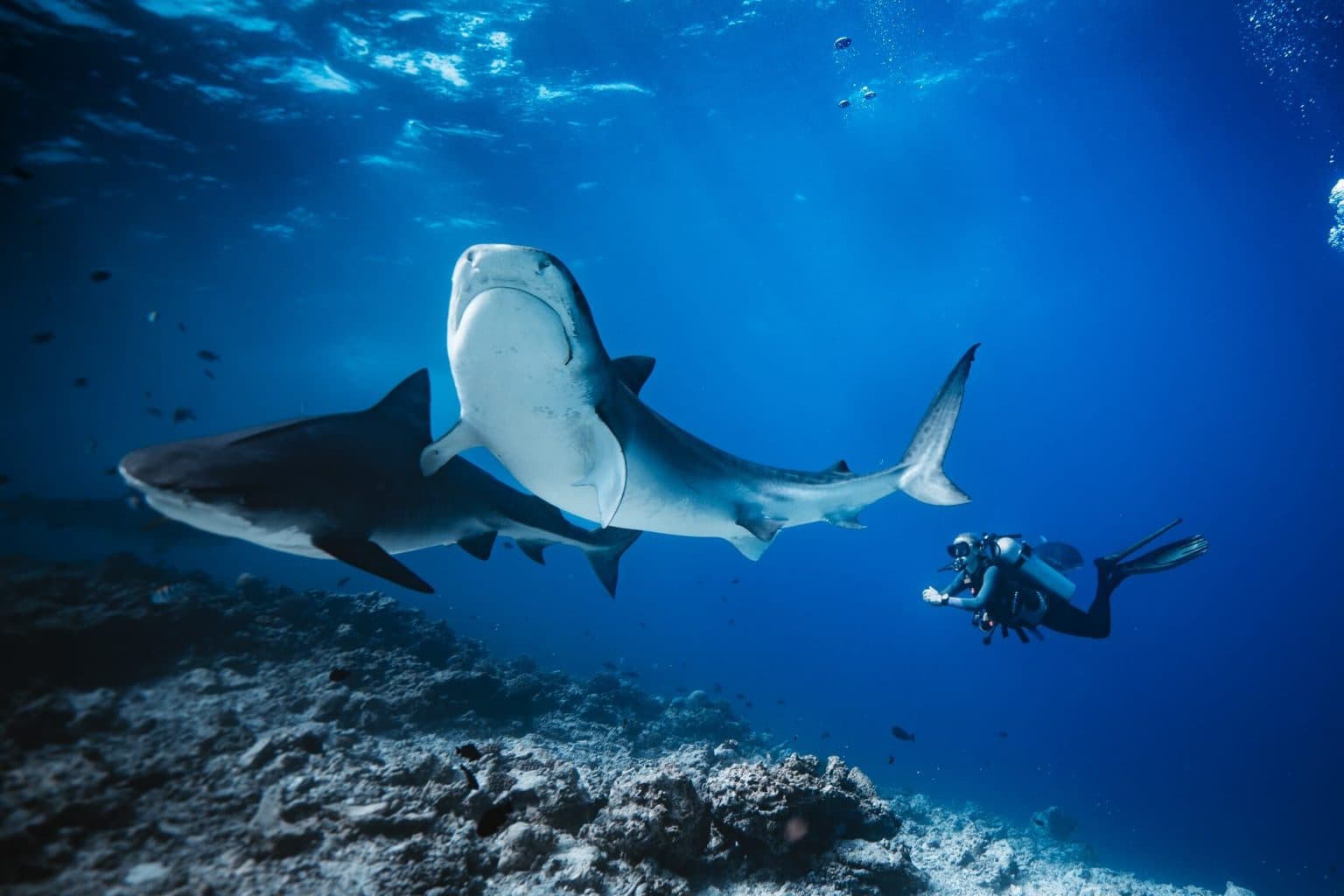
Fuvahmulah is the only place in Asia where you are guaranteed tiger shark sightings on every single dive. That is the marketing line, and it is technically true. What the glossy brochures and ZuBlu landing pages do not explain is why the sightings are guaranteed, what that guarantee actually costs once you factor in flights and hidden fees, or what happened the last time a tiger shark bit a diver in the Maldives.
This guide covers the real operational details of Fuvahmulah tiger shark diving — the baiting practices behind the "natural encounters," the full cost breakdown operators prefer not to itemize, the safety incidents that never make the Instagram reels, and how to decide whether this trip is actually worth it for you.
Why Fuvahmulah Has Tiger Sharks Year-Round
Fuvahmulah is a solitary island in the deep southern Maldives, sitting almost directly on the equator within Gnaviyani Atoll. Unlike the ring-shaped atolls that define most of the Maldivian archipelago, Fuvahmulah is a micro-atoll — 13 kilometres long and 4.5 kilometres wide — with deep oceanic water accessible on all sides and no protective barrier reef. Nutrient-rich Indian Ocean currents flow unimpeded around the island, creating upwelling zones that support an extraordinary concentration of marine megafauna.
The real reason tiger sharks congregate here, however, is not purely ecological. Fuvahmulah's harbour sits next to the local fish market, where fishermen have historically discarded fish heads and scraps directly into the water. This waste creates a daily scent plume that draws tiger sharks to the harbour mouth — a practice that researchers describe as "opportunistic feeding opportunity" rather than active chumming, though the practical difference is negligible for the sharks involved.
A seven-year photo identification study has catalogued over 239 individual tiger sharks at Fuvahmulah, with approximately 43 present at the Tiger Zoo dive site on any given day. Roughly 84.5% of identified individuals are adult females, many showing prolonged abdominal distensions consistent with gestation — suggesting the island may function as a critical nursery area for the Indian Ocean tiger shark population.
The island was designated a UNESCO Biosphere Reserve in 2020 alongside neighbouring Addu Atoll, establishing a formal conservation framework. The warm equatorial water stays 27 to 29°C year-round, visibility typically runs 20 to 40 metres, and the sharks are present regardless of season. This is what makes the "guaranteed" marketing claim work — and what makes the marketing incomplete.
What Operators Do Not Advertise About Tiger Zoo
The famous Tiger Zoo dive site — officially called Merikafalu — sits at the southeastern harbour entrance at a depth of just 5 to 10 metres. Operators describe the experience as "wild, natural encounters" with tiger sharks. The JNCC's 2025 review of shark diving practices in Fuvahmulah tells a more specific story: "dive operators now use only the heads to create a cleaner and more manageable experience in the water."
The reliable sightings at Tiger Zoo exist because fish market waste is discarded at the harbour mouth daily. This is provisioning — deliberate or incidental food supply that maintains shark aggregation at a specific site. Scientific research confirms that tiger sharks at feeding sites form "looser, more random social groups" compared to their more structured social interactions in non-feeding areas. The behavioural changes appear temporary — sharks resume natural patterns when away from the feeding sites — but they are real, and operators rarely discuss them with clients.
ZuBlu's own article on Fuvahmulah describes Tiger Zoo as "probably the only dive site in Asia that guarantees tiger shark sightings every day." That guarantee comes with an unspoken asterisk: the guaranteed encounters happen specifically at the harbour site where baiting occurs, not at the offshore locations that feature prominently in promotional photography.
Social media compounds the gap. Operators post dramatic images of divers surrounded by multiple tiger sharks at depth. What those images do not show is that they represent highly staged conditions — specific timing, positioning, sometimes multiple dives to capture — that create unrealistic expectations for first-time visitors expecting the same experience on their first drop.
The Dive Sites: Tiger Zoo vs Farikede
Fuvahmulah has roughly 20 documented dive sites. The two that matter most are Tiger Zoo and Farikede, and they could not be more different.
Tiger Zoo (Merikafalu) is 5 to 10 metres deep, sheltered, and suitable for Open Water certified divers. The dive typically begins with a safety briefing covering strict protocols: no flash photography, no sudden movements, maintain a horizontal position on the bottom, keep a minimum distance of three metres from the sharks. Guides use specialised hand signals throughout. Some carry stainless steel poles as temporary barriers if a shark approaches too closely. The dive is calm, controlled, and visually extraordinary — named resident tiger sharks exceeding four metres patrol directly overhead.
Farikede sits at the southern point of the island where powerful oceanic currents funnel through a narrow channel. This is where you find thresher shark cleaning stations at 25 to 35 metres — among the most reliable in the Maldives, particularly between April and November. Farikede requires Advanced Open Water certification, and operators limit diving to an average of 193 days per year because conditions can turn dangerous with little warning. Currents can exceed three knots during peak tidal flows. Visibility can deteriorate from 30+ metres to near-zero when strong currents stir sediment. Experienced Fuvahmulah divers describe it as "a washing machine of pelagic activity."
The gap between these two sites is something operators consistently understate. Open Water divers booking a "shark diving package" may find themselves on a boat heading to Farikede when conditions change, only to discover the site demands skills and experience they do not have. Inspection reports from 2025 documented that approximately 30% of operators fail to adequately communicate these condition variations to less experienced divers.
Beyond tiger sharks, Fuvahmulah supports encounters with seven distinct shark species in a single day — tiger, thresher, scalloped hammerhead, oceanic whitetip, silvertip, grey reef, and whitetip reef sharks. Oceanic mantas, whale sharks, mola mola, giant trevally, yellowfin tuna, and sailfish also appear seasonally.
Real Costs: What Your Fuvahmulah Trip Actually Costs
Operators advertise dive packages starting at around US$93 per day. That number is real, and it is also incomplete.
Domestic Flights
You fly from Malé (MLE) to Fuvahmulah (FVM) on Maldivian Airlines, the national carrier. The flight takes approximately one hour 25 minutes covering 500 kilometres. As of May 2026, diver-specific fares are US$187.50 per adult one-way, US$160 per child, infants free. That is US$375 return per person before you have entered the water.
Luggage allowance is 5 kg carry-on and 20 kg checked. Overweight fees run approximately US$15 per excess kilogram — a meaningful cost for divers transporting full equipment rigs, underwater camera systems, or rebreathers.
Domestic flight costs to the southern Maldives have risen approximately 25% since 2022 due to fuel surcharges and limited competition. There are typically one to two scheduled flights daily, and capacity constraints during peak season can mean sold-out flights if you book late.
Dive Packages
All-inclusive packages from Malé are the most transparent pricing option. Dive The World advertises complete packages starting at US$985 for three nights with four dives at The Shark Residence, rising to US$2,915 for ten nights with 24 dives. Single supplement charges range from US$104 to US$347 depending on package length.
For independent travellers, daily dive rates run US$93 to US$125 per dive. Specialty dives targeting thresher sharks or hammerheads sometimes carry additional surcharges of US$20 to US$30 per diver. Full scuba gear rental averages US$25 to US$35 per day. Nitrox fills — increasingly recommended for the deeper cleaning station dives at Farikede — cost an additional US$15 to US$20 per tank.
Accommodation
The island has roughly 46 registered properties ranging from basic guesthouses to diver-oriented boutique hotels. Tiger Shark Residence & Dive — the most diver-centric property — charges approximately US$150 per night for double rooms with all-inclusive dive packages. The AIG Grand Hotel offers three-night, four-dive packages from US$1,134. The Shark Residence starts at US$985 for the same configuration.
Accommodation prices have increased approximately 12% since 2023, with ocean-view rooms commanding a 25% premium over standard rooms. The premium drops during the September to November transitional season when variable visibility reduces demand.
Total Budget
| Trip style | Realistic per-person budget | What you get |
|---|---|---|
| Budget guesthouse, 3-4 dive days, independent | US$1,200-1,800 | 6-8 dives, basic accommodation, self-arranged transfers |
| Mid-range hotel, 5-6 dive days, package | US$2,000-3,000 | 12-15 dives, comfortable accommodation, guided dives |
| Premium dive resort, 7+ days, all-inclusive | US$3,000-4,500 | 18-24 dives, best accommodation, nitrox, photography support |
All budgets exclude international flights to Malé. Add US$375 return for the domestic flight, plus dive insurance (mandatory in the Maldives), tips, and personal spending.
For comparison: a Bahamas Tiger Beach day trip costs US$449 plus 10% VAT for a two-tank dive, excluding accommodation and inter-island travel. Fiji's Beqa Lagoon offers five-night, nine-dive packages from US$1,600 per person. Fuvahmulah sits in the middle of the global tiger shark diving cost spectrum — not cheap, but competitive for what you get.
Safety: What Has Actually Happened
The Maldives has no documented fatalities from shark encounters. That statistic is real and reassuring. The full picture requires more context.
On 15 November 2025, a Chinese diver at Hulhumale's Shark Tank — a different Maldives location, not Fuvahmulah — suffered a head bite from a tiger shark requiring over 40 stitches. Documentation of the incident identified contributing factors: the diver was wearing a brightly coloured novelty hood that may have resembled bait fish or created visual stimulation attracting the shark's attention. The dive site reportedly suffered from "the number of operators working to their own rules," creating inconsistent safety protocols.
The Hulhumale incident is not Fuvahmulah, but it is the Maldives, and it involved a tiger shark at a provisioning site. The parallels are direct enough to warrant attention.
Fuvahmulah's safety record is better because its operators — particularly the established ones — enforce stricter protocols. Industry best practices now include mandatory check dives for all visitors, small group sizes capped at six divers per guide, comprehensive briefings covering emergency oxygen availability, maximum depth limits (30 metres for recreational diving in the Maldives), and full emergency protocols. All reputable operators maintain emergency oxygen systems, AEDs, and staff with comprehensive first aid training.
The calculated risk of a negative interaction at properly managed sites like Tiger Zoo is estimated at less than one in 10,000 dives based on operational data and incident tracking. That is low. It is not zero, and the operative phrase is "properly managed sites." The quality gap between Fuvahmulah's best operators and its worst is significant.
What Increases Your Risk
- Bright or contrasting colours. The Hulhumale incident involved a brightly coloured hood. Dark, neutral exposure suits reduce visual stimulation.
- Flash photography. Sudden light bursts can startle sharks. The no-flash rule exists for a reason.
- Vertical posture on the bottom. A vertical silhouette can resemble prey from below. Stay horizontal.
- Approaching sharks. The three-metre minimum distance is not a suggestion. Investigative behaviour from curious tiger sharks escalates quickly.
- Inadequate experience. Open Water certification gets you into Tiger Zoo. It does not prepare you for Farikede's currents. Do not let an operator talk you into sites beyond your skill level.
- No dive insurance. The Maldives requires dive-specific insurance. Approximately 15% of independent travellers neglect to verify this requirement.
Certification and Experience Requirements
Minimum: Open Water Diver certification for Tiger Zoo. Recommended: Advanced Open Water plus at least 10 to 20 logged dives, with recent experience within the last 12 months, before attempting any Fuvahmulah shark dive.
For Farikede and the thresher shark cleaning stations: Advanced Open Water is mandatory, and operators should enforce this. Current experience is essential — if you have never dived in currents exceeding two knots, Farikede is not where you want to learn.
Industry best practices recommend a medical examination by a hyperbaric physician before the trip. Some operators now require documentation of an annual diving physical.
Getting There
International flights arrive at Malé (MLE). From there, Maldivian Airlines operates domestic flights to Fuvahmulah (FVM), typically one to two per day. Book early — capacity is limited, especially during peak season.
Most operators arrange airport transfers and handle domestic flight bookings as part of their package. If booking independently, confirm flight availability before committing to accommodation.
Fuvahmulah's airport opened in November 2011. Before that, the island was accessible only by overnight ferry from Malé. The airport transformed accessibility but remains a single-runway facility with capacity constraints during peak periods.
Accommodation
The island supports roughly 46 registered properties. The main options for divers:
Tiger Shark Residence & Dive — the dedicated diver property, with camera rinse tanks, gear storage, and direct harbour access. Double rooms from approximately US$150 per night with dive packages.
AIG Grand Hotel — three-night, four-dive packages from US$1,134. More conventional hotel amenities.
The Shark Residence — three-night, four-dive packages from US$985. Solid mid-range option.
Guesthouses — basic accommodation from US$30 to 60 per night for budget travellers arranging dives independently.
Most properties are within walking distance of the harbour. Fuvahmulah is not a resort island — it is a local community of approximately 12,000 residents where tourism is growing but remains secondary to fishing and agriculture. Expect authentic Maldivian island life, not polished resort culture.
Is It Worth It?
Fuvahmulah offers something no other destination replicates: guaranteed tiger shark encounters at shallow depths, year-round, with the possibility of seeing seven shark species in a single day. The marine biodiversity is extraordinary. The experience is genuinely unlike anything else in diving.
The costs are real — US$2,000 to 4,500 per person excluding international flights is a significant investment. The risks are low but non-zero, and operator quality varies more than the marketing suggests. The "natural encounter" framing around what is fundamentally a provisioning-dependent experience is misleading, though the sharks are wild animals making their own choices to be there.
If tiger shark diving is a priority, Fuvahmulah is the best option in Asia and arguably the most accessible tiger shark diving globally. Go in with clear eyes about what the experience involves, choose your operator carefully, and do not let Instagram set your expectations.
MantaraDive Recommendation
Book through an established operator with a documented safety record. Do not choose solely on price — the cheapest option may cut corners on group sizes, briefings, or site selection based on your certification level.
Budget US$2,500 to 3,500 per person for a strong five to six day trip with 12 to 15 dives, mid-range accommodation, and nitrox. Add US$375 for domestic flights, plus international airfare to Malé.
Get dive-specific insurance before you travel. Confirm your operator requires it for all guests. Bring a dark-coloured exposure suit. Leave the novelty hoods at home.
Fuvahmulah is worth the trip. Just know what you are paying for — and what the marketing is not telling you.
Sources
Research for this article drew on the JNCC's 2025 shark diving management report for Fuvahmulah, ZuBlu's diver guide to Fuvahmulah, PADI's Tiger Zoo dive site page, Dive The World's Fuvahmulah pricing, Divernet's report on the Hulhumale tiger shark bite incident, Fourth Element's Tigers of Fuvahmulah feature, Shark Angels' tiger shark behaviour research, PADI's Fuvahmulah diving page, Extreme Dive Fuvahmulah's flight information, Liquid Shark Divers' beginner guide, Fuvahmulah Central Dive Center's Farikede site page, Florida Museum's 2025 worldwide shark attack summary, Ocean Ramsey' safety protocols for shark diving, and ZuBlu's UNESCO Biosphere Reserve announcement. Pricing reflects 2025–2026 operator listings and may vary by season and availability.
Related MantaraDive planning links
- Hanifaru Bay vs Fuvahmulah: Which Maldives Shark Experience Is Right for You?
- Maldives Diving Under $3,000: A Realistic Budget Guide for 2026
- Maldives Shark Sanctuary: What It Means for Divers
- Best Time to Dive the Maldives: Manta and Whale Shark Season
- Maldives Liveaboard vs Resort: Which Delivers Better Diving?
- Malapascua Thresher Sharks: The Complete Honest Guide
- Whale Shark Diving: Maldives vs Philippines vs Indonesia
- Maldives Diving November vs February: Which Month Delivers Better Encounters?