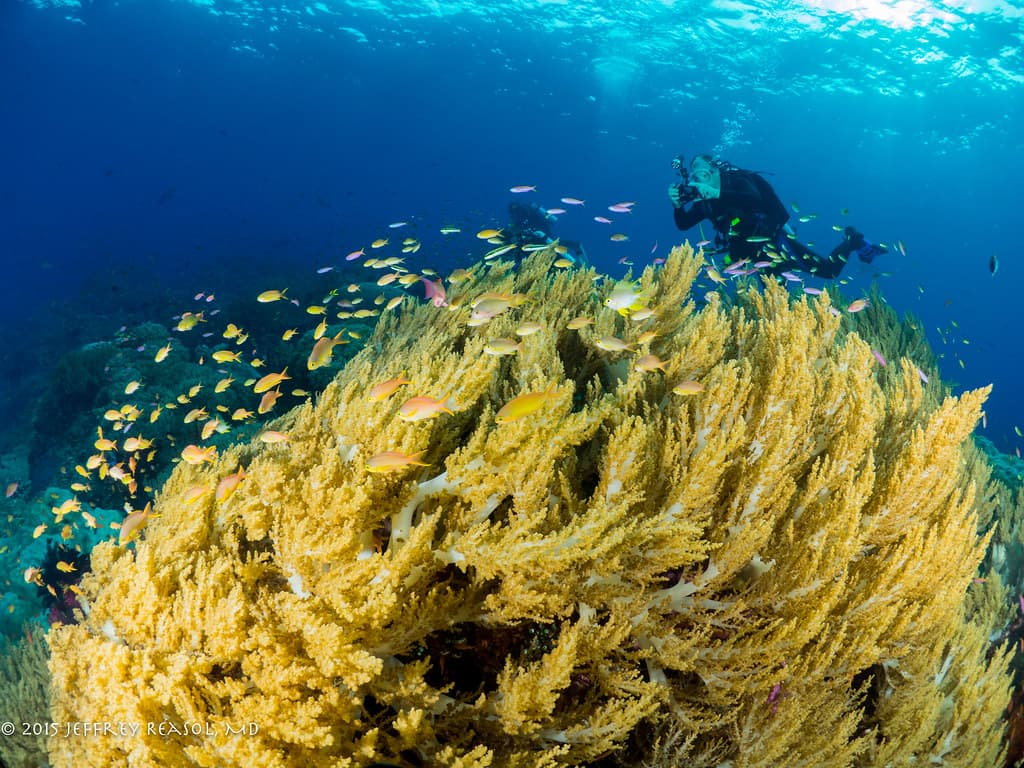
Solo female dive travel is one of the fastest-growing segments in scuba, and the conversation around it still leans too heavily on fear. Most online advice starts and ends with "be careful" or "maybe try a women's group trip." That framing misses the point. The real question is not whether women can dive alone — they obviously can — but how to identify operators who treat solo female guests as competent customers rather than safety concerns to manage.
This guide covers what actually matters when choosing a dive operator or liveaboard as a woman traveling alone: the red flags, the green flags, the destinations where solo female divers are routine rather than exceptional, and the specific questions to ask before you book.
The Problem With "Solo Female Diver" as a Category
The scuba industry has a blind spot. When a man books a single slot on a dive boat, nobody blinks. When a woman does the same thing, some operators respond with extra caution that crosses into condescension: assigning her a "buddy" who is really a minder, questioning her certification level more aggressively than they would a male diver, or steering her toward easier sites she did not request.
This is not universal. Many operators are excellent. But the pattern is common enough that solo female divers have developed their own informal networks — Facebook groups, forum threads, WhatsApp chats — sharing which operators treat them normally and which ones do not. The fact that these networks exist tells you the problem is real.
The solution is not to avoid solo diving. It is to learn what separates operators who handle solo guests well from those who do not, and to book accordingly.
What Good Operators Actually Do Differently
The best operators for solo female divers share a few concrete traits. None of them require a "women's dive week" or a special program. They are just signs of a well-run operation that treats all guests as adults.
They pair by skill level, not by gender
A good dive center matches buddy pairs based on experience, air consumption, and dive style. If you are an Advanced Open Water diver with 80 logged dives and good buoyancy, you should be paired with someone at a similar level — male or female. If an operator insists on pairing you with the divemaster "for safety" when your skills do not warrant it, that is a red flag. It means they have already decided you need supervision before watching you dive.
They do not charge single supplements by default
Single supplements are a legitimate business practice on liveaboards where cabin pricing is based on double occupancy. But at resort-based operations, charging a solo diver extra for a room is a choice, not an inevitability. The best operators either waive the supplement, offer shared room options, or price their rooms as per-person from the start. If a resort quotes you a 40% surcharge for traveling alone, that tells you their pricing model is built around couples, and their service probably is too.
They let you choose your own dive plan
Within the limits of your certification and the site conditions, you should be able to say "I want to do the wall drift" or "I want to spend the whole dive on the manta cleaning station" without being redirected to an easier option. Good operators discuss the plan, explain the conditions, and let certified divers make informed choices. They do not default to the safest possible option because a woman asked for it.
Their briefings are thorough for everyone
The best safety signal is an operator that briefs every diver carefully, regardless of gender or experience level. If you notice that the briefing for your dive is more detailed or more cautious than what the men on the boat received, that is not safety — that is paternalism. Thorough, equal briefings mean the operator takes safety seriously as a system, not as a reaction to who is on the boat.
Female staff are present and visible
This does not mean a woman must be your instructor or guide. But when an operation has female divemasters, instructors, or boat crew, it is usually a signal that the workplace culture is not exclusively male-oriented. Women in visible roles tend to correlate with operations where female guests are treated as standard customers rather than exceptions. It is not a guarantee, but it is a useful heuristic.
Questions to Ask Before You Book
You should not have to ask these questions. But given the current state of the industry, asking them before you commit money saves you from arriving at an operation that will frustrate you.
"How do you handle solo divers on group boats?" The right answer is "we match by experience level and dive plan." The wrong answer is "we assign you a dedicated guide" (unless you are paying for one) or "we pair you with the instructor" (unless your skills genuinely warrant it).
"What is your single supplement policy?" For liveaboards, this is a normal question with a normal answer. For resorts, listen for whether they treat solo travelers as an afterthought or as a standard booking type.
"Can I dive my own profile within my certification limits?" This question reveals whether the operator lets certified divers manage their own dives. If the answer involves a lot of conditions or caveats that do not apply to other guests, that is informative.
"Do you have female guides or instructors?" You are not requesting one. You are checking whether the answer is "yes, several" or "no, but our guys are great." Both answers tell you something useful.
"What happens if I get paired with a diver whose skills I am not comfortable with?" Good operators have a policy for this. They re-pair, assign a guide, or adjust the dive plan. If the answer is vague, the operator has not thought about it, which means you will be stuck with whatever pairing they give you.
Destinations Where Solo Female Divers Are Normal
Some destinations have enough solo female travelers in their diving population that you will not stand out. These are places where the infrastructure — social dive towns, walkable centers, established solo-friendly operators — makes solo travel straightforward.
Southeast Asia: The Default Choice
Thailand (Koh Tao, Koh Lanta) has the highest density of solo divers in the world. Koh Tao in particular is a backpacker-meets-diver town where traveling alone and getting certified is the standard, not the exception. The dive culture is social, the operators are used to pairing strangers, and the costs are low enough that single supplements rarely matter. Koh Lanta is quieter and better for experienced divers who want less party and more reef.
Indonesia (Komodo, Raja Ampat, Bali) works well for solo female divers at the resort level, though liveaboard cabins are usually priced for doubles. Amed and Padang Bai in Bali have compact, walkable dive communities. Komodo's Labuan Bajo has grown into a proper dive town with social hostels and mid-range operators that welcome solo bookings. Raja Ampat is more remote and expensive, but homestay-based diving there is inherently solo-friendly — you book a room and join daily boat dives.
Philippines (Moalboal, Malapascua, Dauin) is strong for solo female dive travel. Moalboal is the easiest social base. Malapascua draws thresher shark divers who tend to be focused and experienced. Dauin has resort-based macro diving with reliable daily boat schedules. The Philippines also has several liveaboards with explicit solo-traveler cabin options.
Red Sea: Europe's Backyard
Egypt (Sharm El Sheikh, Hurghada, Marsa Alam) has a massive European diving population, which means solo travelers are common and operators are used to them. The Red Sea's liveaboard market is competitive enough that boats actively court solo divers with shared cabin pricing. Shore diving from Sharm or Hurghada is straightforward with day boats. The main caveat is that some Egyptian operators still have a noticeably different treatment of female guests, particularly in more conservative coastal towns. Stick to established, well-reviewed centers.
Caribbean and Americas
Belize, Bonaire, and Cozumel are the strongest solo female dive destinations in the Western Hemisphere. Bonaire is the purest solo dive trip in the Caribbean — shore diving on your own schedule, no boat required, rental trucks with tank racks everywhere. It is not social by nature, but it is completely self-directed. Cozumel has drift diving that is easy to manage solo with a guide, and the town is safe and walkable. Belize has a mix of reef and atoll diving with operators accustomed to independent travelers.
Mexico's Yucatan (Playa del Carmen, Tulum) offers cenote diving that attracts experienced solo divers from around the world. The cenote community is small and social, and operators there routinely handle solo certified divers. For reef and wall diving, Cozumel is the better base.
Liveaboards That Work for Solo Women
Liveaboards are where solo female dive travel gets complicated. The diving is often outstanding, but cabin pricing assumes two people per room, and the social dynamics of being the only woman on a boat for a week can go either way.
The best liveaboards for solo female divers share a few traits: they offer shared cabin options or no-single-supplement promotions, they have mixed international guest lists (not all-male groups), and they have at least some female crew. Boats that cater to photography groups tend to attract more solo travelers of all genders, which helps.
Operators worth checking for solo-friendly policies include Aggressor Fleet (global routes, some no-supplement weeks), Emperor Divers (Red Sea and Maldives, shared cabin options), Blue O Two (Red Sea, occasional solo promotions), and Mermaid Liveaboards (Indonesia, flexible cabin arrangements). Always confirm the current policy before booking — solo pricing changes seasonally.
Safety: What Actually Matters vs. What Gets Talked About
The safety conversation around solo female dive travel is distorted by anxiety. Most online advice focuses on worst-case scenarios — harassment, assault, unsafe boat conditions — that are real but rare. The far more common safety issues are mundane: poor buoyancy control from a badly matched buddy, inadequate briefings, rushed surface intervals, and equipment that has not been maintained.
The practical safety priorities for solo female divers are the same as for any diver, with a few additions.
Verify the operator's credentials independently. Do not rely on the hotel recommendation or the hostel bulletin board. Check the operator's agency affiliation (PADI, SSI, NAUI, RAID), read recent reviews on Google and TripAdvisor, and look for specific comments from solo travelers. A five-star rating from a couple on their honeymoon tells you nothing about how the operation handles a solo female booking.
Trust your read of the boat culture during the briefing. If the first dive briefing feels dismissive, rushed, or noticeably different from how other guests are addressed, that pattern will continue all day. You can still dive — but do it with your eyes open, and do not hesitate to request a different guide or buddy if the pairing feels wrong.
Carry a personal locator and a whistle. Not because solo diving is dangerous, but because any diver on any boat should have a surface signaling device. A whistle attached to your BCD and a small personal locator beacon (PLB) or Nautilus Lifeline are standard safety equipment for any diver, and they are especially valuable when you cannot guarantee that someone on the boat is watching your surface marker at all times.
Have a communication plan for the surface. If the boat drops you and your buddy at a drift dive site and the pickup is by RIB after you surface, make sure you know the protocol. Who is tracking your group? What is the plan if you surface away from the group? These are normal dive planning questions, but solo divers should ask them explicitly because no dive partner is asking on your behalf.
Skip the operator if the vibe is wrong before you get on the boat. This is the most important safety advice for solo female dive travel. If the shop feels dismissive during the booking process, if they ask unnecessary questions about your experience that they would not ask a man, if they try to upsell you to a private guide you did not request — go somewhere else. The dive itself may be fine, but the operator has already told you how they see you.
The Gear Question
Solo female divers often ask whether they need their own equipment. The answer depends on where you are diving and how often.
For a one- or two-week trip to a well-equipped destination, renting is fine. Most operators in Southeast Asia, the Red Sea, and the Caribbean have decent rental gear. Make sure the BCD fits your frame — women's-specific BCDs exist for a reason, and a BCD designed for a male torso will ride up and sit poorly on most women. If the shop only has unisex or men's BCDs in your size, that is not a dealbreaker, but it is worth noting.
For frequent divers or those heading to remote destinations, owning your own BCD, regulator, and wetsuit is worth the investment. Fit matters more than brand. A women's-specific BCD from any major manufacturer — Aqua Lung, Scubapro, Cressi, Mares — will outperform a unisex model for most women. Regulators are gender-neutral, but get yours serviced before a trip if you are renting from an operator you do not know.
A well-fitting mask is the single most important personal item. Bring your own regardless of whether you rent everything else. A leaking mask ruins a dive, and face shapes vary enough that rental masks are a gamble.
What Solo Female Dive Travel Is Actually Like
The experience of diving solo as a woman is, for most trips, unremarkable in the best possible way. You show up, you dive, you eat dinner with whoever is on the boat or in the dive shop, and you go back to your room. The moments that stand out are the dives themselves — the manta that hovered above you for ten minutes, the reef shark that passed close enough to count its gill slits, the night dive where the bioluminescence made the water look like a moving galaxy.
The social experience varies by destination. In Koh Tao or Moalboal, you will meet other solo travelers within hours. In Raja Ampat or a Maldives liveaboard, you may have quieter evenings. Neither is better; it depends on what you want from the trip.
The moments that are not great are usually logistical, not dangerous. A room that costs more because you are alone. A buddy pairing that does not click. A divemaster who explains things to you more slowly than to the men in the group. These are annoyances, not threats, and they become less common as you gain experience and learn to read operators before you book.
The best thing about solo female dive travel is the autonomy. You choose the destination, the operator, the dive site, and the schedule. You do not compromise on what you want to see or how you want to dive. That freedom is worth the occasional extra cost or the five minutes of research it takes to find an operator that will treat you like the diver you are.
MantaraDive Recommendation
If you are planning your first solo female dive trip, start with a destination where solo diving is infrastructure-normal: Koh Tao, Bonaire, Moalboal, or Cozumel. These places have the operator density, the social fabric, and the pricing structure to make solo travel easy.
If you want a liveaboard, check Emperor Divers in the Red Sea or Mermaid Liveaboards in Indonesia for solo-friendly cabin policies. Book early — solo slots on popular routes fill up.
Wherever you go, email the operator before booking. Ask the questions in this guide. The quality of their response tells you everything you need to know about how your week will go.
Talk to a Specialist
MantaraDive can help match solo female divers with operators that have strong track records for independent travelers. Bring your certification level, logged dives, preferred destination, travel dates, and whether you want a social trip or a quiet one. We will shortlist operators that fit.
Sources
Sources reviewed for this guide include PADI's Women in Diving initiative; Divers Alert Network's solo diving safety analysis; the Women Divers Hall of Fame member directory and historical context; LiveAboard.com's solo traveler cabin policies; ScubaBoard's solo female diver discussion threads; and operator-specific booking policies from Emperor Divers, Aggressor Fleet, and Mermaid Liveaboards reviewed in May 2026.
Related MantaraDive planning links
- Solo Diving Philippines: Resorts and Liveaboards That Work
- Best Solo-Friendly Liveaboards: Maldives, Indonesia, Philippines
- Komodo Liveaboard Prices: What It Actually Costs (and What's Worth It)
- Red Sea Liveaboard Itinerary: North vs South for European Divers
- Maldives Diving for Beginners: What You Actually Need to Know
- 5 Essential Beginner Tips for Your First Tropical Dive Trip
- Best Dive Sites in Bali: 3 That Matter for a 7-Day Trip
- Cozumel vs Cancun for First-Time Caribbean Divers